Exiled and Alone, She Bought a Failing Farm for $3—What Was Buried Under the Field Changed Her Life
THE ELEVEN ACRES
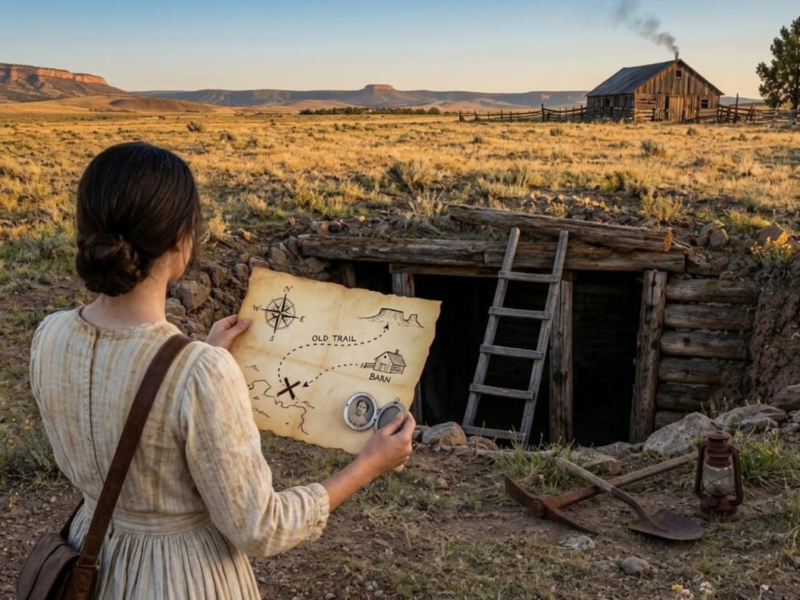
The old Tarant place did not look like a farm; it looked like a skull half-buried in the sand.
The cabin was built of cottonwood logs that had shrunk and warped until the chinking had fallen out in gray, crumbling chunks. Wind whistled through the walls with the mournful pitch of an ungreased axle. But to Norah, as she bolted the sagging oak door from the inside that first night, it was the most magnificent palace on the North American continent.
It was hers. No ledger could trace her here. No uncle could point a finger and summon the ghost of a theft she never committed.
She set to work before the sun cleared the eastern ridge. Her hands were blistered raw by noon of the second day, the skin splitting across her palms as she cleared the waist-high goosefoot and thistle choking the yard. She had no plow, no ox, and no seed, but she had her father’s voice echoing in her memory: “The soil talks, Nora-girl. You listen to it.”
On the third day, working the northeast corner near an old dead cottonwood stump—a landmark so old even the old-timers couldn’t remember it green—her spade hit something with a flat, dull clink.
It wasn’t a stone. Stones sang when iron struck them; this sounded leaden. Heavy. Reluctant.
Norah dropped to her knees in the dirt, ignoring the dampness soaking through her wool skirt. She used her bare fingers, scraping away the gray, lifeless topsoil, then the yellow subsoil beneath, until her fingernails were torn and bleeding.
Two feet down, her fingers brushed rough, rotted canvas.
It took her an hour to free it. When she finally heaved the object out of the trench and onto the dry grass, she sat back on her heels, gasping for breath in the thin autumn air.
It was an iron strongbox, about the size of a flour tin, its hinges crusted in red-brown rust so thick it looked like dried blood. The hasp was held by an old brass padlock that had long since seized shut.
Norah didn’t try to pick the lock. She wasn’t a thief, and she didn’t possess tools for burglary. Instead, she took her small hatchet—the one tool Silas had grudgingly allowed her to pack in her trunk—and wedged the blade into the rusted seam of the lid.
With a sharp crack that startled a flock of crows from the cottonwood overhead, the latch gave way.
Inside, wrapped in layers of oilcloth that had turned to brittle lace, lay two things.
The first was a neat stack of forty silver trade dollars, heavy and dull, their milled edges gleaming faintly in the slanting evening light. Forty dollars. More money than Norah had seen at one time since her father died.
The second was a leather-bound ledger, its pages water-stained and swollen, and a folded sheet of heavy rag paper sealed with a glob of red sealing wax stamped with the imprint of an oak leaf.
Norah carried them into the cabin as the sun dipped below the prairie rim, plunging the valley into a sudden, icy violet shadow. She lit her single tallow candle, sat down at the wobbly pine table, and broke the seal on the letter.
The handwriting was shaky, sprawling across the page like the legs of a dying spider, but legible.
To whoever finds this ground worth tending,
If you are reading this, old Elias Tarant is under the sod by the creek, and some poor soul has been desperate enough or brave enough to buy my eleven acres. Good on you. The dirt isn’t cursed; it’s just tired of being lied to.
I leave you this book and these forty dollars. The money is what was left of the Founders’ Relief fund from the winter of sixty-four. Josiah Vain—current storekeeper’s father—thought he could borrow it to save his failing bank in Omaha. I caught him at it. I stopped him. But I didn’t ruin him, because the town was too fragile then, and I was a soft-hearted fool who thought men could be shamed into decency.
I was wrong. The boy, Silas, grew up with his father’s ink on his fingers and his father’s grease in his soul. He’s been dipping into the cooperative drawer since the rails went through. The book tells the whole tale—every draft diverted, every name forged, every lie told to keep the farmers paying into a box that hasn’t held a true dime in five years.
Use the silver to buy a mule, girl—or boy. And use the book to hang Silas Vain by his own necktie.
— Elias Tarant, October 1872
Norah sat very still in the flickering candlelight.
The silence in the cabin was absolute. Outside, the wind rose, pressing against the warped logs with a low, whistling sigh.
For a long time, she looked at the forty silver dollars. Forty dollars could buy a ticket on the Union Pacific train heading west to Denver, or east to Chicago. In Chicago, no one knew the name Fenwick. In Chicago, she could buy a new dress, find a position in a dry-goods house, and leave Silas Vain, Amity Creek, and the whole miserable territory behind her like a bad dream.
She picked up one of the heavy coins, turning it over in her palm. The silver was cold against her skin.
“You listen to the sod, Nora-girl,” her father’s voice whispered in the dark. “A field like a person can be coaxed back to life if you’re patient enough and humble enough to ask it properly.”
Slowly, deliberately, Norah set the coin back down in the iron box. She closed the lid.
She wouldn’t run. If she ran, Silas won. If she ran, the lie remained the truth. And she had spent ten years living under a lie; she was done with rentals.









