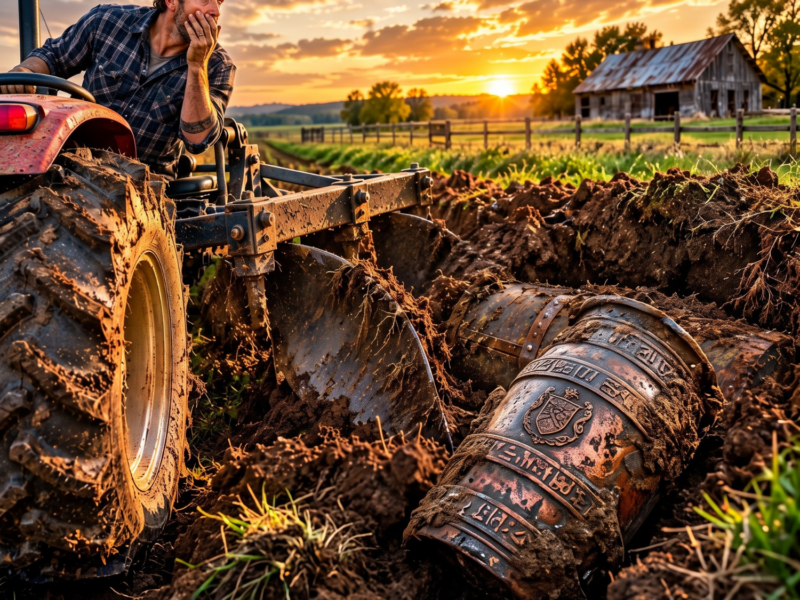
He Bought 18 Acres Nobody Wanted — Then His Plow Hit Something Buried Below
The Time Capsule
Ethan clicked on a heavy, industrial flashlight and shined the beam straight down into the pitch-black interior of the iron cylinder.
He let out a low whistle of sheer awe.
The entire interior hull of the iron cylinder was lined with three inches of solid, tongue-and-groove red cedar wood panels. The cedar acted as a natural desiccant, keeping the interior bone dry, perfectly insulated against temperature fluctuations, and free of insects.
Neatly, meticulously arranged inside the vault were three distinct, physical compartments separated by wooden dividers.
Ethan leaned his upper body into the vault, his heart hammering against his ribs, and began to inventory the contents.
Compartment One: Stacked perfectly were twelve heavy canvas sacks. The tops of the sacks were double-stitched with thick twine and completely sealed with a thick layer of red wax. Stenciled onto the canvas in faded black ink were labels: CORN – HICKORY KING, WHEAT – RED FIFE, BEANS – CHEROKEE TRAIL. Ethan estimated the sacks contained over four hundred pounds of heirloom, non-hybrid seeds. From 1914.
Compartment Two: Ethan shined the light further back. Sitting securely in custom-built wooden cradles were six heavy, iron-bound wooden toolboxes. He popped the latch on the closest box and opened the lid. The tools inside were pristine, wrapped in oilcloth to prevent rust. There were heavy, hand-forged blacksmithing hammers, replacement steel gears for early steam tractors, and incredibly precise, polished brass surveying instruments that looked like they belonged in a museum.
Compartment Three: Resting alone in the final, smallest compartment was a heavy, leather-bound ledger wrapped meticulously in oiled canvas. Beside the ledger sat two thick, waterproof metal cylinders containing rolled architectural maps.
Ethan reached down and carefully lifted the leather ledger out of the vault.
It was incredibly heavy. He walked over to the massive rear tire of his tractor and sat down on the rubber tread. He gently unspooled the twine holding the oilcloth together, unwrapped the canvas, and opened the heavy leather cover.
The paper inside was thick, crisp white, and perfectly preserved, possessing the distinct, sharp scent of old parchment.
On the title page, written in flawless, dark black fountain pen ink, was a clear heading:
THE GRAYSON COUNTY HERITAGE RESERVE Established October 12, 1914 To be opened only in the event of total agricultural collapse, or by the rightful heirs of the Cooperative.
Ethan gently turned the yellowed pages as the afternoon sun began to dip behind the Appalachian Mountains, casting long, skeletal shadows across the pasture.
The records contained within the ledger told a story of profound, terrifying foresight that local history books had completely forgotten, or deliberately erased.
In the late summer of 1914, the world was plunging headfirst into the mechanized slaughter of the First World War. International tensions were skyrocketing, global supply chains were fracturing, and at home, the very nature of farming was undergoing a violent, permanent shift. Modern commercial agriculture was pushing aggressively toward fragile, single-crop farming, heavily reliant on expensive chemical fertilizers and industrial, fuel-hungry machinery.
A group of twenty-four local Grayson County farmers saw the writing on the wall. They realized something critical, something the corporate agricultural conglomerates were ignoring: they were rapidly losing their native, drought-resistant heirloom crops. Crops with deep root systems that had survived brutal mountain blizzards and severe summer droughts for over a century were being systematically replaced by fragile, high-yield commercial seeds that required constant chemical intervention to survive.
Led by a brilliant, fiercely independent local farmer named Henry Vance—who Ethan realized with a jolt of shock was his own great-granduncle—the cooperative of farmers pulled their meager life savings together.
They didn’t buy prime real estate. They bought eighteen acres of rocky, unwanted, heavy clay land. The Stony Waste. Because they knew no commercial developer would ever want to build on it, and no commercial farmer would ever try to plow it.
Working in absolute secrecy during the dead of night, they built four heavy iron vaults. They buried them in deep, hand-dug gravel beds strategically located across the property, and filled them with their finest heirloom seeds, their highest-quality hand tools, and comprehensive soil maps of the entire valley.
Their goal was simple, yet incredibly profound: If the new industrial farming complex collapsed under its own weight, or if a severe global crisis destroyed their regional supply chains, this subterranean reserve would give the valley the exact tools, seeds, and knowledge needed to rebuild their agriculture from scratch.
It wasn’t a time capsule. It was a survival cache.
Ethan set the ledger down on his lap, his mind reeling. He reached into his coat pocket and pulled out one of the metal cylinders he had taken from the vault. He popped the cap off and unrolled the thick, vellum surveying map inside.
The masterfully drawn ink map showed the full eighteen-acre parcel drawn to exact scale. But it was the markings on the map that made the blood rush in Ethan’s ears.
Marked in heavy red ink across the map were four clear target points. Each red ‘X’ was labeled with precise, GPS-like landmarkers relative to the old stone property boundaries and specific oak trees.
Ethan’s disc plow hadn’t just stumbled upon a single, random container left by an eccentric farmer.
It had uncovered Vault Number One of a massive, four-vault emergency network.
Vault One: Seed Reserve and Mechanical Equipment. (Uncovered). Vault Two: Marked East. Vintage Agricultural Machinery Parts and Copper Piping. Vault Three: Marked North. Emergency Water System Plans and Artesian Well Mapping. Vault Four: Marked South. Community Land Records and Comprehensive Soil Mineral Studies.
Ethan looked out over the darkening pasture. The cold wind whipped against his face.
He finally realized why the land had been sold so cheaply at the county auction for $12,000. The modern tax records listed the parcel as “unusable scrubland” because no one in the modern county offices knew the hidden, incredible history buried beneath the pasture.
He wasn’t standing on the Stony Waste. He was standing on the Grayson County Heritage Reserve.









