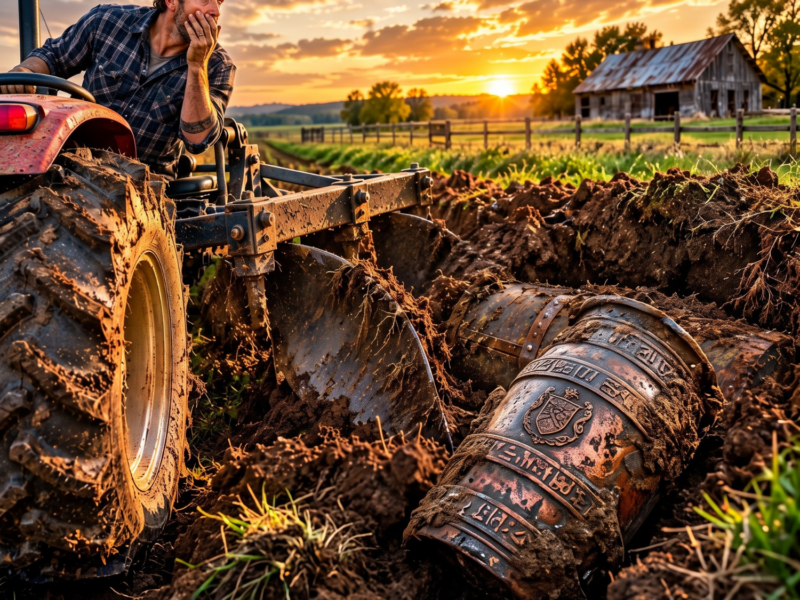
He Bought 18 Acres Nobody Wanted — Then His Plow Hit Something Buried Below
The Resurrection of the Earth
In early December, Ethan made a phone call to the Virginia Agricultural Extension Office, requesting a meeting with the head botanist from the local state university.
When Dr. Aris Thorne arrived at Ethan’s farm, he expected to find a local hobbyist with a jar of old, dead corn kernels. Instead, Ethan walked the bewildered academic into his shed and showed him the open iron vaults, the wax-sealed canvas bags, and the 1914 ledger.
Dr. Thorne nearly dropped his clipboard.
Partnering with the university, Ethan allowed them to carefully test a small, controlled sample of the 1914 Hickory King heirloom corn seeds. The academic consensus was that after seventy-seven years in storage, the germination rate would likely be single digits, if not entirely zero.
But Henry Vance’s vacuum-sealed iron cylinders and cedar-lined insulation had essentially frozen time.
When planted in the university’s high-tech, climate-controlled test greenhouses, the results shocked the entire agricultural department. Despite sitting in canvas sacks since before the First World War, over eighty-two percent of the heirloom seeds successfully germinated.
But the real miracle wasn’t that they grew; it was how they grew.
The ancient, pre-industrial corn variety possessed incredibly dense, deep, aggressive root structures. When Ethan planted the first crop on his own property the following spring, the plants didn’t just survive the “Stony Waste”—they dominated it.
The deep roots easily penetrated the rocky, heavy red clay that choked modern hybrid crops. Because of their historical adaptation to the brutal Appalachian terrain, the heirloom crops required forty percent less water than modern commercial seed varieties, making them virtually immune to the late-summer droughts that plagued the region.
Furthermore, utilizing the soil remediation maps from Vault Four, Ethan treated the heavy clay with the precise mixture of local limestone dust and organic compost prescribed by the 1914 farmers. The soil, which had been declared “unusable” by modern tax assessors, exploded with microbial life and fertility.
Within two years, Ethan’s barren eighteen acres became one of the most famous, highly studied agricultural research plots in the state of Virginia.
He didn’t just grow corn. He cultivated the recovered heirloom wheat and beans, carefully harvesting and multiplying the seed yields season after season. Ethan established the Grayson Heritage Seed Company. He began supplying incredibly rare, fiercely hardy, non-hybrid seeds to organic farmers, homesteaders, and researchers across the country who were desperately looking for drought-resistant crops that didn’t rely on massive chemical intervention.
He drilled the artesian well exactly where Vault Three’s map had indicated, hitting a massive, pressurized aquifer of pure, cold mountain water at eighty-two feet, providing endless irrigation for his expanding operation without draining the local creeks.
The Stony Waste was dead. The Grayson County Heritage Reserve had been reborn.









