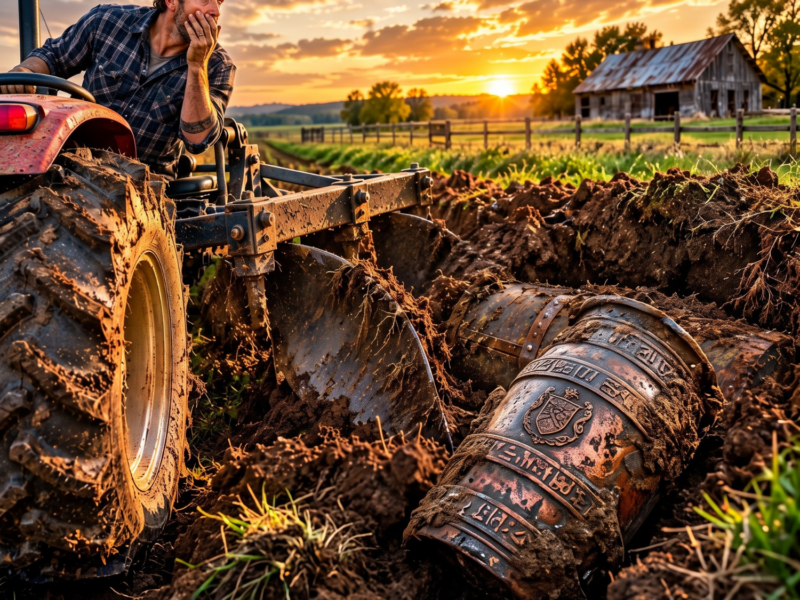
He Bought 18 Acres Nobody Wanted — Then His Plow Hit Something Buried Below
The Barn of Iron and Wood
By the autumn of 1994, Ethan’s farm was highly profitable, self-sustaining, and internationally recognized by agricultural historians. But Ethan hadn’t forgotten the men who made it possible.
Using the profits from his seed sales, Ethan hired a local crew of master carpenters. Together, using traditional post-and-beam construction methods, they built a beautiful, towering timber-frame barn directly over the original excavation site of Vault Number One.
It was a working agricultural building, housing his restored Massey Ferguson tractor and processing equipment, but the front foyer of the barn served an entirely different purpose.
Inside the large, sunlit entryway, Ethan created a meticulously curated mini-museum open to the public.
Sitting on heavy, custom-built oak cradles were the four original, dark green iron cylinders, fully restored, their brass maker’s plates polished to a mirror shine. Displayed in climate-controlled glass cases were the original 1914 leather ledger, the pristine architectural maps, and the immaculate, hand-forged blacksmithing tools his great-granduncle had buried nearly a century prior.
On opening day, the barn was packed with local farmers, university academics, and descendants of the original twenty-four cooperative members, many of whom had no idea their grandfathers had participated in the secret project.
Ethan stood at the front of the room, dressed in clean denim and a work shirt, and addressed the crowd.
“We are constantly told that progress means throwing away the past,” Ethan said, his voice echoing in the timber rafters. “We are told that newer is always better. But the men who owned this land in 1914 knew that true resilience doesn’t come from a laboratory. It comes from the earth. And it comes from memory.”
He walked over to the main iron vault, the one that had stopped his plow blade three years ago.
Mounted directly beneath the original 1914 brass inscription was a new, polished brass plate.
Ethan stepped back, allowing the crowd to read the heavy, engraved black lettering:
GRAYSON COUNTY HERITAGE RESERVE Uncovered: October 1991 Restored by Ethan Vance Buried to protect the future. Preserved to feed the next generation.
The crowd erupted into applause, the sound mixing with the autumn wind howling outside the heavy barn doors.
Ethan stood by the vault, resting his hand against the cold, solid iron. He looked out the large glass windows of the barn foyer, gazing over eighteen acres of rich, dark earth, heavy with the golden stalks of harvest-ready heirloom corn blowing in the wind.
Ethan’s story proves a profound, inescapable truth: sometimes, the land nobody wants is holding the exact answers we desperately need for tomorrow.
The old, calloused farmers of 1914 didn’t spend their life savings to bury those heavy iron vaults in the freezing mud for personal wealth, or for fame, or for recognition in history books. They buried them because they cared about the resilience of their children, and their children’s children, long after they themselves were gone.
They planted a seed of hope in an iron shell, trusting that one day, when the world was hungry enough, someone with the patience to dig would finally break the seal.









