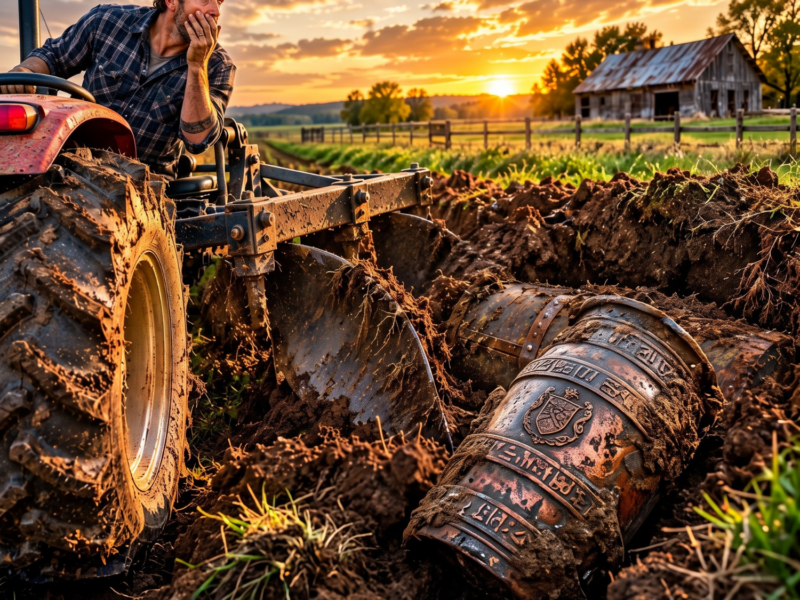
He Bought 18 Acres Nobody Wanted — Then His Plow Hit Something Buried Below
The Excavation
Over the next three weeks, Ethan Vance barely slept.
He suspended all plans to clear the surface of the pasture. The Stony Waste had transformed from an agricultural hurdle into a massive, eighteen-acre archaeological dig site.
Armed with his 1968 Massey Ferguson tractor, a high-end commercial metal detector, and his great-granduncle’s 1914 surveying maps, Ethan systematically hunted the remaining three target points.
He refused to use heavy excavation equipment like a backhoe. He knew that one careless scrape from a hydraulic steel bucket could compromise the vacuum seal on the remaining iron vaults, exposing the delicate contents to seventy years of accumulated ground moisture.
Instead, once his metal detector pinged violently over a target site, he worked exclusively with hand shovels, picks, and trowels, digging carefully through the dense, heavy red clay to avoid damaging the historical metalwork.
The work was brutal, backbreaking labor. But with every foot of earth he moved, Ethan felt a profound connection to the twenty-four farmers who had dug these exact same trenches by lantern light in 1914.
He excavated all three remaining sites by mid-November.
The foresight of Henry Vance’s engineering was staggering. Each vault was found in the exact same pristine, vacuum-sealed condition as the first, perfectly protected by its subterranean gravel drainage bed and its heavy, lead-sealed iron latches.
Ethan moved the massive iron cylinders into his modern steel equipment shed, hooking up high-lumen halogen work lights to catalog the contents through the long, freezing Appalachian nights.
Vault Two Findings: Located exactly where the map indicated on the eastern perimeter, Vault Two was a mechanic’s holy grail. Ethan unsealed the lid to find over 800 pounds of unused, heavy-gauge, hand-forged steel plowshares. There were dozens of solid copper irrigation valves, wrapped in oilcloth, and heavy iron transmission gears perfectly compatible with vintage steam and early combustion tractors. If the global supply of manufactured steel had ceased to exist during a war, this vault contained enough spare parts to keep the valley’s equipment running for a decade.
Vault Three Findings: Buried deep on the northern slope, Vault Three contained no seeds or metal. It contained knowledge. Ethan opened it to find a cache of thick, sealed lead tubes. Inside were incredibly detailed, hand-drawn subterranean water maps of Grayson County. But one map was circled heavily in blue ink. It pinpointed a massive, previously untapped, pressurized natural artesian spring running exactly eighty feet directly beneath Ethan’s high pasture. It was a permanent, drought-proof water source that the modern county geological surveys had completely missed.
Vault Four Findings: Located on the southern border, Vault Four contained complete, exhaustive soil chemistry studies of the region. The 1914 farmers had documented exactly how to naturally enrich the heavy, nutrient-poor red clay soil of the “Stony Waste” using a specific, calculated mixture of local crushed limestone dust, organic compost, and rotational planting of deep-rooted cover crops, entirely eliminating the need for expensive, synthetic commercial fertilizers.
Ethan sat in his shed, surrounded by the open vaults, a cup of black coffee turning cold in his hands.
He pulled out a legal pad and a pen, doing the rough mental math. The financial and agricultural value of the discovery had completely, irrevocably transformed his $12,000 land purchase into something staggering.
Original Property Cost: $12,000. Estimated Value of Vintage Heirloom Seeds to Specialty Commercial Growers: $35,000. Value of Untapped Artesian Spring Access to Farm Equity: Over $50,000. Historical Value to County Museum or Smithsonian: Priceless Regional Artifacts.
He was sitting on a gold mine. He could sell the incredibly rare, pre-hybridization seeds to a massive agricultural conglomerate for a fortune. He could sell the pristine 1914 hand-forged tools to private collectors and antique dealers. He could flip the land, with its newfound artesian water rights, to a commercial developer and retire at thirty-two.
But as Ethan looked at the leather-bound ledger, resting open to a page containing the signatures of the twenty-four desperate farmers who had pooled their life savings to bury this hope for the future, he made a decision.
He didn’t sell the heirloom seeds. He didn’t sell off the historical tools. And he certainly didn’t sell the land.
He was a Vance. And he had work to do.









