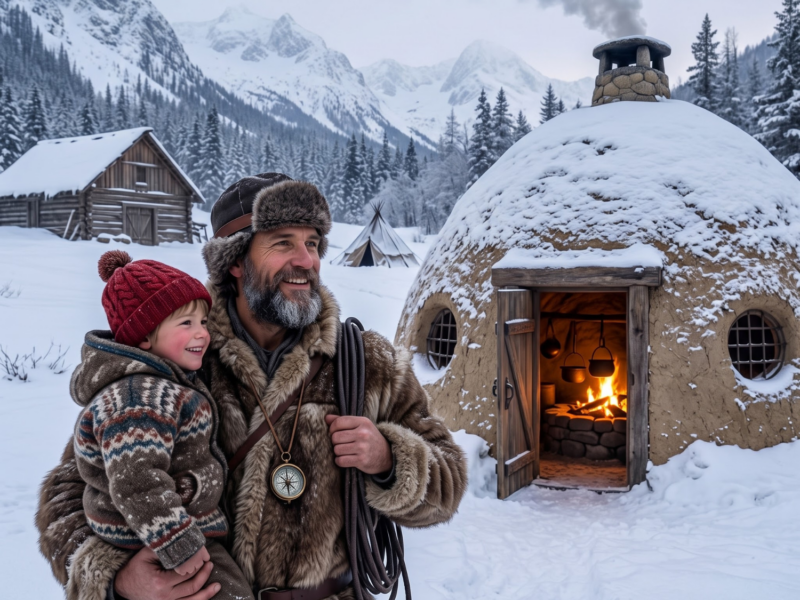
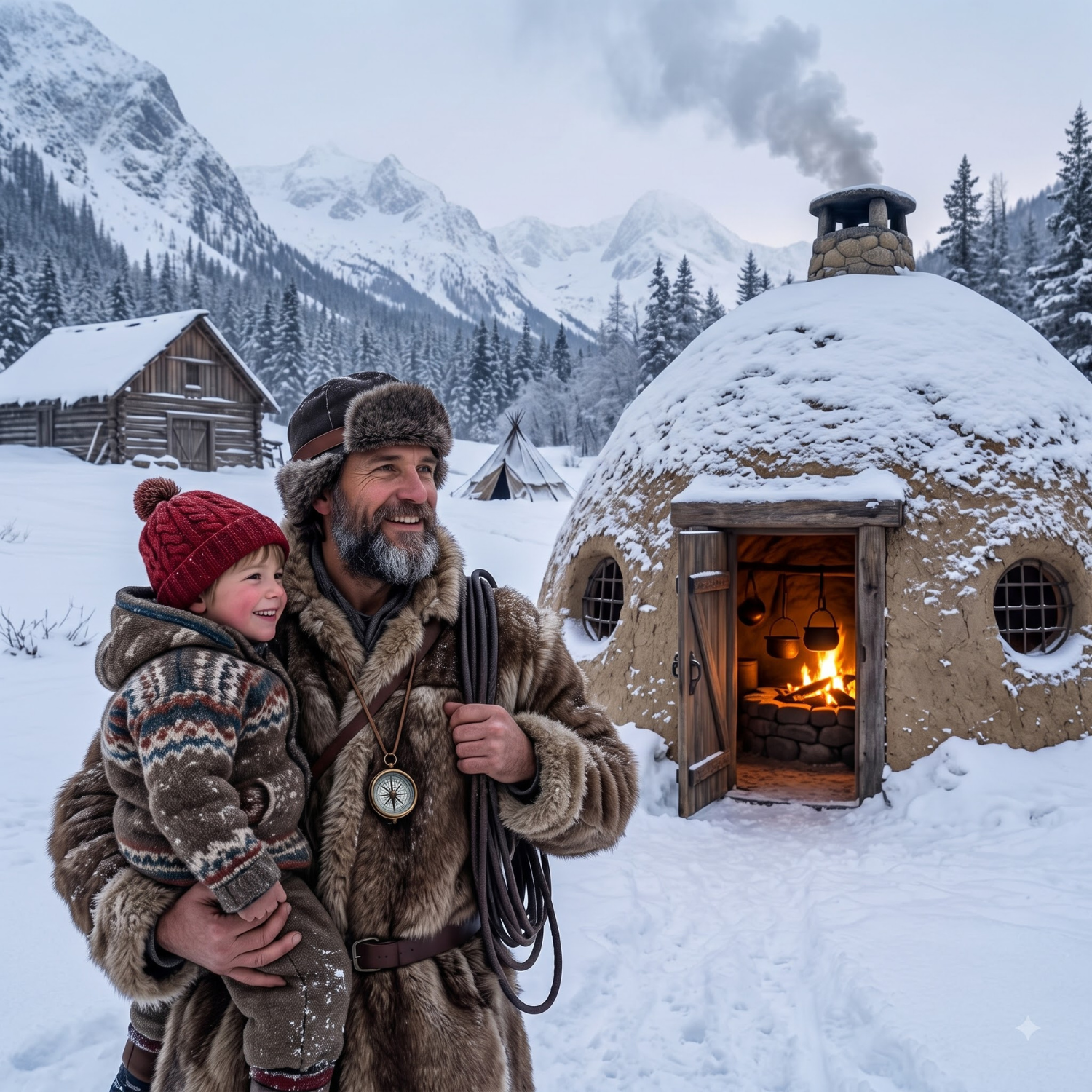
He Built a Round Clay House With No Corners — All Winter, the Blizzard Couldn’t Find a Way In
He Built a Round Clay House With No Corners — All…
He Built a Round Clay House With No Corners — All Winter, the Blizzard Couldn’t Find a Way In
Ellis County, Kansas. October 1885.
The wind across the high prairie was a living thing, ceaseless and unforgiving. It carried the smell of dry grass, distant dust, and the sharp, metallic promise of coming cold.
Friedrich Wagand stood ankle-deep in the yellow earth, his heavy forearms plunged up to the wrists in a trough of thick, wet clay. He was a broad, quiet man with hands rougher than bark and a face that rarely betrayed panic. Beside him stood his seven-year-old son, Willi, shivering slightly in the autumn breeze despite the oversized red knit cap pulled low over his ears. Willi held a massive armful of golden straw pressed tightly against his small chest.
“More, Willi,” Friedrich grunted, his accent thick with the consonants of the Volga River colonies.
The boy stepped forward and dropped the straw into the mud. Friedrich immediately began working it in, folding the wet earth over the dry stalks, pressing, kneading, binding the two materials together until they formed something stronger than either alone.
They were building a house that looked like a mistake.
It was rising out of the flat, endless Kansas grass like a giant, inverted bowl. It was a ring of brown clay, currently the height of a man’s chest. It was perfectly round, resembling a massive rain barrel, and its walls were as thick as the stone steps of a cathedral. It stood entirely alone on the open claim, devoid of lumber, devoid of nails, and devoid of corners.
The sound of approaching hooves broke the rhythmic slapping of Friedrich’s work.
Erastus Plimpton, the proprietor of the only lumberyard within thirty miles, rode up on a fine chestnut gelding. Plimpton was a man who sold pine boards, tar paper, and iron nails to every hopeful, desperate claim-staker between Hayes and the river. He was a man who believed implicitly in straight lines and sawmills.
Plimpton pulled his horse to a halt, the animal snorting at the smell of wet earth. He sat in the saddle for a long moment, staring down at the bizarre structure. Then, a sharp, barking laugh erupted from his chest.
“Wagand!” Plimpton called out, swinging a leg over his saddle and dropping to the grass. “What in the name of God are you doing? I thought you were digging a well, but now I see you’re building a mudpot.”
Friedrich did not stop working. He lifted a heavy, straw-bound lump of clay and slapped it onto the rising rim of the wall, pressing it down firmly with the heel of his hand.
Plimpton walked slowly around the circular ring. He kept his hands clasped behind his back, his posture radiating mocking authority. He evaluated the structure exactly the way a shrewd buyer walks around a sick cow at market.
“One wet week,” Plimpton pronounced, stopping near Willi. “One proper Kansas downpour, Dutchman, and your ‘house’ goes right back to being a muddy field. You can’t live in dirt.”
“It is not dirt, Mr. Plimpton,” Friedrich said quietly, wiping his muddy brow with the back of his wrist. “It is clay.”
“Nobody pays for clay because clay is dirt,” Plimpton sneered.
To prove his point, Plimpton stepped forward. He lifted his heavy, leather riding boot and drove his heel aggressively into the freshly laid, soft wall.
The wet clay took the blow with a sickening, wet slap.
Plimpton pulled his boot free, leaving a deep indentation. Not satisfied, he set his weight, drove his heel in a second time, significantly lower, and viciously twisted his foot before pulling away.
Willi did not move. He stood frozen with the straw pressed against his chest. The boy watched in horror as a dark crack opened in his father’s work.
It ran upward from the jagged heel mark like a crooked black river on a map, tearing through the fresh course of clay they had painstakingly laid that morning, stopping only when it reached the height of Friedrich’s broad shoulder.
Friedrich slowly took his hands out of the wall. He turned to face the lumberman. The prairie wind seemed to hold its breath.
“You will pay for boards you break, Mr. Plimpton,” Friedrich said, his voice dangerously low.
“And I told you,” Plimpton scoffed, waving a dismissive, gloved hand, “nobody pays for dirt. When this thing melts, you come see me at the yard. I’ll sell you a proper pine shack on credit. At least it won’t wash away.”
Plimpton climbed effortlessly back into his expensive saddle. He looked down at the boy in the red cap.
“Tell your stubborn father the rain is coming, son,” Plimpton said. “Tonight.”
He spurred his horse and rode away, leaving the deep, jagged crack weeping moisture in the side of the wall.
Plimpton, as it turned out, was absolutely right about the weather.
By late afternoon, the pale blue sky over the western rise turned the heavy, ominous color of wet slate. The temperature dropped sharply, and the rain arrived just after dark. It was not a gentle autumn shower. It was a cold, slanting, driving rain, blown sideways by the wind, hammering straight at the cracked side of the clay wall.
Friedrich did not curse. He walked to their temporary canvas tent, lit a kerosene lantern, and hung it on a wooden stake driven into the ground beside the wall. The yellow light flickered wildly in the storm.
“Willi,” Friedrich called out over the wind.
Willi emerged from the tent. He had pulled on one of his father’s old wool coats, which hung comically down to the tops of his boots. Without being asked, the boy ran to the protected stack of slough grass, gathered a massive armful, and ran back through the freezing mud, his head tucked down against the stinging rain.
Friedrich knelt in the mud. He jammed his thick fingers directly into the crack Plimpton had made, digging it completely open, widening the wound all the way down to the heel mark to expose the clean clay underneath.
Then, he began to pack it.
Clay and straw. Clay and straw.
He worked with frantic, precise energy, pressing each wet handful violently home with the heel of his palm, forcing the fibers to interlock. The freezing rain ran in steady rivers off the brim of his hat and down into the collar of his shirt, chilling him to the bone.
Beside him, standing ankle-deep in the freezing muck, Willi handed up fistful after dry fistful of straw. The seven-year-old’s hands were red and shaking, but he never complained. He never once asked to go inside the dry tent.
It took two hours of grueling, freezing labor. When the crack was finally closed and smoothed over, Friedrich stood up, his back aching, and laid his bare hand flat on the wet, patched wall.
Willi looked up, the rain streaming down his face. “Will it fall down, Papa?”
Friedrich looked at his son, then at the wall holding firm against the driving rain.
“No, Willi,” Friedrich said softly. “It will dry harder than it was.”
Related Articles

They Mocked the Widow’s Dirt Cellar—Then the Freeze Left Every Cabin Cold but Hers Warm
They Mocked the Widow’s Dirt Cellar—Then the Freeze Left Every Cabin Cold but Hers Warm…

A Homeless Veteran and His German Shepherd Inherited a Ridge No One Wanted — 35 Feet In, They Found
Chapter 1 / 7 A Homeless Veteran and His German Shepherd Inherit… A Homeless Veteran…

Neighbors Laughed When He Built A Cabin Inside An Old Barn—Until It Kept His Home 35 Degrees Warmer
Chapter 1 / 8 Neighbors Laughed When He Built A Cabin Inside An… Neighbors Laughed…

His Sod House Had No Woodpile in January – Until the Trains Stopped and the Town Came Begging
Chapter 1 / 10 His Sod House Had No Woodpile in January – Until t……

She Built Her Cabin Over the Woodshed and Never Burned Wet Wood Again
Chapter 1 / 8 She Built Her Cabin Over the Woodshed and Never Bu… She…

The Duke Abandoned Her on Their Wedding Day—Years Later, He Discovered What He Had Lost
Chapter 1 / 7 The Duke Abandoned Her on Their Wedding Day—Years… The Duke Abandoned…

He Wedged a Tiny A Frame Into a Crevice Before Winter and His Family Slept at 75°F While Town Hit
Chapter 1 / 7 He Wedged a Tiny A Frame Into a Crevice Before Win……

He Was Too Old to Ride—So He Bought the Ruined Ranch and Found the Room Behind the Fireplac
Chapter 1 / 5 He Was Too Old to Ride—So He Bought the Ruined Ran……

Settlers Laughed at His Underground Heat Recovery Duct — Until It Kept His Cabin 71°F Warmer
Chapter 1 / 9 Settlers Laughed at His Underground Heat Recovery… Settlers Laughed at His…

A Navy SEAL Built a Home Inside a Mountain—Then His Dog Warned Him Before the Storm
Chapter 1 / 5 A Navy SEAL Built a Home Inside a Mountain—Then Hi… A…