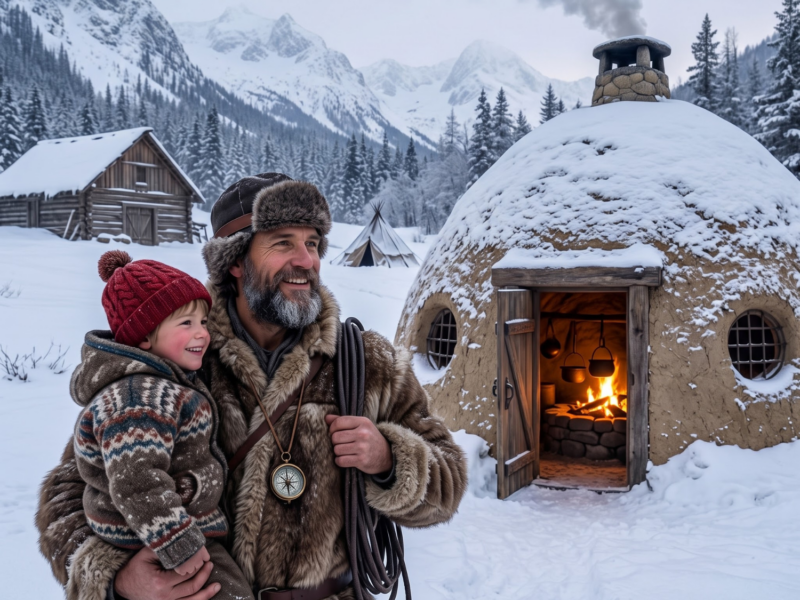
He Built a Round Clay House With No Corners — All Winter, the Blizzard Couldn’t Find a Way In
The Beacon in the Storm
Plimpton had foolishly driven his buggy out to a struggling claim miles east of the Wagands on the morning of the second storm, determined to aggressively collect on a past-due load of boards before the weather turned. Supremely arrogant, he was absolutely certain he could beat the incoming weather home to town.
He could not.
The snow came down so incredibly thick and fast that he lost the wagon road completely inside of a single mile.
Disoriented, he pushed his horse too hard. The exhausted, panicked animal floundered deeply in a massive, hidden drift, snapped the wooden shaft of the buggy with a loud crack, and bolted into the whiteout, tearing the reins from Plimpton’s hands.
Plimpton was suddenly on foot, entirely alone, in a blinding whiteout.
The ambient temperature and the screaming wind chill took his breath away before he could even use it to scream for help. He walked blindly for most of an hour, stumbling through waist-deep drifts. He had absolutely no idea where he was. The landscape had been erased.
His hands, inside his expensive leather gloves, had entirely stopped hurting.
Plimpton knew enough about the prairie to know that the cessation of pain was not a relief; it was the final, terrifying biological warning before deep frostbite and death. It frightened him far more than the agonizing pain had. He was going to die out here, ten miles from his warm office, frozen like a discarded log.
Then, low to the ground and glowing a faint, hazy orange through the violent, flying snow, he saw a light.
It blinked out as a gust of snow obscured it, and then it came again. Steady.
It was the kerosene lantern, shining brilliantly through the deep, narrow little window of the clay dome.
Plimpton stumbled desperately toward it, his legs feeling like heavy, useless stumps of wood. Suddenly, his shins struck something hard in the snow, tripping him. He fell face-first into a drift.
He flailed blindly, and his bare hand—having lost a glove in the fall—closed around something rough. It was a thick hemp rope, stretched incredibly taut and knotted at intervals.
He gripped it with the last ounce of his strength. He pulled himself up and followed the lifeline, hand-over-hand, exactly the way little Willi had followed it a hundred times over the last three days. He dragged himself along the rope until his shoulder struck a solid wall.
The wall was distinctively curved.
He felt his way along the freezing surface, moving around and around the structure. And as he moved to the southeast side, a miracle occurred. The deafening, battering wind suddenly, completely let go of him. Because on the leeward side of the aerodynamic dome, there was hardly any wind at all.
His numb, shaking hand found the rough wood of a plank door. He pounded on it weakly.
It opened before he could even knock a second time.
Willi stood inside the doorway, bathed in golden lamplight, wearing only his shirtsleeves.
Plimpton fell heavily through the low, arched door, collapsing onto the dry clay floor in the firelight. Snow began instantly sliding in thick sheets off his expensive, useless wool overcoat as he hit the warm air. He lay there, gasping, and could not find the strength to get up.
Friedrich immediately stepped forward. He hauled the heavy lumberman up by the armpits and dragged him over to the clay bench. He sat Plimpton down firmly, with his back resting directly against the warm clay wall, and began rapidly pulling off the man’s frozen, stiff remaining glove and his ice-caked boots.
Willi, moving with practiced efficiency, brought a tin pan filled with snow from outside. He began rubbing the snow vigorously onto Plimpton’s stark white, frostbitten fingers, exactly as Friedrich quietly instructed him to do to save the tissue. Then, the boy fetched a steaming tin cup of rich, salty broth from the cast-iron pot simmering at the back of the stove.
For a very long time, absolutely nobody spoke.
The only sound in the room was the muffled, distant howling of the wind outside. It was going violently round and round the dome, desperately searching for a corner, a seam, an edge, and finding absolutely nothing to hold on to.
Plimpton’s hands came back to life first, the returning blood bringing agonizing, throbbing pain that made him grit his teeth. Then, slowly, the feeling returned to his feet.
As the violent shivering began to subside, he finally noticed his back.
He shifted awkwardly on the bench. He reached behind himself, put his bare, thawing palm flat against the solid clay wall he was leaning against, and left it there.
“It’s warm,” Plimpton whispered, his voice hoarse and broken. “The wall… the wall itself is warm.”
“It is warm all night,” Friedrich said quietly, sitting across the room, watching the man recover. “The fire only visits.”
Plimpton looked across the room at Willi. The seven-year-old boy was sitting on the floor by the lantern, his sleeves rolled up, casually twisting dry hay into tight bundles.
Then, Plimpton slowly lifted his gaze to the glass thermometer hanging on the nail directly above the bench.
It read fifty-six degrees.
Plimpton knew, because he had seen his own breath freeze instantly before he found the rope, that outside the heavy wooden door, it was twenty degrees below zero. He knew, with absolute, horrifying certainty, exactly what the thermometers inside the drafty board shacks along the road would be reading that morning.
“I sold boards to every single claim between here and the river,” Plimpton said at last, staring at the thermometer, his voice cracking with the weight of the realization. “I looked every one of those men in the eye, and I told them it was the absolute only way a sensible, civilized man could live out here.”
He looked at Friedrich, the arrogance entirely stripped from his face, leaving only profound humility.
“And I was wrong, Wagand. I was completely wrong. Not one of those expensive houses… not a single one… is as warm as your mudpot tonight.”
Friedrich did not answer that. He did not gloat. He simply stood up, walked to the stove, filled the tin cup with hot broth again, put it gently into Plimpton’s shaking hands, and let the man drink.









