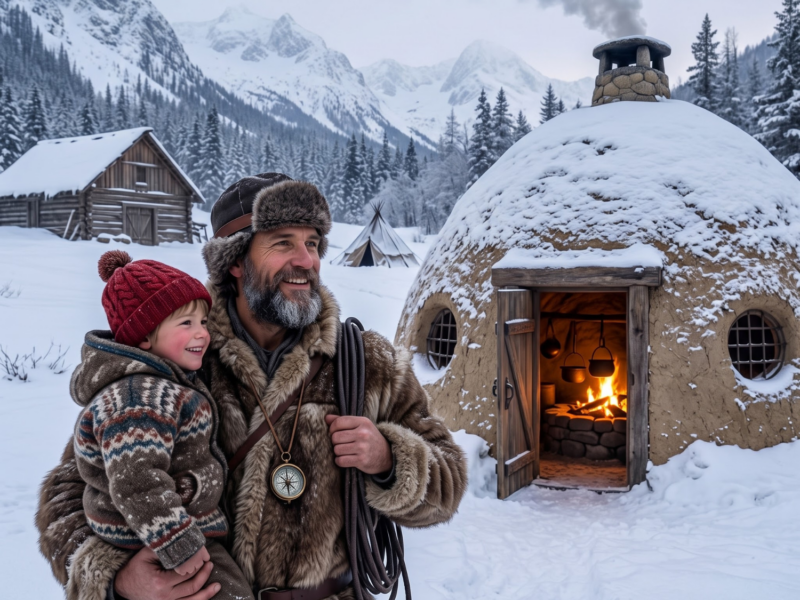
He Built a Round Clay House With No Corners — All Winter, the Blizzard Couldn’t Find a Way In
The White Wall
On New Year’s Day, 1886, the sky in the northwest went a terrifying, bruised black by noon.
The first blizzard came screaming down the Smoky Hill country like a physical, moving wall of ice.
For three straight days, absolutely nobody on that stretch of prairie could see the ground they walked on. The wind drove the hard, crystalline snow perfectly flat along the grass. The whiteout was so incredibly thick that a man standing at his own woodpile could not see the front door of his own house ten feet away.
Then, after the briefest, deceptive lull of a few hours, the second storm system slammed in directly behind it, significantly colder and more violent than the first.
Willi had a very specific job in the storm, and he and his father had rehearsed it rigorously all through December, treating it like a military drill.
Before the very first flakes of the blizzard came down, Friedrich and Willi had run a thick, heavy hemp rope from the sturdy doorpost of the dome, straight out to the small ox shed, and then out to the massive haystack. The rope was tied with thick, tactile knots at every single step.
They hung the kerosene lantern on a designated iron hook just inside the dome’s door, positioned exactly where its bright yellow light would shine like a lighthouse beam through the little, deep-set window, visible through the blinding snow.
Every single trip out to the stack for hay went hand-over-hand, gripping that frozen rope. Friedrich went first, breaking the wind, and Willi stayed right behind him, gripping his father’s flapping coat. They would return with a massive bundle of dry slough grass under each arm, their backs caked white, snow packed tightly into every fold of their clothing.
Inside the safety of the dome, Willi twisted the hay. That was his other vital job.
He took a long, thick handful of the dry grass, twisted it violently tight, doubled it over on itself, and twisted it again until it was as hard, dense, and rigid as a heavy stick of firewood. Loose hay flares up in a stove and is gone in seconds, offering no sustained heat. But tightly twisted hay burns hot, slow, and long, mimicking the thermal output of wood.
Willi sat on the comfortably warm clay bench in just his shirtsleeves, bathed in the soft lantern light, twisting hay for hours. And Friedrich fed the clay stove exactly twice a day, just as he had promised, and no more.
On the terrifying third morning of the second storm, Friedrich opened the heavy door just a hand’s width, letting in a shrieking blast of wind, and read Plimpton’s thermometer on the post outside.
It read twenty degrees below zero.
He slammed the door shut, threw the heavy iron bolt, walked over to the bench, and held the lantern up to the small, delicate glass thermometer he had purchased at the Hayes drugstore in the autumn. He kept it hanging on a nail directly above where Willi sat.
It read a perfectly stable fifty-six degrees.
Across the draw, in the traditional board shack, it was an entirely different, horrific winter.
Rolland Brink possessed a very good, expensive cast-iron stove. On the very first night of the blizzard, terrified by the plunging temperature, he fed it with precious wood and coal until its flat top literally glowed a dull red in the dark room.
It did absolutely no good.
The freezing, pressurized air came screaming through the wooden walls at every single seam. On the exposed north side of the shack, the hurricane-force wind tore a long strip of black tar paper loose. It flapped violently, sounding like a machine gun, until the iron nails finally pulled free from the pine.
Fine, powdery snow sifted effortlessly in through the widening cracks between the boards. It lay on the floorboards in neat, perfectly straight little white lines, and because the floor was so incredibly cold, the snow did not melt, even with the stove roaring ten feet away.
By the agonizing dawn of the second morning, the entire supply of fuel Brink had stacked inside beside the door was completely gone.
Desperate, he burned the wooden bench. Then he chopped up and burned the dining table. Then, weeping with frustration, he took an axe to the heavy wooden lid of his wife’s heirloom trunk.
The water in the tin kettle sitting on top of the stove froze solid the absolute moment the fire died down. Inside the shack, as the wind howled through the missing tar paper, his own wall thermometer stood at a lethal four degrees below zero.
It was vastly worse elsewhere on the plains.
Down toward the settlement of Victoria, a young sheep herder was found in the spring thaw, frozen solid a few hundred yards from his own front door, having lost his way in the whiteout. Entire herds of cattle drifted helplessly before the blinding wind until they piled up against the newly strung barbed wire fences, exhausted, and simply froze to death standing upright. Passenger trains stood completely buried in the deep cuts along the railroad tracks for days, the engines dead.
And in his plush office in Hayes, Mr. Ewing, the wealthy railroad land agent, was reduced to burning the company’s expensive, watermarked letter paper in his ornate office stove just to keep his fingers from going numb.
And Erastus Plimpton, the arrogant lumber dealer who had confidently kicked a crack into a wet clay wall, was caught out in the absolute worst of it.









