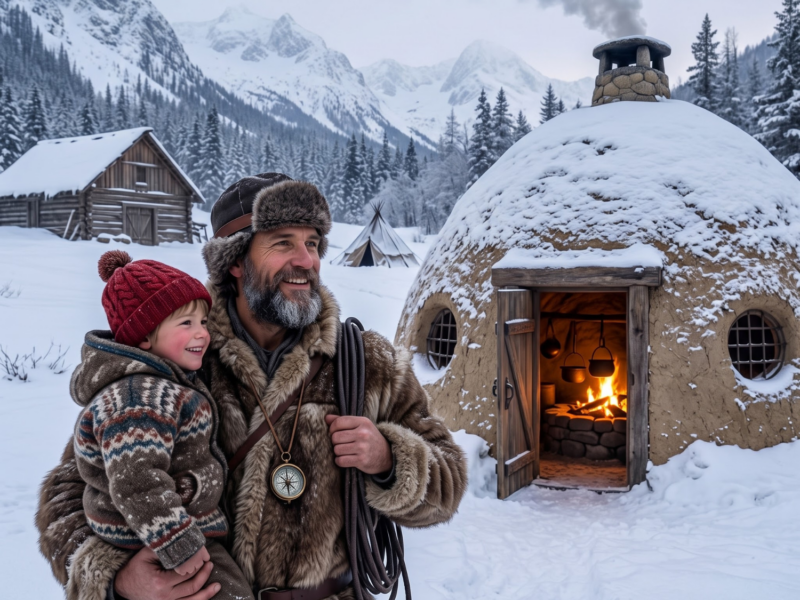
He Built a Round Clay House With No Corners — All Winter, the Blizzard Couldn’t Find a Way In
The Echoes of the Volga
Friedrich Wagand was not a carpenter, and he had never claimed to be one. He possessed absolutely no reverence for the straight edge of a pine board or the sharp point of an iron nail.
His grandfather had built ovens in the German colonies along the Volga River, deep in the Russian province of Saratov. In those harsh, unforgiving winters, survival was not guaranteed by timber—which was scarce—but by the earth itself. Every single household baked their bread in a massive clay oven, and Friedrich’s grandfather was the master builder the entire village sent for when a hearth cracked.
Friedrich had carried wet clay for the old man since he was old enough to walk, exactly the way little Willi carried straw for him now. Even standing in the freezing Kansas rain, Friedrich could still clearly hear the old man’s ironclad rules, spoken over every oven they ever built together.
“The fire only visits, Friedrich,” the old man would say, tapping his trowel against the dried clay. “The fire is a guest. The walls are what keep the heat.”
A well-built clay oven, the old man taught him, did not need a roaring fire all day long. That was a waste of precious fuel. You burned tightly twisted straw or dried dung in the firebox aggressively for exactly one hour, until the thick clay walls themselves absorbed the energy and became hot right through to the core. Then, you raked out the ashes completely.
You baked your daily bread in the ambient heat the walls gave back. You slow-cooked your beans at noon in that same heat. And by nightfall, the oven walls were still warm enough to dry your freezing mittens and keep the kitchen comfortable. All of this from one single, modest armful of straw.
And there was a second, equally vital lesson the old man had taught him, pointed out from the far, wild side of the river.
Out on the open, brutal steppe, where the nomadic Kalmyk herders drove their massive flocks of sheep, the winter wind blew exactly as hard, and as cold, as any wind howling across the Kansas plains. Yet, the herders lived comfortably all winter in round, felt tents. Yurts.
They were never square. They were strictly, perfectly round.
“Look how the wind goes around it, boy,” his grandfather had said, pointing a gnarled finger at the distant tents withstanding a gale. “A wind is like a grasping hand. A hand needs a corner to take hold of.”
Friedrich had carried both of those ancient, practical rules across an ocean in the hull of a steamship.
But for his first two winters in Kansas, desperate to assimilate and afraid of looking foolish, he had used neither one.
Willi’s mother had not survived the journey. She lay buried in a small, quiet churchyard back in Saratov Province, taken by a cough that turned into pneumonia. Friedrich had brought Willi over to America entirely alone, a grieving man seeking a blank slate.
Like almost every new, inexperienced man settling on the railroad lands, Friedrich had blindly done exactly what the wealthy lumber dealer told him to do.
He had gone to Erastus Plimpton’s yard. He had signed a promissory note. He had bought expensive, thin pine boards, boxes of iron nails, and rolls of black tar paper. He had built a standard claim shack—a wooden box exactly twelve feet by fourteen feet, with a tin roof and a sheet-iron stove sitting dead in the middle of the floor.
It took exactly one Kansas winter to teach him what a board house truly was. It was a wooden sieve.
The iron nails betrayed him first. On the absolute coldest mornings, when the temperature plummeted below zero, the flat heads of the nails inside the cabin walls grew thick, white fur made of frost. Each iron nail acted as a tiny, highly conductive thermal road, carrying the lethal cold from the outside wind straight through the wood and directly into the room.
Then, the water pail split.
He found it one brutal January morning. A solid disc of ice was standing up out of the wooden bucket, and the wooden staves had violently sprung apart like the petals of a dead flower. The bucket had frozen completely solid, less than four feet away from an iron stove that Friedrich had been desperately feeding with expensive wood all night long.
Next, the metal stovepipe collar cracked. Where the hot iron pipe met the freezing wooden roof, the extreme temperature difference caused the metal to heat to a glowing red and then freeze rapidly, over and over, until the collar fractured. Acrid, choking smoke began blowing back down into the tiny, freezing room.
And then, worst of all, Willi started to cough.
It was a small, dry, rattling cough at first. Then it grew into a deep, wet, terrifying sound that echoed in the dark cabin. It did not leave the boy’s chest until the thaw of April.
Friedrich sat awake for dozens of nights that terrible winter, wrapped in blankets, holding his coughing son, and listening to the wind actively hunt them. He could hear it finding the seams. He could feel the freezing air rushing in—a thin, high-pitched whistle at every single corner of the room where the straight pine boards met but never quite closed tightly enough.
In the spring, when the cough was finally gone and the ground thawed, Friedrich walked out onto the center of his new claim. He carried a heavy iron spade. He dug aggressively down through the thick prairie grass, past the topsoil, to see exactly what the earth was made of.
A foot below his boots, he found it.
It was clay. It was dense, yellow-brown, incredibly sticky, and rich. It was perfect, old-world oven clay.
That night, as he cooked their meager supper, he told Willi they were going to tear down the drafty wooden shack. He told the boy they were going to build a new house, exactly the way the old man in Russia built his bread ovens.
“Will it be warm, Papa?” Willi had asked, his voice still raspy.
Friedrich looked at his son. “It will be warmer than bread,” he promised.









