He Built a Water-Filled Heat Barrel — His Cabin Stayed 29°F Warmer Than His Neighbors’
THE MAP OF AN OBSESSION
The mockery had begun in the scorching heat of July 1878, when Anders first unfurled his architectural sketches on a flat cedar stump outside the local land office and explained his cabin design to his prospective neighbors.
He was filing a homestead claim like dozens of other hopeful settlers, planning to carve a life out of the untamed wilderness and prove up his land. But his building plans were radically, incomprehensibly different from the standard single-room log boxes going up across the territory. The absolute centerpiece of his design was water.
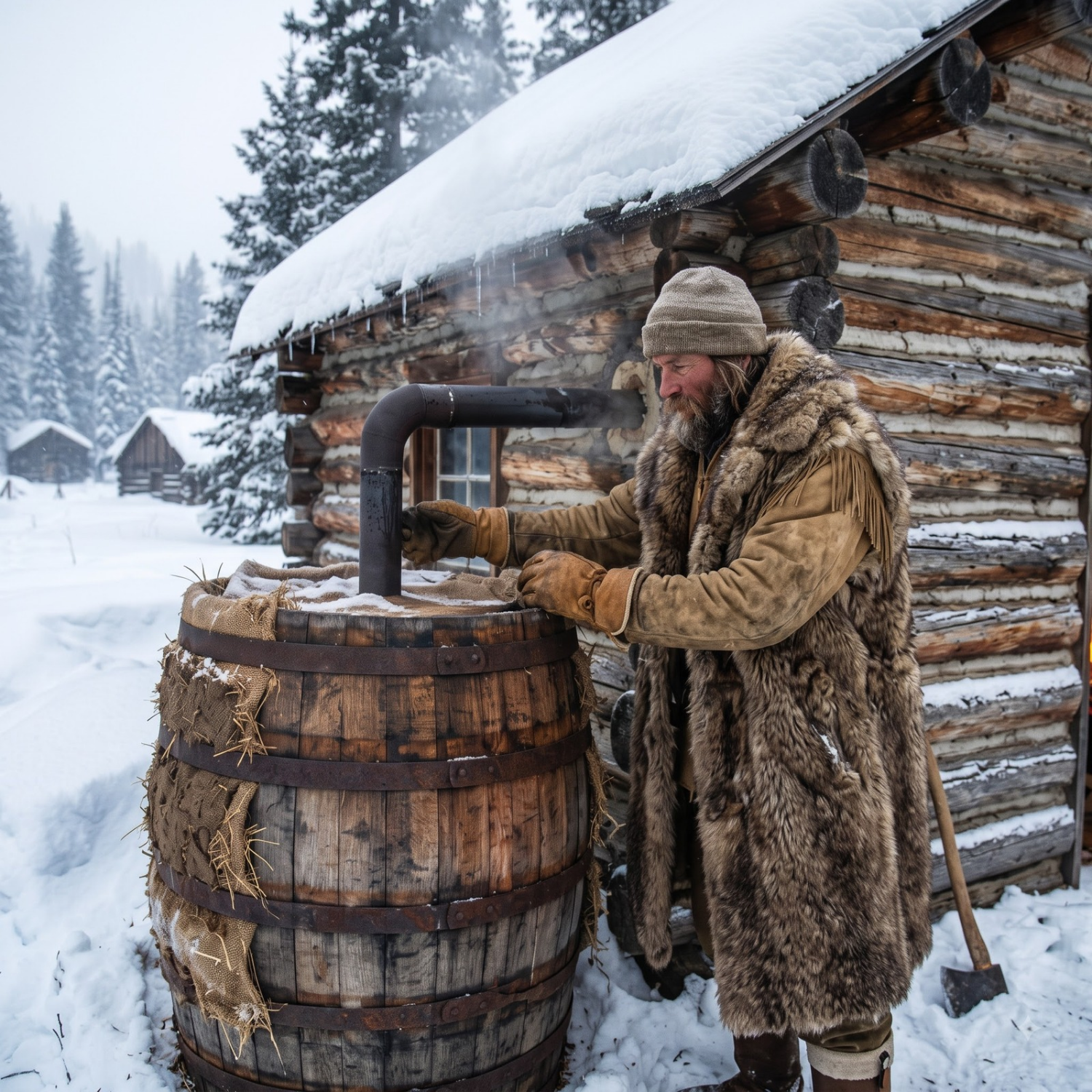
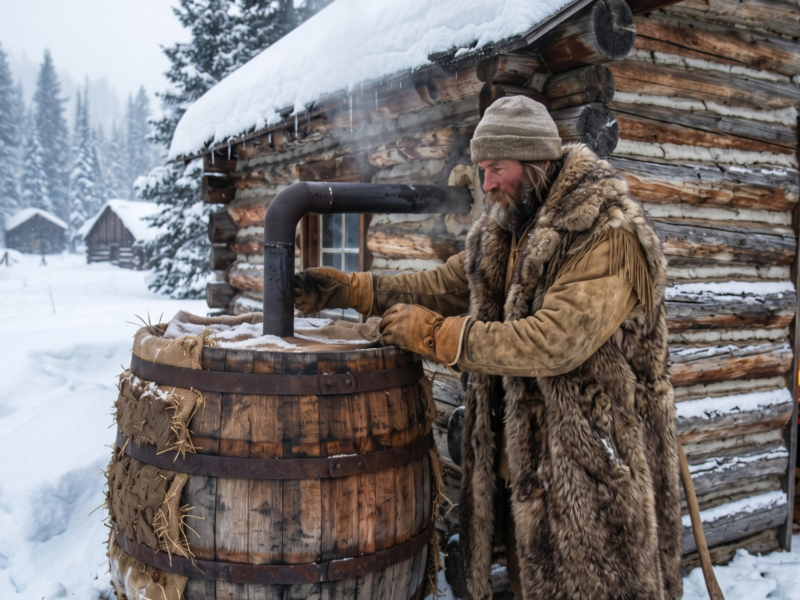
Lots of water. Specifically, six massive oak casks, each engineered to hold fifty gallons, positioned strategically inside the perimeter walls where they could absorb, hold, and slowly bleed out heat.
When he first outlined this vision to his nearest neighbor, Samuel Hutchkins—a weathered, pragmatic man who had farmed the Montana dirt for five straight years—the response was instant skepticism.
“You’re going to put barrels of water inside your house?” Hutchkins asked, squinting down at the neat ink lines on Anders’s parchment. “Why in God’s name would you do that?”
“To store heat,” Anders replied in his crisp, deliberate English, his voice devoid of irony. “Water holds heat remarkably well. Far better than stone, far better than wood, and infinitely better than air. If I fill these barrels with water and warm them during the day, they will retain that thermal energy for many hours. They will release it steadily through the night, keeping the cabin warm long after the hearth fire has burned to ash.”
Hutchkins stared at him as if he had spoken in ancient Greek. “That is the craziest thing I’ve ever heard. Water doesn’t hold heat, Anders. It cools down instantly. That’s why you boil water for coffee and it’s stone cold again in an hour.”
Anders smiled patiently, the smile of a man accustomed to teaching stubborn students. “The water in your tin cup cools quickly because the cup is small and thin, with a massive surface area relative to its tiny volume. A barrel is an entirely different proposition. It possesses very thick oak staves and a minimal surface area compared to the enormous body of water trapped inside. The core cools very slowly—so slowly that you cannot fathom the mathematics until you see it work. And three hundred gallons… that is a tremendous thermal reservoir.”
Hutchkins shook his head, rolling a tobacco chew into his cheek. “You’re going to regret this, Dane. Your first winter in Montana, you’re going to freeze your old bones because you filled your living room with useless stagnant ponds instead of building a proper house.”
Anders was not deterred. He had spent months hunched over calculations of specific heat capacities, thermal mass matrices, and conductive heat-loss rates. He had worked out every digit on paper using principles forged in the technical academies of Denmark. He knew his design would work with the unyielding certainty of mathematics. He simply needed to build it and let the winter render the verdict.