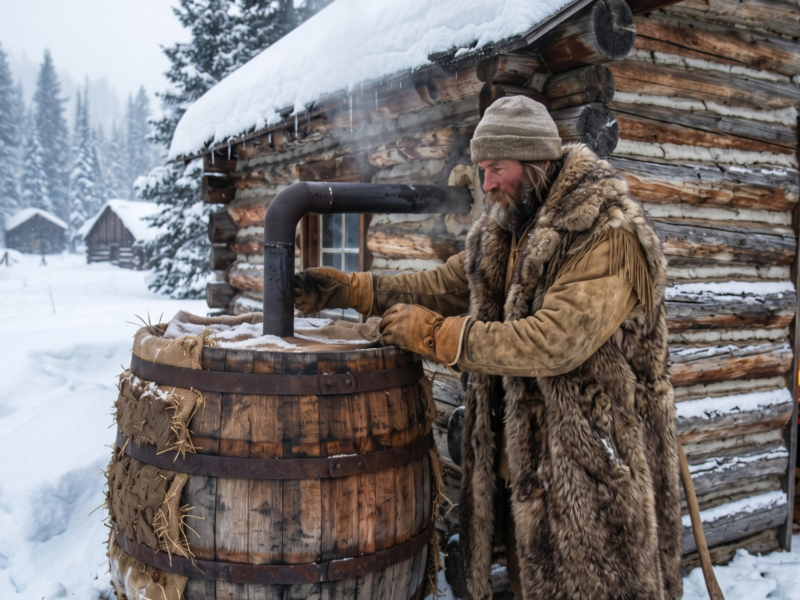
He Built a Water-Filled Heat Barrel — His Cabin Stayed 29°F Warmer Than His Neighbors’
THE FORTRESS OF THE FLOOR
Construction began in July. Anders started where every great structure must: with an exceptionally robust foundation.
He knew the dead weight of his water barrels would be staggering. Six barrels, each holding fifty gallons of water, meant roughly twenty-five hundred pounds of liquid alone—not accounting for the heavy iron-hooped oak staves that housed them. That was well over a ton of concentrated downward force bearing down upon specific load points inside the cabin.
He dug foundation piers at each intended barrel location, sinking them four full feet below the local frost line and filling them with heavy fieldstones locked together with lime-and-clay mortar. Each pier was capped with a thick, adzed white oak beam designed to distribute the immense weight across multiple floor joists.
The floor itself was brutally over-engineered. Eschewing the standard practice of laying two-inch pine boards across joists spaced two feet apart, Anders laid three-inch tongue-and-groove planks over massive joists spaced just sixteen inches apart, hewn from solid pine logs at least ten inches in diameter. The resulting floor was rigid enough to support an anvil without flexing.
The walls went up next, utilizing an unorthodox double-wall technique. He erected an inner shell of logs and an outer shell, leaving a full twelve-inch gap between them that he packed tightly with dry sawdust for insulation. The total wall thickness approached three feet—ludicrously excessive by frontier standards, where a single eight-inch log wall was considered state-of-the-art.
“He’s wasting timber,” the neighbors whispered as they rode past. “He’s wasting time. He’s building a European fortress when he needs a simple shelter.”
The roof was engineered with identical obsession: heavy support beams, a double layer of tight planks, and six inches of packed sod sealing the top. Every square inch of the envelope was designed to trap energy and deny the wind any purchase.
By late August, the shell was complete. Then came the barrels.
Anders had ordered them custom-built from a master cooper in Missoula, specifying quarter-sawn white oak with extra-thick staves and heavily reinforced iron hoops. Each barrel cost him eight dollars—a staggering expense in a territory where most homesteaders built entire cabins for fifty. The six barrels totaled forty-eight dollars, more than many families spent on their entire setup.
“He spent more on empty kegs than I spent on my entire homestead,” one homesteader scoffed. “And what does he have to show for it? A bunch of wet wood sitting in his parlor.”
The placement was meticulously calculated. Four barrels were lined up against the south wall—the elevation dominated by triple-glazed windows designed to capture low-angled winter sunlight. Two barrels were positioned tightly against the stone hearth, flanking the fireplace where they could directly absorb radiant heat from the blazing logs.
Once anchored to their reinforced platforms, the barrels were filled via a hand-pump hauled down to the nearby creek. Anders filled each fifty-gallon cask to within two inches of the top, leaving an air gap for thermal expansion; he knew water expanded as it warmed, and he had no desire to see his expensive oak staves burst under hydraulic pressure. Heavy wooden lids were fitted and sealed to prevent evaporation and keep dust out.
When finished, the six barrels held three hundred gallons of water, weighing nearly three thousand pounds in total—a ton and a half of liquid thermal mass anchoring the center of the home.
Samuel Hutchkins came by to inspect the finished monstrosity. He walked around the casks, tapped them with his knuckle, and shook his head in disgust. “You’ve built a house inside a cooperage, Anders. This is the most impractical thing I’ve ever laid eyes on. Where’s your bed? Where’s your table? How are you supposed to live in here?”
Anders gestured calmly to the remaining space. “There is ample room for a cot, a writing desk, chairs, a cooking range, and all my provisions. The barrels do not prevent me from living, Samuel. They enable me to live.”
“They’re just sitting there,” Hutchkins snapped. “They don’t do a damn thing.”
“They do everything,” Anders replied quietly. “Wait for January.”









