He Built a Water-Filled Heat Barrel — His Cabin Stayed 29°F Warmer Than His Neighbors’
THE SPREAD OF THE HEARTH
Within weeks, the bitter irony of the valley shifted. The eccentric Dane with his water barrels hadn’t frozen; he was living like a European aristocrat while the rest of the settlement hacked their fingers bloody in the snow.
Curious homesteaders began arriving in droves, tracking slush across Anders’s immaculate floorboards. They tapped the barrels, felt the warm wood, and peppered the old engineer with questions. Anders welcomed every visitor with German precision, pulling out his dog-eared notebooks and explaining the principles of specific heat and thermal mass with serene patience.
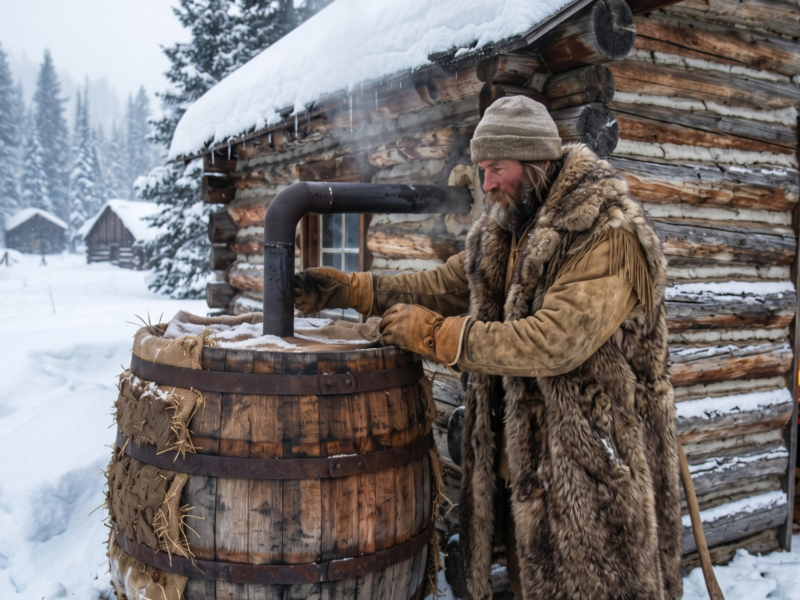
Some settlers were immediate converts. One ambitious carpenter named James Cooper drove his team into town, bought three heavy oak barrels, and retrofitted them into his existing cabin along his south wall and hearth. The results were instantaneous: his wood consumption plummeted by nearly a third, and his family stopped waking up with frozen breath on their pillows.
Others attempted clumsy shortcuts with disastrous results. One frustrated homesteader threw water-filled whiskey kegs into the cold, dark corners of his single-walled cabin where neither sun nor fire could reach them. When the water turned to solid ice within twenty-four hours, he declared the whole invention a fraud and stomped back to his axes.
Anders tried to intervene where he could, gently explaining the cardinal rule of his architecture: Thermal mass is useless without an insulated envelope.
“The barrels do not create energy,” he told a skeptical crowd gathered outside the general store in January 1879. “They merely borrow it and hoard it. If your cabin leaks air like a wicker basket, the heat will escape before the water can catch it. You must seal the house, insulate the roof, and position the mass where the sun and fire can touch it. The system is holistic.”
The underlying science was unassailable. Water possesses a specific heat capacity of 4.18 Joules per gram per degree Celsius—dwarfing stone (0.8), steel (0.46), and dry pine wood (1.5). Three hundred gallons of water translated into roughly seventy-five thousand kilocalories of storable thermal energy for every thirty-degree swing—an energy payload equivalent to burning forty-two pounds of dry hardwood, captured entirely for free.
By the spring thaw of 1879, Anders Peterson was no longer the village idiot. He was an oracle.
Settlers from Idaho, Wyoming, and the distant Dakotas began writing letters to the local land office asking for details on the “Copenhagen Heating Method.” At the urging of his neighbors, Anders sat down at his desk and penned a short, brilliantly clear technical pamphlet titled Efficient Cabin Heating Through Thermal Mass and Insulation, distributing hand-copied editions free of charge to anyone who asked.
EPILOGUE: THE ARTIFACT OF INNOVATION
Anders Peterson lived in his water-heated cabin for thirty-eight uninterrupted years, passing away peacefully in 1916 at the ripe age of ninety.
The cabin itself stood for another two decades before being carefully dismantled in 1936 during a property transfer. Remarkably, when the structure was taken down, the original oak barrels were found to be completely sound—the wood seasoned to a dark, indestructible iron by decades of continuous internal warmth.
One of those surviving fifty-gallon casks was salvaged and transported to the Montana Historical Society Museum in Helena, where it rests today behind a glass partition. Modern museum-goers frequently stare at it with mild confusion, wondering why an old whiskey cask is holding a place of honor among pioneer relics.
Yet for those who understand the silent arithmetic of heat and mass, it is an artifact of profound genius—tangible proof that a single mind armed with first principles can conquer an environment that defeats everyone else through brute force.
Anders Peterson proved something vital to the American frontier: that survival does not always require endless suffering, and that progress is born not merely from working harder, but from understanding how the world works.
When the bitter winter winds howled down the Bitterroot Valley, his neighbors burned their youth away in the forest, feeding a bottomless beast of cold. Anders simply filled six wooden barrels with water, sat back in his wooden chair, and let the sun and the science keep him warm.









