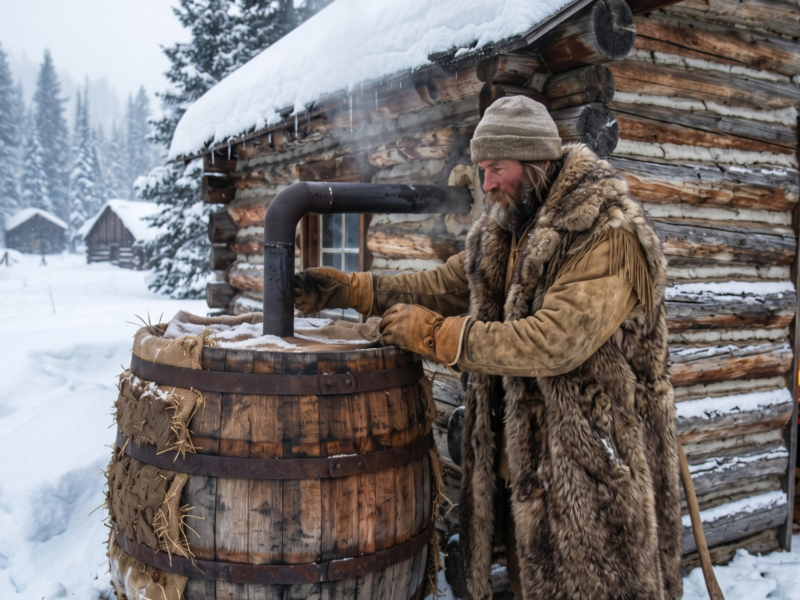
He Built a Water-Filled Heat Barrel — His Cabin Stayed 29°F Warmer Than His Neighbors’
THE BITTERROOT FREEZE
Winter arrived in the Bitterroot Valley with an icy, merciless fury in late 1878.
By November, daytime temperatures rarely clawed their way above forty degrees. By December, the valley was locked in a deep, punishing freeze, with nighttime lows plunging to ten below zero and daytime readings struggling to reach twenty.
The homesteaders burned firewood with reckless desperation. A standard log cabin required a roaring fire burning twenty-four hours a day just to maintain a miserable, shivering baseline of comfort. Most families were tearing through a full cord of seasoned pine every ten days—sometimes faster during the brutal nocturnal drops.
The physical labor of felling, bucking, hauling, and splitting that mountainous volume of wood was exhausting, endless, and dangerous. By early January, Samuel Hutchkins had completely exhausted his winter wood supply and was forced to spend his days venturing out into blinding gales to hack down green timber—a miserable, frostbitten task that brought him to the edge of physical collapse.
Anders Peterson’s daily routine looked entirely different.
Each morning, Anders built a modest, controlled fire in his hearth—a fire that burned brightly for perhaps three or four hours. During this brief window, the flames heated the cabin air and, crucially, supercharged the two water barrels flanking the stone fireplace.
On clear, sunny days—which were frequent in Montana even during winter—the four south-facing barrels drank in the golden radiation streaming through the wide glass panes. The dark, treated wood of the barrels and the thermal mass within absorbed the sun’s energy with ruthless efficiency. By midday, the water in those southern casks was lukewarm; by late afternoon, it felt like a warm bath, registering between seventy and eighty degrees Fahrenheit. The fireplace barrels routinely exceeded ninety degrees.
Then, as twilight fell and the Montana air plummeted toward the sub-zero mark, the cabin entered its secret phase.
Anders allowed his hearth fire to die down to a bed of glowing coals, and eventually to go out entirely. In any other cabin in the valley, this moment triggered an immediate, terrifying nosedive in indoor temperature as heat bled rapidly through the porous walls and thin roofs.
In Anders’s cabin, however, the laws of thermodynamics performed their quiet magic.
The three hundred gallons of water, now charged to eighty or ninety degrees, began their slow, stubborn process of thermal discharge. Warm water radiates its stored energy outward into its surroundings. The thick oak staves, heated from within, acted as massive, low-temperature radiators, bleeding warmth into the cabin air at a steady, unyielding rate.
The mathematics were staggering. Water possesses one of the highest specific heat capacities of any substance on earth—it takes a full calorie of energy to raise a single gram of water by one degree Celsius. For three hundred gallons, that translated into millions of calories of stored energy.
As the water cooled overnight from eighty degrees down to fifty, it dumped hundreds of thousands of BTUs into the living space. While a typical frontier cabin lost heat at a frantic clip of ten thousand BTUs per hour, Anders’s hyper-insulated, double-walled envelope lost less than a quarter of that.
The practical result was staggering: while his neighbors huddled under frozen quilts, Anders’s cabin held its ground. The indoor temperature dropped at a snail’s pace—perhaps two degrees an hour—settling at a comfortable sixty degrees by dawn.
When Anders woke up, he didn’t wake to frost on his blankets. He woke to a cool, habitable room, stoked his small fire for a few hours, and let the physics of water do the rest.









