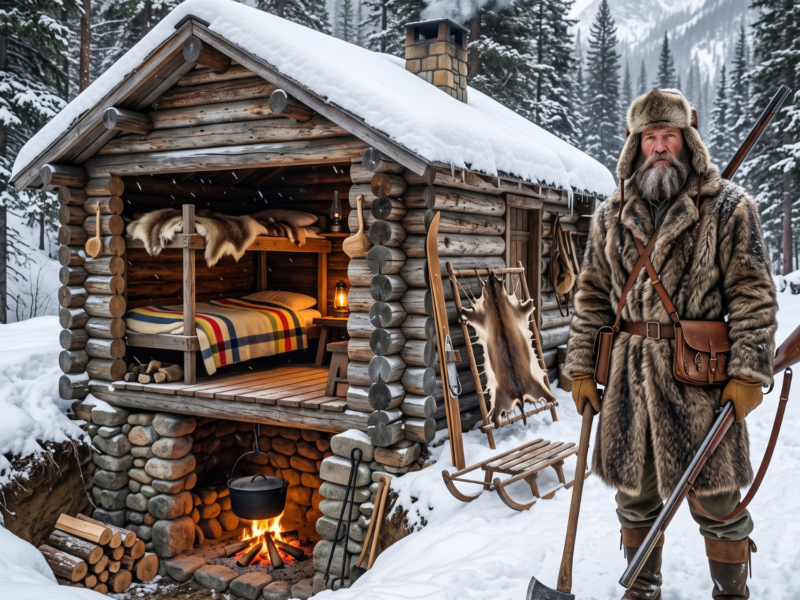
He Built the Cabin Everyone Hated — It Survived the Harshest Winter on Record
The Architecture of Paranoia
Summer to Early Autumn, 1879
The construction had been a grueling, solitary crusade.
Henrik had started in late April, the moment the frost surrendered its grip on the soil. Where other men felled trees to build upward, Henrik had dug downward. He chose a south-facing slope with excellent drainage and excavated a cavernous space twelve feet deep at the rear, sloping gently to grade at the front.
For three weeks, his hands bled as he hauled flat stones from a creek bed two miles away, laying them over a thick bed of drainage gravel to form his floor. Stone held heat. Stone ignored moisture. Stone endured.
Then came the walls. Not the simple, notched logs of his neighbors, but a fortress designed to hold the line against the Arctic. He sank massive pine posts three feet into the earth. Between these, he built double walls of split timber. But it was the three-foot chasm between the inner and outer walls that baffled the onlookers.
Into this void, Henrik packed layers of the prairie itself: dry grass to trap insulating air, thick river clay to form an impenetrable moisture barrier and thermal mass, and heavy earth for sheer stability. By the time he was done, his walls were four feet thick. Four feet of armor against the cold, compared to his neighbors’ eight inches of porous pine.
The roof was a feat of terrifying engineering. Heavy timber beams supported split planks, covered by overlapping sheets of dried birch bark. Over this went thick bricks of sod, another layer of bark, and a final, massive layer of seeded earth. It weighed tons. It required a skeletal structure that would have supported a small church. But Henrik knew that when the snows came, they wouldn’t slide off this roof; they would pile up, creating yet another layer of natural insulation.
But the true heart of the molehole was the tile stove.
It sat in the center of the excavated room, a massive, two-ton monolith of mortared stone and clay. It lacked a simple, direct chimney. Instead, the exhaust channels wound back and forth like a labyrinth inside the stone mass. Henrik had spent six weeks hauling and placing every rock. The design ensured that before the smoke ever reached the sky, the fire surrendered every ounce of its heat to the stone. He could burn a hot, furious fire for two hours, and the masonry would bleed that warmth into the room for a dozen more.
By September, while Patterson and the others were clearing fields for spring planting, Henrik was still hauling firewood. He built a covered annex just for his wood, and a root cellar packed tight with potatoes, carrots, and turnips. He rendered animal fat, preserving dried berries in clay pots.
“Acting like the world’s coming to an end,” Patterson had said one afternoon, shaking his head at Henrik’s towering woodpile. “Scared of his own shadow.”
Henrik had only nodded, turning back to his axe. He was not preparing for a season. He was preparing for a siege.









