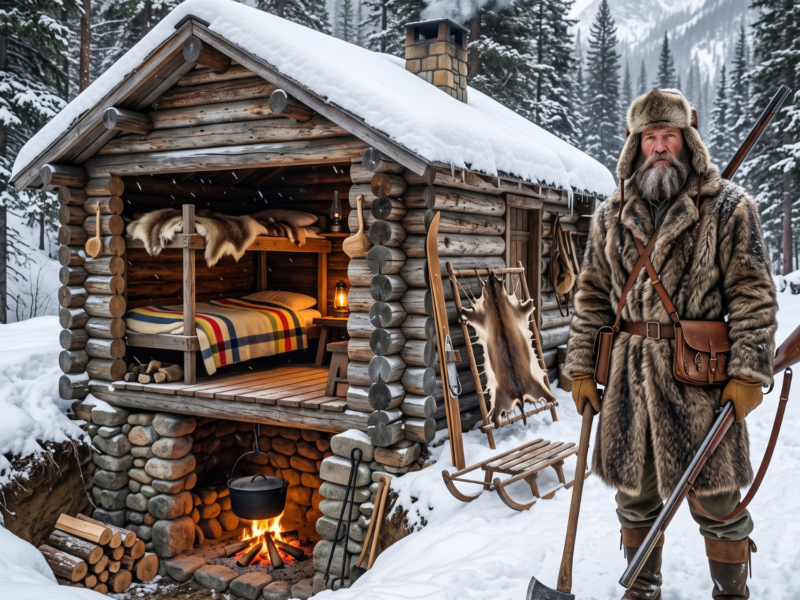
He Built the Cabin Everyone Hated — It Survived the Harshest Winter on Record
The White Death
October 24-25, 1879
It was ten degrees Fahrenheit when the snow began—not a gentle flurry, but a dense, horizontal wall of wet white driven by a shrieking north wind. By noon, six inches had fallen. By dusk, a foot.
Then the temperature fell off a cliff.
Minus twenty. Minus thirty. Minus forty.
The wind screamed across the flatlands at seventy miles an hour, a relentless physical force that battered John Patterson’s cabin. Inside, the conventional wisdom of the frontier was failing catastrophically. The wind found every minuscule gap in Patterson’s chinking. The heat from his roaring fireplace was sucked up the chimney and dragged through the log walls. He burned a week’s worth of wood in a single afternoon, and still, his breath plumed white in his own bedroom.
By the second day, Patterson was losing the war.
His woodpile was nearly gone. The cabin was a freezing tomb. His wife, Mary, was curled under four wool blankets, shivering violently, her lips tinged blue, her eyes glassy and confused.
Patterson looked at his dying fire, panic seizing his chest in an icy grip. If they stayed, they would die. The cabin had failed them.
“Mary, get up,” Patterson urged, his voice trembling. “We have to go to Henrik’s.”
“It’s too cold, John,” she mumbled, barely coherent.
“It’s half a mile. We can make it.” He forced her up, wrapping her in every coat, scarf, and blanket they owned. He tied a length of hemp rope around his waist and secured the other end to hers. If they lost each other in the whiteout, they were dead.
They pushed the door open, and the wind hit them like a freight train.
The cold was so absolute, so vicious, that it burned the lungs with every breath. The snow was waist-deep, a shifting, blinding ocean of white. Patterson put his head down and forged ahead, dragging his wife through the drifts, navigating purely by instinct and memory.
Ten minutes should have covered the distance. After an hour, Patterson couldn’t feel his feet. He couldn’t feel his face. They got turned around in a blinding squall, wandering in a tight circle before Patterson found a familiar rock outcropping. Mary collapsed twice, the rope pulling taut, and Patterson had to haul her back to her feet, screaming over the roar of the wind.
When they finally saw the dark lump in the hillside—the ugly, misshapen roof of Henrik Larson’s molehole—Patterson fell to his knees in the snow, weeping tears that instantly froze on his cheeks.
He dragged himself to the low entrance tunnel and pounded his numb, wooden fists against the heavy timber door.
It swung open instantly. Henrik stood there, lantern in hand. He had been waiting.









