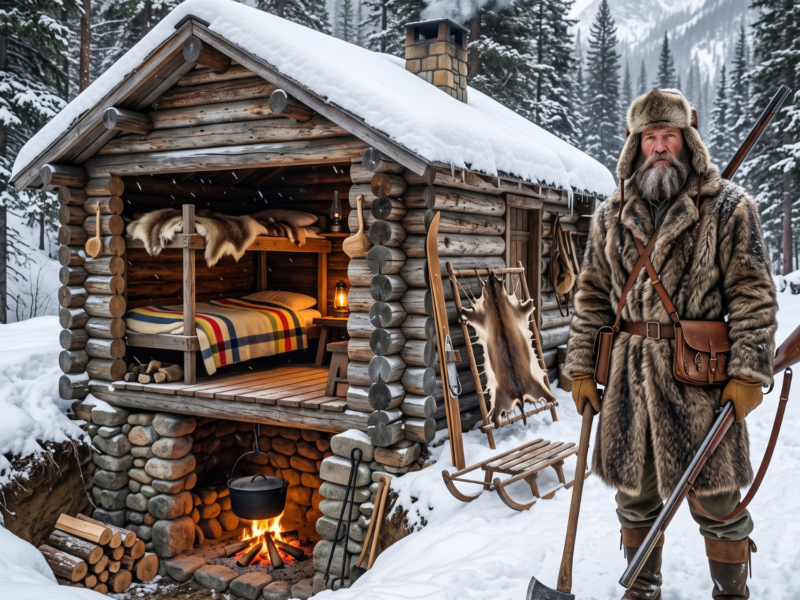
He Built the Cabin Everyone Hated — It Survived the Harshest Winter on Record
The Great Die-Up
Winter, 1886-1887
The storm of ’79 was a warning, but the winter of 1886 was an apocalypse.
History would remember it as the Great Die-Up. It was the winter that broke the open-range cattle industry, freezing hundreds of thousands of steers where they stood. The snow was deeper, the cold more profound, and the duration agonizingly long. Across the Montana territory, families who had survived ’79 by the skin of their teeth, but refused to change their ways, paid the ultimate price in ’86.
But Henrik Larson was ready.
By then, he had married a Norwegian woman named Ingred, who had taken one look at his earth-sheltered home and wept because it felt like the fjords she had left behind. They had expanded the molehole, digging further into the hill, adding a second tile stove for summer cooking and an attached greenhouse on the southern face.
Once again, the prairie froze. Once again, conventional cabins failed. And once again, Henrik’s door opened to the desperate, the freezing, and the humbled. He had two years of food stored in his root cellars. His greenhouse provided fresh greens even as blizzards raged outside.
He was no longer the odd Swedish fellow with the ugly cabin. He was the master of the winter.
EPILOGUE: Legacy of the Stones
Decades Later
John Patterson never went back to his old cabin. The spring after the storm of ’79, he tore it down. With Henrik’s patient guidance, Patterson dug into his own hillside, built double walls, and spent a month hauling stones to build his own tile stove. His new cabin was just as ugly as Henrik’s, and Patterson couldn’t have been prouder of it.
The knowledge spread. Families across the region adopted the earth-sheltered designs, the airlock tunnels, and the high-mass tile stoves. Agricultural extension agents came to document the thermodynamics of the structures. Academics wrote papers on the staggering efficiency of capturing heat in stone rather than letting it bleed through thin pine.
Henrik Larson lived in his cabin until his death in 1928, at the age of eighty-seven. He died warm, safe, and deeply respected.
The cabin stood for decades more, eventually passing out of use in 1949 as modern infrastructure arrived. But in 1998, a replica was built near the original site by the Montana Historical Society. Modern building scientists flocked to it, hooking up sensors and thermal cameras. They found that Henrik’s intuitive, traditional design achieved an insulation value of R-45—nearly double the efficiency of modern standard construction. The replica stayed cool in the blazing Montana summers and held seventy degrees in the bitterest winter colds with minimal firing.
The story of Henrik’s cabin is a testament to the fatal danger of arrogance and the profound value of inherited wisdom. The settlers mocked what they did not understand, assuming that their limited, comfortable experiences represented the totality of the world. Henrik knew that nature is a ruthless editor of bad ideas. He didn’t build for convenience, and he didn’t build for aesthetics. He built for the extreme. He built for survival.
He knew that the earth, if respected and understood, is not just dirt and rock. It is a blanket. It is a shield.
And when the wind howls and the temperature drops to the point where iron shatters and breath turns to ice, it is only the deep, quiet embrace of the earth that can keep a fragile human flame from blowing out.









