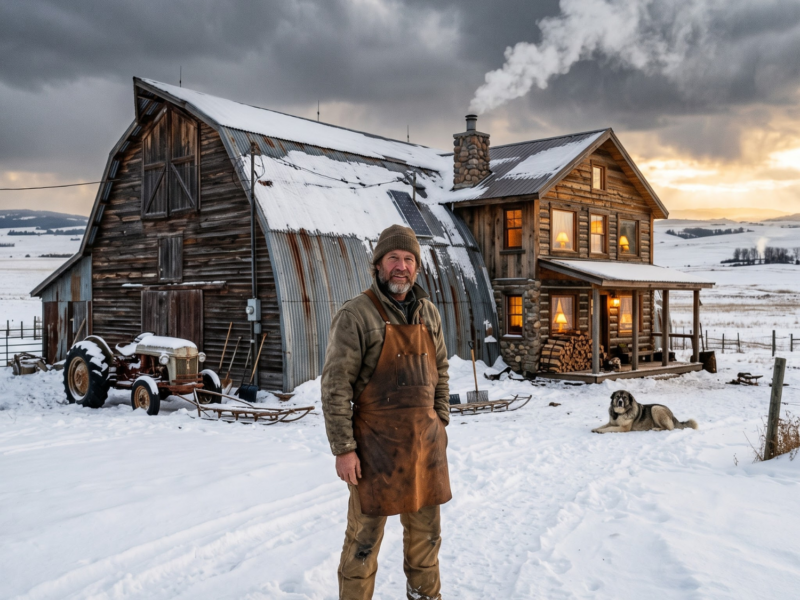
He Joined His Cabin, Barn, and Workshop Under One Roof — One Fire Heated All Three
The Winter of Three Failures
To understand the impossible metal arch, you had to understand the nightmare that birthed it.
Two years earlier, Ansel Brandt had been a fundamentally different man.
December 1890 had arrived with a sudden, screaming fury that even the most grizzled, scarred old-timers in the territory called “unprecedented.”
At that time, three very separate, very traditional structures sat on Ansel’s property. A modest, square timber cabin for his family. A drafty wooden barn for the livestock. And a separate, poorly insulated blacksmith workshop that earned the crucial cash when the farming yields could not.
Three buildings. Three massive heating demands. Three constant, agonizing failures.
The barn surrendered first.
The wind tore through the gaps in the warping pine boards. Ansel went out on the morning of December 14th and found two of his youngest, strongest calves dead, frozen solid to the dirt floor. Their metal water trough was a solid block of impenetrable ice.
The workshop froze next. The temperature dropped so low in the unheated building overnight that his heavy wooden quenching barrel—filled with water for cooling hot iron—froze completely through, cracking the thick oak staves with a sound like a gunshot and ruining the barrel.
By Christmas week, even the cabin was losing the brutal war of attrition.
The wind stripped the heat from the wooden walls faster than the small iron stove could possibly generate it. His wife, Margaret, slept shivering under the covers in every single piece of woolen clothing she owned. Their two young children, Franz and Elise, entirely stopped leaving their beds except to quickly eat their meals, huddled together for warmth.
And Ansel ran.
He ran back and forth across the freezing, snow-swept yard all day, every single day. He would violently feed the cabin stove with wood. Then he would run frantically through the drifts to the barn to chop ice and try to warm the surviving animals. Then he would run to the workshop to check the tools, and then he would sprint desperately back to the cabin before the fire died down and the family froze.
Three roaring fires, constantly consuming three rapidly shrinking woodpiles, while three separate, flawed structures bled their life-saving heat directly into the dark, freezing void of the Nebraska sky.
He collapsed on January 3rd, 1891.
It was not directly from the biting cold, but from sheer, physical exhaustion. Margaret found him lying face down in the snowpack halfway between the cabin and the barn, completely unconscious. His arms were still locked fiercely around an armful of firewood he had been carrying to a desperate, fourth feeding of the barn stove that day.
She managed to drag him inside by his coat collar and revive him by the stove.
“I cannot do this, Margaret,” Ansel told her that night. He was lying in their bed, staring blankly at the frost-covered wooden ceiling while the iron stove hungrily devoured another twenty pounds of precious, split wood.
“I know,” she whispered, holding his cold hand.
“Three buildings,” Ansel muttered, his voice hollow. “Three fires. Three failures. I am only one man. I cannot physically be in three places at once to keep the fires lit.”
He lay silent for a long time, listening to the shrieking wind actively tearing at the cabin walls, knowing with absolute, sickening certainty that the exact same wind was tearing at his barn, and at his workshop. Three separate, desperate battles being lost simultaneously.
“What if…” Ansel started, his voice suddenly changing pitch. “What if there were no corners?”
Margaret frowned in the dark. “What do you mean?”
“What if there was only one building?” Ansel sat up slightly, the exhaustion suddenly replaced by a manic, desperate energy. “One building. One fire. One single place to be.”
“Ansel, you cannot put horses in a cabin,” Margaret reasoned gently. “You cannot put a dirty, sparking forge next to sleeping children. The smoke. The smell.”
“Why not?”
She laughed softly, thinking it was the delirium of exhaustion speaking. But he was absolutely not joking.
His mind, forged in the intense, practical heat of his profession, was rapidly assembling disparate pieces of knowledge that had always existed separately in his memory.
He remembered the vast, curved metal roofs of the grand hay barns he had seen back in rural Germany as a boy. He remembered reading about ancient longhouses where entire tribes and their crucial animals shared the same ambient warmth to survive the ice. And, most importantly, he remembered the brilliant, efficient heat distribution in the long, rectangular, cavernous industrial forges of Düsseldorf, where he had apprenticed as a young man.
“One long building,” Ansel said slowly, visualizing it in the dark air above the bed. “A massive, curved metal roof. No interior walls bearing any structural weight. The living cabin is dead in the center, where the heat is greatest.”
He began gesturing with his hands. “The barn is at the east end, where the ambient animal heat actively supplements the system. The forge is at the west end, where the massive waste heat from the fire flows inward to the house, instead of escaping out a window. One single, massive fire at the center. The heat rises into the curve, spreads smoothly in both directions, reaches both ends to warm the animals and the tools, before cooling just enough to settle back down the walls.”
“Ansel, that is insane,” Margaret said, sitting up now, staring at him.
“No,” Ansel said firmly, his eyes blazing in the dark. “That is survival. I will not spend another winter running between three freezing buildings while all three fail. I will not.”
He did not abandon his claim and flee back East. He did not die in the snow between structures that could not keep his family alive.
He spent the entire rest of that brutal winter drawing, scheming, and calculating. By the time the spring thaw finally turned the prairie to mud, he knew exactly, mathematically, what he was going to build.









