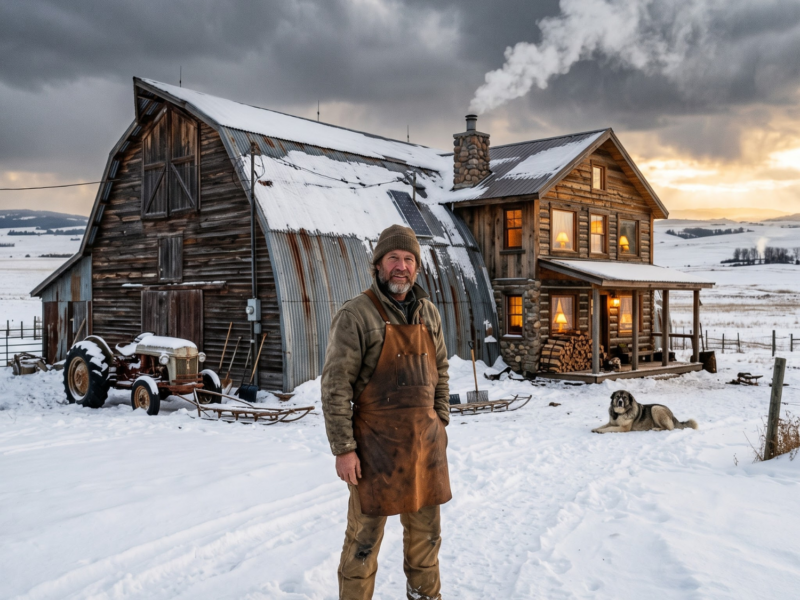
He Joined His Cabin, Barn, and Workshop Under One Roof — One Fire Heated All Three
The Iron Leviathan
The heavy, corrugated iron sheets arrived in May on three groaning freight wagons from the railhead in Grand Island.
There were forty-seven massive sheets of industrial iron in total. Each one was twelve feet long and thirty inches wide, specifically, expensively curved to Ansel’s exact mathematical specifications by a large industrial manufacturing firm in Chicago.
The staggering cost of the custom metal had completely consumed every single dollar Ansel had painstakingly saved from two years of brutal forge work, plus a substantial, humiliating loan from Margaret’s brother back East—a loan that carried the heavy, unspoken weight of family obligation and the expectation of failure.
The skeptical neighbors arrived in their wagons before the freight drivers had even finished unloading the metal.
Hinrich Vogler, a successful, traditional wheat farmer, stood at the edge of the property, his hands on his hips, watching the massive iron sheets stack up in the sun like the giant, silver scales of a dead dragon.
“You’re building a bridge, Brandt?” Vogler called out, laughing. “A water tank? What is this?”
“A home,” Ansel replied, not stopping his work of unloading.
“That’s industrial barn roofing,” Vogler scoffed. “You already have a barn.”
“I’m replacing everything,” Ansel said, wiping sweat from his forehead. “One structure. One roof.”
Vogler laughed louder. “Metal conducts heat, Brandt! Every child knows that. It conducts it in every direction. You’ll literally cook like a roast in the summer sun, and you’ll freeze to death instantly in the winter when the wind hits it. You might as well try to live inside a giant cast-iron cookpot!”
Ansel did not argue. Arguments cost precious time, and he had none to spare. The massive structure absolutely had to be entirely complete and sealed before the first hard frost of autumn, or the entire, expensive gamble was lost, and his family would be homeless.
He had spent the entire month of April painstakingly preparing the foundation. He had leveled eighty feet of compacted, hard-packed earth with obsessive, surveyor-level precision.
The base timber anchors went down first. They were massive, heavy oak beams, scavenged and salvaged from a collapsed, abandoned barn miles away. He laid them in two perfectly parallel, eighty-foot lines, exactly eighteen feet apart, pinning them deeply into the earth to aggressively anchor the tension of the curved iron sheets.
The custom bending jig took him two frustrating weeks to construct in the yard.
Each corrugated iron sheet went onto the wooden jig flat. It was clamped securely at both ends, and was slowly, agonizingly bent to the exact, required arc using a complex system of heavy ropes and leverage that required all four family members pulling in perfect, coordinated unison.
Franz, at twelve years old, manned the heavy anchor rope, wrapping it around a post. Elise, at nine, stood back and yelled out when the curve of the metal perfectly matched the wooden template Ansel had carved. Margaret operated the heavy secondary iron clamp, and Ansel pulled the primary tension rope, his massive, blacksmith’s shoulders straining violently against the thick metal that eventually, loudly surrendered to his persistence.
Twelve sheets a day, when everything worked perfectly. Four sheets on the bad days, when the metal fought back or the ropes slipped.
By late June, all forty-seven sheets were perfectly curved and stacked in the yard, gleaming in the sun.
The actual raising of the leviathan began on July 1st.
Ansel hired three burly day laborers from town who happily took his money and asked absolutely no questions about the madness they were constructing. They started at the far east end, where the barn section would eventually house the livestock.
The very first iron sheet went up on a temporary timber frame. Its curve locked beautifully into position against the oak base beams, its upper, fluted edge waiting patiently for the next sheet to overlap and seal the joint.
Each subsequent heavy sheet overlapped its neighbor by exactly six inches. The seams were heavily, meticulously sealed with sticky, waterproof pine tar, and then permanently riveted together with heavy, custom iron fasteners that Ansel had stayed up late forging himself in his shop.
The massive curve grew westward, day by grueling day, sheet by heavy sheet, looking exactly like a towering metal wave frozen in the act of breaking over the prairie.
By July 20th, the outer skeleton was completely finished.
It was eighty feet of curved, corrugated iron, gleaming blindingly in the brutal summer sun. It was completely open at both ends like a massive tunnel, hollow inside, waiting for the complex interior work that would transform it from a bizarre agricultural experiment into something absolutely no one in Nebraska had ever attempted.
A home, a barn, and a workshop. One structure.
Hinrich Vogler rode past on his horse on July 21st and stopped dead in the road to stare at the completed arch.
“You actually built it,” Vogler said, shaking his head in disbelief at the sheer scale of the thing. “The shell.”
“The system inside comes next,” Ansel said, leaning on a shovel.
“The system that will freeze you solid come winter,” Vogler retorted, refusing to yield his skepticism.
Ansel smiled. It was a confident, dangerous smile. “Come back in January, Hinrich. Bring salt. Words taste much better when you eat them with salt.”









