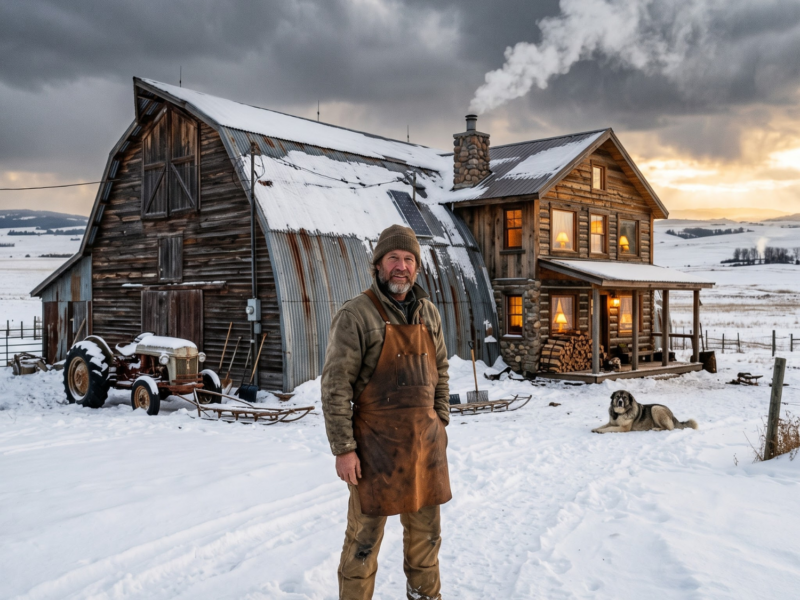
He Joined His Cabin, Barn, and Workshop Under One Roof — One Fire Heated All Three
The First Breath
October brought the first, undeniable answer.
The first hard, killing frost arrived early, on the 17th of October. Temperatures plummeted to 19 degrees overnight, accompanied by a fierce northern wind that battered and rattled the curved iron roof like a snare drum roll.
Ansel woke abruptly at four o’clock in the morning. He did not wake from the biting cold, but from sheer, nervous anticipation. He threw off the quilt and walked barefoot in the dark to the massive masonry heater.
He pressed his bare palm flat against the brickwork. It had been cooling since the previous evening’s burn, over twelve hours ago.
It was still deeply, wonderfully warm.
Fourteen hours after the actual fire had died to ash, the bricks still held a surface temperature of perhaps 90 degrees, radiating a gentle, comforting heat into the dark room.
Ansel smiled. He lit an oil lantern and walked the full, eighty-foot length of the structure in the darkness, physically feeling what his eyes could not see.
The central living section held a steady 58 degrees. It was cool, yes, but perfectly comfortable for sleeping. The air was incredibly still; there were absolutely no freezing drafts cutting across the floorboards.
He passed through the simple doorway in the partition gap and stepped into the barn section. The temperature dropped immediately, perhaps ten degrees, as he moved away from the heater. But it was nowhere near the killing, sub-zero cold that had claimed his calves three winters ago. The air was calm. The cattle stood completely relaxed in their stalls, chewing cud, not huddled together for survival.
The workshop at the far west end was the coldest zone, resting at perhaps 40 degrees. But the massive iron forge sat ready and waiting to completely change that equation the moment he started his workday.
At exactly 6:00 AM, Ansel lit the morning fire in the central heater.
The massive masonry structure accepted the dry kindling with the aggressive, roaring hunger Ansel had learned to recognize—the powerful, rushing draw of a flue system brilliantly designed to pull air through itself as effortlessly as water flowing downhill.
Within an hour, roaring flames licked furiously through the serpentine brick channels. He placed his hand on the exterior and felt the bricks rapidly warming, aggressively absorbing the intense heat that they would slowly, generously release throughout the rest of the day.
By 8:00 AM, the living section reached 64 degrees. By 10:00 AM, it was a balmy 68 degrees.
And something else, something miraculous, was happening.
The barn section was warming up, too. Ansel grabbed a wooden ladder, stood at the open partition gap near the ceiling, and physically felt it.
A steady, powerful current of warm air was flowing directly overhead, riding the smooth curve of the iron ceiling toward the east end, descending gently over the cattle as it cooled, and returning as a cool breeze along the floorboards.
The theoretical circulation pattern he had drawn obsessively on scrap paper for months was absolutely real. It was visible in how the dust motes drifted lazily through the morning light shafts. It was tangible in the exact temperature gradients he felt, perfectly matching where his mathematical calculations predicted they would be.
Hinrich Vogler appeared in the yard at midday. He arrived ostensibly to return a borrowed iron tool, but it was incredibly obvious he had come primarily to witness Ansel’s catastrophic failure in the first frost.
Ansel opened the door and invited him inside without a word of comment.
Vogler stepped into the living section and stopped dead. He said nothing. He slowly removed his heavy winter coat, sweating slightly. Then, he removed his hat.
He walked directly to the barn partition, stuck his head entirely through the gap, and stood there, feeling the air temperatures on both sides.
“The animals are warm,” Vogler said, his voice quiet with disbelief.
“Forty-seven degrees in there this morning, and rising,” Ansel replied, leaning against the warm brick heater.
“And you’ve burned exactly how much wood to achieve this?” Vogler asked suspiciously.
“Twenty-two pounds since six o’clock this morning,” Ansel said. “One fire. The bricks are still releasing yesterday evening’s heat.”
Vogler walked the full eighty-foot length of the structure, his bare hands touching the walls, the floor, the ceiling, looking for hidden stoves or tricks. He ended his inspection back at the masonry heater. He stood with his broad back to it, letting the intense, radiant warmth soak deeply into his tense shoulders.
“I said you would freeze to death in this tin can in the winter,” Vogler admitted, staring at the floor.
“You said that,” Ansel agreed neutrally.
“I was completely wrong.” Vogler paused, struggling with his pride. “But… I will be back in January, Brandt. When the real blizzards hit. If this thing still works then… then I will gladly eat my words in front of the whole town.”
“Bring salt,” Ansel grinned, offering his hand.
Vogler retrieved his heavy coat, but he did not put it on. He carried it draped over his arm as he walked out the door into the freezing wind, the exact way a man carries a coat in the warm springtime.
October was not January. But October was aggressively promising something that January would have to undeniably confirm.









