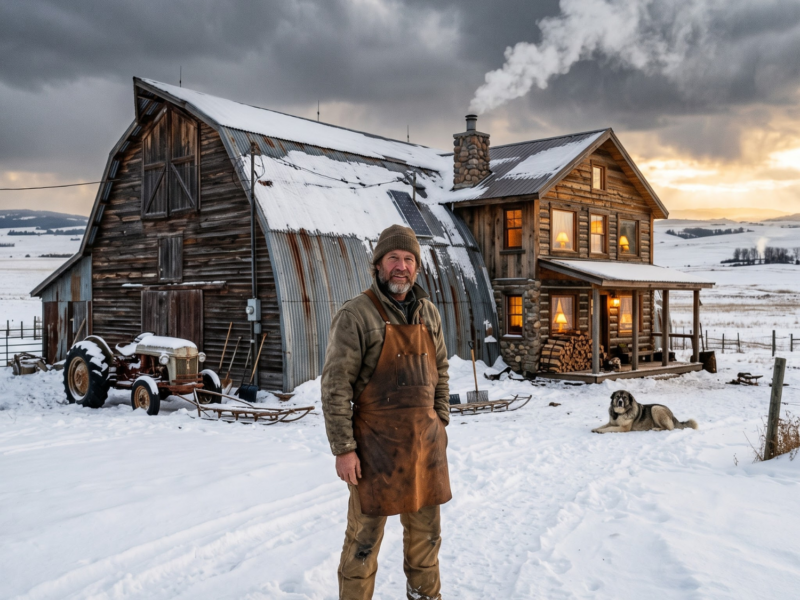
He Joined His Cabin, Barn, and Workshop Under One Roof — One Fire Heated All Three
The Pilgrimage
They started arriving in early February.
It was not an organized tour. It was just desperate men who had heard wild rumors at the mercantile, from men who had heard rumors from the blacksmith, following impossible claims across the frozen prairie until they stood at Ansel Brandt’s strange door with frost in their beards and sheer desperation in their eyes.
The very first was a massive Bohemian farmer named Vaclav Horacek, who had ridden forty miles on horseback through a blinding blizzard just to see it.
He did not knock immediately. He simply stood outside in the howling wind with his bare hand pressed flat against the curved metal wall, feeling for the impossible heat he had been told existed within.
“It is warm,” Horacek muttered to himself in disbelief as Ansel opened the door. “The metal outside is freezing cold. But the air inside is warm. The metal just isn’t stealing it as fast as you expect.”
Horacek stayed for three days. He slept peacefully in the barn section among cattle that did not shiver, asking Ansel complex architectural questions until the German’s voice grew hoarse. When Horacek finally left to ride the forty miles back, he carried highly detailed, hand-drawn copies of Ansel’s original sketches rolled tightly in waterproof oilcloth against his chest.
The second visitor was a tragic figure. It was a Swedish widow named Ingrid Lindqvist, who had lost her husband and her two young children to the horrific “Schoolhouse Blizzard” of 1888. She had survived only because she happened to be trapped in town buying supplies that day, while her family froze to death in a drafty cabin that simply could not hold its heat against the wind.
She did not want to build a new house. She only wanted to see it with her own eyes.
Ansel walked her through the eighty-foot structure in absolute silence. She touched the warm brick walls of the heater. She felt the still, comfortable air. She watched Franz and Elise playing happily on the floor where winter was merely a rumor outside the door.
She stayed for an hour, said absolutely nothing, and left with hot tears freezing instantly on her weathered face.
“Why did she come all this way in the cold?” Margaret asked softly, watching the widow’s wagon pull away.
“To know it was physically possible,” Ansel said, his voice heavy with sorrow. “To know that her family did not have to die. That someone, eventually, found an answer to the terrible question that killed them.”
By March, seventeen different visitors had made the pilgrimage to the curved house.
Some desperately wanted the plans. Some wanted to hire Ansel for consultations. Some wanted only to witness the miracle for themselves. Ansel turned absolutely no one away. The plans he gave freely, staying up late drawing copies by lamplight. The consultations he offered to anyone willing to listen.
But he warned them: the massive structure could not be easily or cheaply replicated by a poor farmer.
The curved iron sheets required highly specialized industrial bending in Chicago. The massive masonry heater required expensive firebrick and specific expertise to draft correctly. The eighty-foot clear span required heavy anchor timber and capital that most struggling homesteaders simply did not possess.
“What can be replicated,” Ansel told a young, exhausted German couple holding a newborn baby, “is the principle.”
He sat them down at his table. “You do not need an eighty-foot metal roof,” Ansel explained, drawing on a scrap of paper. “Start with what you have. Your small cabin, and your chicken coop. Move them. Connect them together. Build one, single curved roof over both of them, even if it is small and made of wood and sod. Let the body heat of the birds help heat your home, while your stove heats theirs. The massive scale does not matter. The connection and the airflow matter.”
The young couple left with a crude plan for a thirty-foot connected structure that would cost a quarter of what Ansel had spent. It would not be as perfectly warm, nor as flawlessly efficient as the iron arch, but it would be vastly warmer and vastly more efficient than the separate, freezing boxes they currently had.
By late April, as the mud dried, six modified, connected versions were under active construction across three different counties.
Each one was smaller than the original. Each one was creatively adapted to locally available, cheaper materials. But each one carried the exact same core, architectural truth that had driven Ansel Brandt through his dark winter of desperation:
One structure. One enclosed system. One chance to stop running blindly between freezing failures.
The principle of the breathing house was spreading. And to Ansel, that mattered far more than the building itself.









