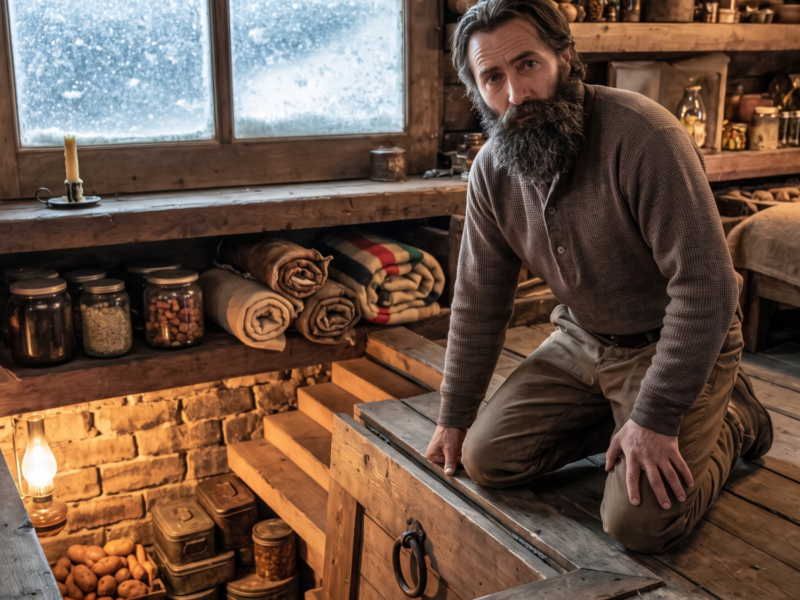
How One Settler’s “Hidden” Winter Room Became the Only Safe Place in the Blizzard of ’47
THE ANATOMY OF THE EARTH
When the ground thawed enough to yield to a shovel in early March, Jacob buried Anna on a hillside overlooking their claim. He marked the grave with heavy river stones, stood over it for an hour as the spring wind tugged at his coat, and then returned to the cabin.
Most widowers in his position would have abandoned the claim. They would have retreated to the civilized east, or moved to a larger settlement to escape the ghosts of the frontier. Jacob stayed. Leaving before he solved the problem of the cold felt like abandoning Anna a second time.
He spent the spring riding to nearby settlements. Ostensibly, he was checking on his neighbors after the brutal winter. In reality, he was a man obsessed. He was studying how humanity interacted with the dirt.
Fifteen miles east, at the Hartman trading post, Jacob spent an entire afternoon inside Otto Hartman’s root cellar. It was dug eight feet into a hillside and lined with fieldstone.
“Take all the measurements you want, Jacob,” Otto said, holding a lantern as Jacob ran his hands over the cool, damp stones. “But what are you looking for?”
“Stability,” Jacob muttered. He noted that the cellar maintained a temperature of approximately fifty degrees. In the dead of winter, it stayed fifty. In the blazing heat of August, it remained fifty. It was passive. It required no fuel.
Thirty miles north, Jacob talked his way into a silver mine. He descended past the twenty-foot mark and felt the bite of the surface air vanish, replaced by a deep, eternal warmth. At a remote homestead, he found Swedish immigrants living in a backstuga—a cabin built half into a hillside, using the earth as a thermal blanket. They had survived the January blizzard burning a fraction of the wood Jacob had used.
Finally, he found an old French trapper named Baptiste, who lived in a hide-covered pit house near a winding creek. The structure was accessed by a ladder through a smoke hole. It was cramped, dark, and smelled of rendered fat, but as Baptiste brewed coffee, Jacob realized he was sweating.
“I burn less wood in a winter than you Americans burn in a month,” the old trapper chuckled, revealing toothless gums.
Jacob returned to his cabin in late April, his leather journal thick with charcoal sketches, dimensions, and thermal theories.
For two weeks, he sat at his table, drafting the blueprint of his salvation. It would not be a crude pit. It had to be a genuine refuge. He calculated the dimensions: ten feet deep, twelve feet wide, fourteen feet long. Large enough for multiple people, small enough for one man to excavate.
The walls could not be dirt—they would crumble. They had to be brick. The ceiling would be heavy timber beams supporting the cabin floor above. The entrance would be a concealed, insulated hatch. Ventilation would be achieved through a disguised double-flue chimney. Heat would come from a small iron stove.
In early May, Jacob rode to Otto Hartman’s trading post and slid a piece of paper across the wooden counter.
Otto adjusted his spectacles and read the list. “Four hundred bricks. Eighty pounds of mortar. Twenty linear feet of iron stove pipe. One small heating stove. Forty square feet of corkboard. Iron brackets… Jacob, what in God’s name are you building?”
Jacob explained. He spoke of earth insulation, of passive thermal dynamics, of the failure of the surface cabin.
Otto listened in absolute silence. He was a businessman, but he knew the frontier. “The bricks have to come from a kiln forty miles south,” Otto said slowly. “The cork has to come from St. Louis. It will take most of your savings, Jacob. And it will take six weeks to arrive.”
“Order it,” Jacob said.
Otto nodded, writing out the freight manifest. As Jacob turned to leave, Otto spoke softly. “People are going to think you are crazy, Jacob.”
Jacob pulled his hat down low over his eyes. “I know.”









