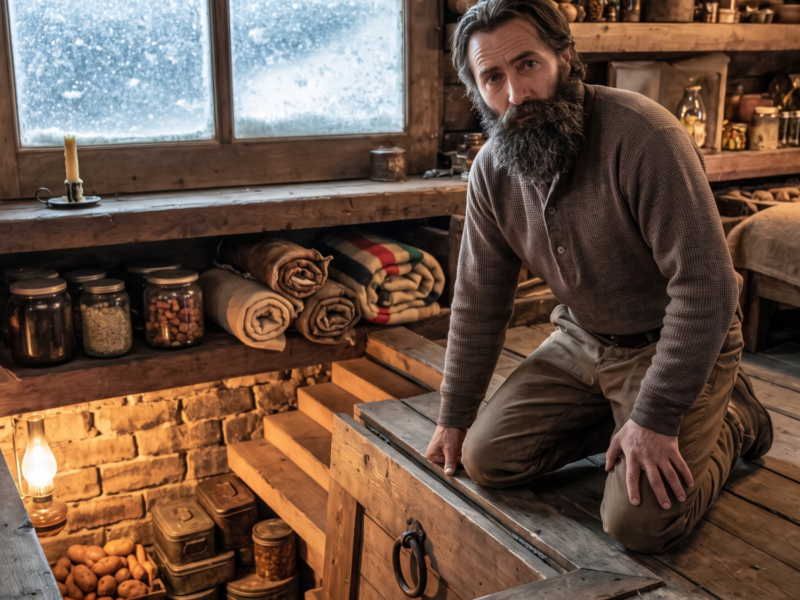
How One Settler’s “Hidden” Winter Room Became the Only Safe Place in the Blizzard of ’47
THE AFTERMATH
On the morning of November 28th, the wind finally died.
Jacob unbarred the hatch and pushed the cabin door open. The survivors emerged, one by one, into a blinding, alien landscape. Snow had drifted to depths of eight feet, burying fences, wagons, and outbuildings. The temperature was still bitterly cold, but the lethal fury of the storm had passed.
The reality of the frontier was waiting for them.
Over the next week, the grim tally was taken. Five families who had remained in their conventional surface cabins did not survive. Their bodies were found huddled near dead, ash-filled hearths. Twelve cabins required complete reconstruction, their roofs caved in or their chinking entirely blown away.
The settlement was scarred, traumatized, and forever changed. But a profound shift had occurred in the collective consciousness of the valley.
The conversation about how to build didn’t happen in a town hall. It happened quietly, organically.
In April, as the spring thaw turned the ground to mud, Ernst Vogle knocked on Jacob’s door. Ernst had survived the storm, but only by burning his own furniture and tearing up his floorboards to feed the fire.
He took off his hat, looking at the dirt in front of Jacob’s porch. “Jacob,” Ernst said humbly. “Will you show me how to dig the hole? Will you show me how to lay the brick?”
Jacob didn’t gloat. He simply nodded, put on his coat, and walked to Ernst’s homestead. For two days, he marked out the dimensions, explained the necessity of the cork seal, and diagrammed the double-flue chimney.
By May, Ernst was digging.
He was not alone. Over the next two years, eleven more families in the valley excavated the earth beneath their homes. Some built smaller chambers. New settlers arriving from the east incorporated the underground refuge into their blueprints before they even cut the first log for their surface cabins.
Otto Hartman’s trading post transformed. He kept massive pallets of red brick, bags of mortar, and sheets of St. Louis corkboard in permanent stock.
Friedrich Klene, the German mason, passed through the territory again in 1849. When he saw what his two weeks of teaching had spawned, he delayed his trip to Oregon for a month, traveling from homestead to homestead, teaching the settlers the proper way to mix mortar and plumb a wall.
The knowledge could not be contained. Travelers passing through the Hartman post carried stories of the “Wyoming Cellars” to other territories. By 1852, identical brick-lined, ventilated underground rooms began appearing beneath cabins in Montana and the brutal, wind-swept plains of Idaho.
The exact number of lives saved by Jacob’s design over the following decades was never officially recorded by historians. But frontier diaries from the 1850s to the 1880s are littered with accounts of families retreating beneath their floorboards when the “white death” came howling across the plains, surviving on a handful of firewood while the world above froze solid.
EPILOGUE: THE STONE REMEMBERS
Jacob Werner never patented his design. He never wrote a book, never sought recognition from the territorial governor, and never asked for a penny when he rode out to help a neighbor align their brickwork.
In 1851, he met a widow named Elizabeth whose wagon train had been decimated by cholera. They married in the spring. They had three children, whose laughter filled the surface cabin, and who used the underground room to play hide-and-seek during the mild summer months.
Jacob lived a quiet, unremarkable life to the outside observer. He farmed his land, tended his cattle, and loved his new family fiercely. He died in September of 1873 at the age of sixty-two.
They buried him beside Anna on the hillside overlooking the claim.
As the decades passed and the frontier period drew to a close, the era of the isolated log cabin ended. The railroad brought coal, modern insulation, and standardized housing. Jacob’s children grew up and moved to growing cities in the east. The old Werner cabin was abandoned.
Over fifty years, the elements took their toll. The wooden shingle roof collapsed. The log walls rotted, turning soft and gray, eventually melting back into the earth from which they were cut. The surface world erased the cabin completely.
But beneath the rotting floorboards, if one were to pry away the debris and lift the heavy, iron-hinged hatch, they would find something miraculous.
The brick walls stood perfectly plumb. The iron stove sat waiting in the corner. The air was cool, dry, and eternally fifty degrees. The sanctuary remained structurally flawless, a testament to a man who had looked at the overwhelming, lethal force of nature and decided that humanity did not have to simply accept defeat.
It was a monument built of grief, forged in dirt, and sealed with love. And long after the names of those who mocked it were forgotten, the earth remembered.









