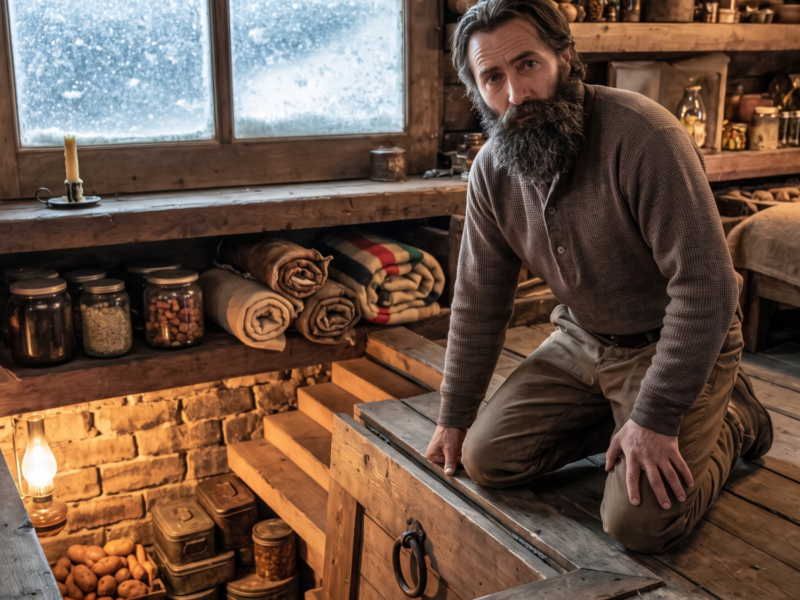
How One Settler’s “Hidden” Winter Room Became the Only Safe Place in the Blizzard of ’47
THE WHITE LEVIATHAN
The true test arrived not with a whisper, but with a roar.
November 23, 1847.
The first two snows of the season had been gentle, manageable dustings. But on the afternoon of the 23rd, the sky turned the color of a bruised plum.
Jacob was outside splitting firewood when the atmosphere seemed to suck the air from his lungs. The temperature plummeted twelve degrees in less than two hours. The wind, which had been a gentle breeze, suddenly accelerated into a sustained, shrieking gale. The snow didn’t fall; it drove sideways like millions of white needles.
Jacob gathered his wood and bolted for the cabin.
By nightfall, the temperature was ten below zero. By midnight, it had dropped to twenty below. The wind was a physical entity, slamming against the log walls with the force of a battering ram.
Inside the cabin, Jacob built a roaring fire in the hearth. It didn’t matter. The wind found every microscopic flaw in the mud chinking. It infiltrated the cabin, slicing through the room like an invisible blade. Jacob could see his own breath pluming in white clouds mere feet from the blazing fire.
The cabin was failing. It was failing exactly as it had ten months ago.
At dawn, with the storm showing no signs of abating and snow drifting four feet high against the north wall, Jacob made his move.
He rolled back the rug. He lifted the heavy iron ring of the hatch.
Instantly, a wave of ambient, fifty-degree air rose from the darkness below, washing over his frozen face. It felt like a summer breeze.
Jacob descended the wooden stairs, securing the locking bar on the hatch behind him. He stood in the center of the brick chamber. It was completely silent. The howling, apocalyptic fury of the blizzard above was reduced to a faint, distant vibration.
He opened the flue of the small iron stove and lit a handful of kindling, adding a single, small log of split oak.
Within an hour, the temperature in the underground sanctuary climbed to sixty-five degrees. The cork seal held perfectly, trapping the heat. The brick walls absorbed the warmth and radiated it back into the room. The disguised ventilation shaft drew in fresh oxygen without creating the slightest draft.
Jacob sat at his small table, poured himself a cup of water, and took off his heavy wool coat. He was sitting in his shirtsleeves while the world above froze to death.
The design had worked. It was a triumph of engineering, observation, and sheer will. But as Jacob sat in the warm silence, a profound loneliness washed over him. He had built it for Anna, but Anna was gone. Whether anyone else would ever recognize its value remained to be seen.









