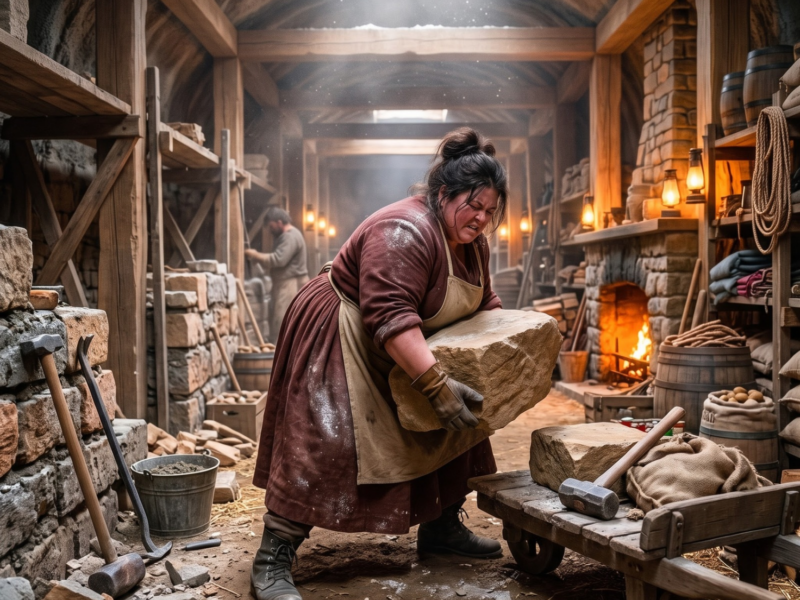
Neighbors Laughed at the Fat Widow’s Stone Hut — Until the Blizzard Couldn’t Break It
The Warmth That Remains
When the blizzard finally broke at midday, the sun burst across the valley in a blinding, triumphant glare of white and gold.
The old wooden cabin across the yard was entirely gone—its roof snapped like a toothpick, its walls collapsed inward under the crushing weight of the drifts. But the stone house stood untouched, proud and unyielding against the ridge, holding fifteen human beings safely inside its warm embrace.
The neighbors emerged one by one into the blinding sunlight.
Prudence Halloway walked slowly out onto the snow on her daughter’s arm. Stopping before Hattie, she did not hesitate or speak empty words. She sank straight down to her knees in the pristine snow.
“Prudence, get up,” Hattie said gently, reaching down with her large hands to pull the banker’s wife to her feet.
“I was wrong,” Prudence whispered, her voice cracking. “I was wrong at every tea. I was wrong about your walls. I was wrong about you. God help me, Hattie… I was wrong.”
Hattie looked deep into Prudence’s tear-filled eyes. She didn’t gloat. She didn’t lecture. She simply placed her forehead gently against Prudence’s forehead—two women, one large and steady, one broken and healing, sharing the silent weight of survival.
“Nobody deserves what winter does, Prudence,” Hattie said softly. “And nobody deserves to be turned away from a warm door. Not even the ones who tried to keep me from mine.”
Epilogue: Fifty Years Later
Fifty years later, Sage Hollow had paved roads, telephone wires, and a modern two-room schoolhouse. More than half the buildings in the valley were now constructed of solid stone.
At the base of the ridge, the original stone house still stood, preserved by the town as a living monument.
Silas Wickham was fifty-eight years old now, his temples dusted with gray. His mother had passed away peacefully in 1908 at the age of sixty-nine, her strong heart finally resting after a monumental life.
On a bright March afternoon, Silas walked up the familiar path holding the small hand of his six-year-old granddaughter, little Hattie. He unlocked the heavy wooden door and stepped inside. The room was cool, but not freezing.
The stone remembered. The stone always remembered.
He led the little girl to the wall beside the firebox and guided her small palm flat against the native rock.
“Papa, it’s warm,” she gasped, looking up. “Is there a fire?”
“No, sweetheart. There hasn’t been a fire in this room since April.”
“How can it be warm?”
Silas smiled, pulling her up onto his lap as he sat on the old wooden floor. “Because your great-grandmother built it that way. She built it so that once a stone absorbed the warmth, it took a lifetime to forget.”
“Tell me the story,” the little girl begged, snuggling close.
“Well,” Silas began, his voice deep and rich with affection as he looked toward the hearth. “There was a woman named Hattie Wickham. She was tall, she was heavy, and for a whole year, the town laughed at her…”
“Why?”
“Because they were afraid of a woman who didn’t fit the shape they had drawn for her.”
“And what happened?”
“A great storm came. And her hands—the ones they had laughed at—lifted a dying boy out of the cold. And her house—the one they had mocked—opened its doors and kept fifteen neighbors warm through the worst night the valley had ever seen.”
The little girl pressed her palm harder against the comforting stone. “Did they stop laughing, Papa?”
“Oh, yes, baby,” Silas whispered, looking out the south window toward the sunlit valley where generations of stone homes stood strong and secure. “They stopped laughing. Because they finally learned what a real home looks like.”
He pointed to a small, carefully chiseled line of lettering carved into the stone near the fireplace—carved decades ago by a repentant woman with careful hands and a grateful heart:
A heart is not measured by a scale, and a woman is not made by what our eyes see. Hattie Wickham taught me both. — Prudence Halloway
Little Hattie touched the engraved letters with her fingertips. “Papa?”
“Yes, my girl?”
“When I grow up… if somebody laughs at someone for being different… what should I do?”
Silas looked down at his granddaughter, then out at the eternal stone ridge rising behind them, and smiled.
“You do what your great-grandmother did,” he said softly, tightening his arm around her. “You build a warm place, and you open the door.”









