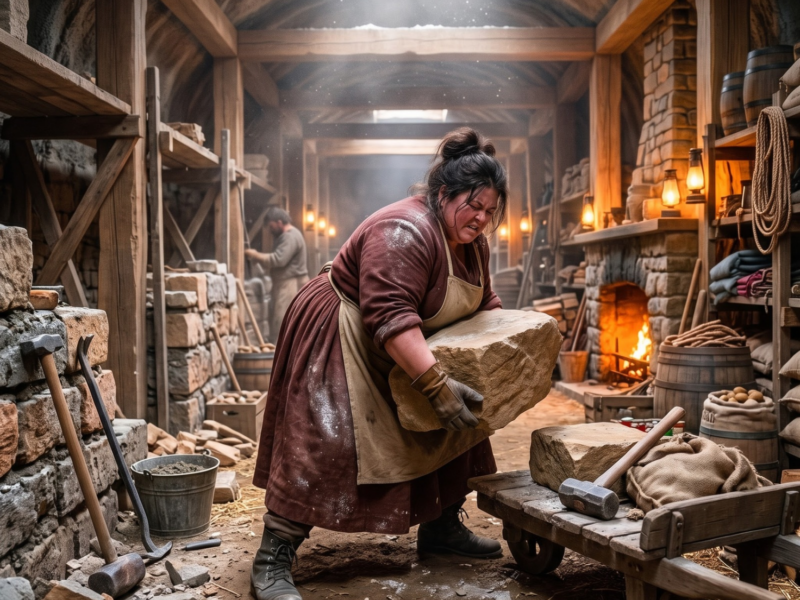
Neighbors Laughed at the Fat Widow’s Stone Hut — Until the Blizzard Couldn’t Break It
The Parlor Decree
Bo Coulter didn’t dare laugh at Hattie to her face anymore. Instead, he laughed for everyone else.
By Wednesday of the next week, the local myth had grown legs. The widow is building a cave, they said. The widow is making a tomb. The widow is trying to bury herself in stone before God gets the chance.
Bo told the story best of all down at the mercantile, using grand hand gestures and winks while Perkins, the aging shopkeeper, counted out coffee and sugar. And every time Bo reached the part where Hattie had declared, “So is this,” he raised his eyebrows and let the room fill in the joke.
The joke didn’t stay at the mercantile. It drifted next door to the parlor of the local boarding house, where the respectable women of Sage Hollow took their weekly tea on Thursdays.
Prudence Halloway sat regally at the head of the table. At forty-one, she possessed a long neck, a pursed mouth, and hair the exact color of an autumn fox. Her husband owned the only bank between Sage Hollow and Cheyenne, rendering her social opinions absolute law. She had never forgiven the funeral. She had never forgotten being overheard, and she certainly hadn’t forgiven Hattie Wickham for refusing to break under her quiet cruelty.
Prudence sipped her tea, set her porcelain cup down with a sharp clink, and surveyed the six women seated around her. “Ladies,” she began, her voice dropping to a conspiratorial hum, “I have been thinking.”
A polite murmur rippled through the table.
“I think,” Prudence continued, leaning forward, “that we have been far too kind.”
Mrs. Fenton blinked. “Kind?”
“Kind by omission,” Prudence clarified. “By letting our children play with her children as if nothing were amiss. Well, Delphine will no longer be playing with the Wickham boy.”
Dead silence fell over the parlor. Prudence picked up her cup again. “And I hope none of your children will, either.”
“But—” Mrs. Fenton started.
“It is not just the stones,” Prudence interrupted coldly. “The stones are foolish; they will fall of their own weight. That is God’s business. It is the example. A woman without a husband, of that unnatural size, trying to defy nature with her own bare hands. What are we teaching our daughters if we let that stand?”
The women looked down at their laps, one by one. They nodded. They nodded because Prudence Halloway’s husband held their mortgages; because her church committee dictated community standing; because Prudence possessed a memory like a ledger and a tongue like a mousetrap.
That night, fourteen-year-old Delphine Halloway sat on the edge of her bed as her mother brushed her hair. Fifty strokes every night—that was the strict rule.
“Mama,” Delphine whispered, “why can’t I play with Silas Wickham anymore?”
Prudence laid down the silver-backed brush with a heavy thud. “Because his mother is a public disgrace, Delphine.”
“But he’s nice. He gave me a biscuit last summer at the picnic.”
“You will not accept biscuits from her—or anything else—ever again.”
Silas, meanwhile, walked to school the following Monday to find that no one would sit with him at the long wooden bench. No one traded apple slices. No one spoke to him during recess. Betsy Fenton, who had shared his double desk since the first grade, silently moved her lunch slate to the far corner of the room, her lower lip trembling violently when he caught her eye.
Silas walked home that afternoon with his coat buttoned crooked and his eyes burning hot. Addie held his hand for the final mile, sensing his misery. When they reached the cabin, Hattie was outside mixing mortar in the yard, and Barrow was tracking a rabbit across the frosted meadow.
Silas walked straight past his mother without a word and went inside.
Hattie set down her trowel. She didn’t follow him immediately; she waited, knowing the bitter truth: when a town decides to hate a mother, they always find a way to break her son first. That was where they cut. That was where it bled fastest.
Ten minutes later, Silas came back outside. His eyes were red, but his jaw was stubbornly set. He picked up an empty water bucket. “Mama?”
“Yes, son?”
“What do I do with this?”
Hattie looked at him, her heart aching. “You fill it, son.”
He nodded once, turned, and walked resolutely to the water barrel.









