Neighbors Laughed at the Fat Widow’s Stone Hut — Until the Blizzard Couldn’t Break It
The Colorado Book
The answer arrived in July, wrapped in oilcloth and tied with coarse brown string. It was a short note in a crooked hand from her father’s landlady in Colorado: Your father passed. He asked me to send his book.
The small, leather-bound volume was cracked at the spine, its pages soft and yellowed from decades of handling. Hattie opened it at the kitchen table while Silas watched and Addie napped. Inside were her father’s handwriting and rough technical drawings: low ceilings, thick stone walls, deep fireplaces set straight into the earth, banked against the freezing north winds with small, slit windows facing south. He had spent his entire life building subterranean shelters and mining structures in the high Rockies—places where snow lasted nine months and men still slept in their shirtsleeves.
Silas leaned over her shoulder, his eyes wide. “Grandpa built houses?”
“Yes.”
“Out of rock?”
“Yes.”
“Can we?”
Hattie did not answer immediately. She was staring at a page near the middle of the book—or rather, at the jagged white gap where a page should have been. Someone had torn it out cleanly. Only a ragged strip of paper remained glued to the binding. On the facing page, in her father’s hurried handwriting, sat the fragment of an unfinished sentence: My daughter, if you ever read this, never…
That was all. The rest was gone.
Hattie turned the torn edge over in her rough fingers. “Old tear,” she murmured. Her father had done it himself.
“Mama, what’s wrong?” Silas asked softly.
“Nothing. You look like Papa’s chair,” she said, trying for a light tone.
Jonas’s old wooden chair had faced the window for so long that the leather was permanently stained on one side from the sun. Hattie closed the book abruptly and stood up. “Get your coat, Silas. We’re going up the ridge.”
The ridge sat directly behind the cabin like the massive shoulder of a sleeping animal—sandstone underneath, tough bunch grass on top, scarred by a thin trail worn down by Barrow’s daily patrols. Hattie climbed slowly. She always climbed slowly, not out of physical weakness, but out of sheer dignity. She had learned early on that people watching a large woman struggle uphill wanted the cheap entertainment of a show. She refused to give it to them.
At the top, she stopped beside a massive shelf of sandstone the color of wet bread. She tapped it firmly with a heavy iron hammer. A clean, ringing crack answered her.
Silas set down the rope he was carrying. “Are we digging a cellar?”
“No.”
“Cutting stone for a chimney?”
“No.” Hattie crouched down, placing her father’s open book on a flat rock. “We’re building our house right here.”
Silas stared at the barren hillside, then at his mother, and back at the hillside. “Out of… out of that? Stone houses are always freezing.”
“Not the way your grandfather built them.”
Silas rubbed his palms nervously on his trousers, his warm breath pluming into the crisp air. He was thinking of the schoolhouse in Sage Hollow, which was built of stone and perpetually felt like a meat locker every December. “Mama… people are going to laugh.”
“Yes.”
“A lot?”
“Yes.”
Hattie looked down at him, her expression softening. She never lied to her children—not since Jonas. “They are going to laugh at the walls, Silas. And they are going to laugh at me building them because of an old book. Because of a lot of reasons.”
Silas nodded slowly. He was only eight, but he already understood what the unspoken second reason was.
Barrow trotted up and sat between them, his blind eye turned toward the howling wind, his good eye fixed steadily on Hattie. She reached out and placed her heavy hand on her son’s thin shoulder.
“Silas,” she said quietly. “I need you to promise me something.”
“Yes, ma’am?”
“When they laugh, you do not fight them.”
Silas’s mouth dropped open in protest.
She lifted a single finger. “You do not raise your fists. You mix mortar. You carry stone. You keep your hands busy. That is how we answer them. With walls.”
Silas closed his mouth. Then, slowly, heavily, he nodded.
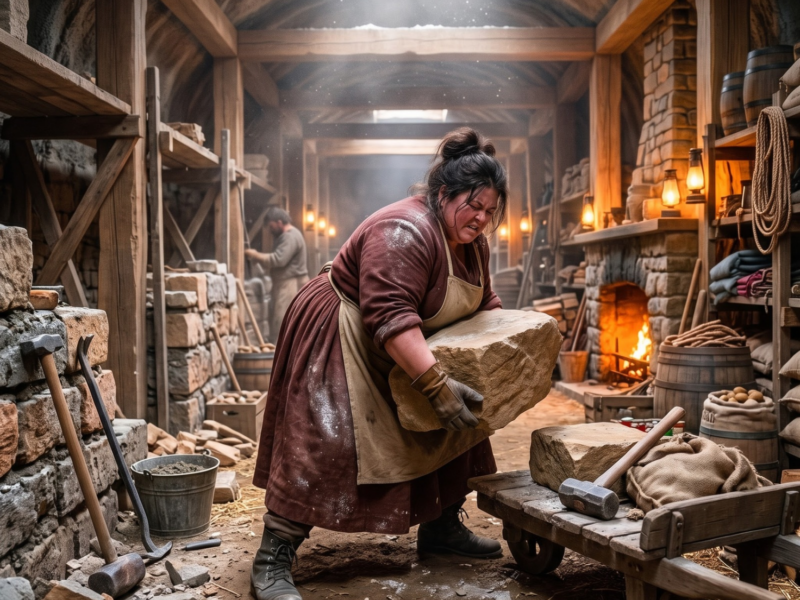
Hattie stood up, her spine straightening one vertebra at a time. She walked over to a ledge, bent down, and grasped a slab of sandstone the size of a man’s chest. With a single, fluid motion of astonishing raw power, she lifted it clean off the earth and set it squarely onto the flat spot where the north wall would begin.
Silas watched. Barrow watched. The silent wind watched.
That was the first stone.









