She Found a Secret to Surviving Winter That Changed an Entire Town
She Found a Secret to Surviving Winter That Change…
She Found a Secret to Surviving Winter That Changed an Entire Town
The thermometer on Dr. Harlon Cook’s front porch shattered at 38 degrees below zero. It did not bend. It did not slow. The mercury column that had measured every winter in Caldwell Crossing, Montana Territory—or, further south, the jagged passes of the Colorado elk range—for eleven years simply reached the limit of what glass, metal, and human engineering could record.
And then it stopped being useful. The column froze solid at the bottom of the tube—a silver pillar that refused to move in either direction. And then the glass itself gave way. The crack sounded like a rifle shot in the pre-dawn stillness. Shards of the instrument scattered across the snow-dusted planks of the porch, each fragment catching the pale moonlight like a piece of broken mirror, like something that had held truth and now held nothing at all.
High in Colorado’s unforgiving elk range, miles from any town with a doctor or a blacksmith, the sky had already turned the color of cold iron weeks ahead of schedule. Frost covered every twig and fence line before the sun even considered cresting the jagged peaks. The mountain streams carried thin, jagged sheets of ice that hissed against the rocks. Even the ravens flew lower, winging heavily through the gray timber as if they knew something larger, meaner, and infinitely colder was hunting them from behind the northern divides.
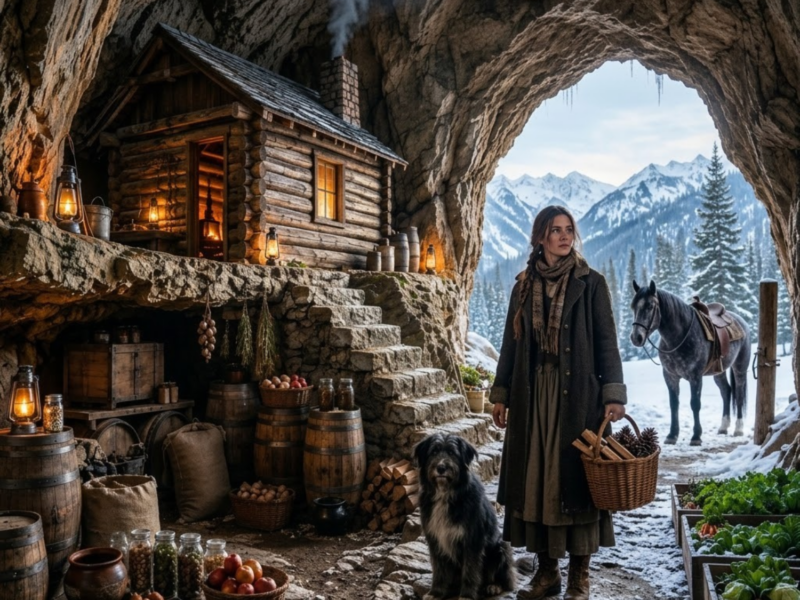
Deep inside a hidden fissure of rock, a woman rested her palm flat against a granite wall.
The stone did not bite with winter’s usual malice. It held steady, absorbing the heat of her skin without complaint and returning a deep, subterranean patience. She closed her eyes for only a heartbeat, listening to the muffled howl of the wind outside the narrow threshold. Then she picked up her lantern, adjusted the wick, and returned to work.
Her name was Merritt Ainsworth. She was thirty-four years old.
Four years had passed since her husband, Jonas, disappeared beneath thousands of pounds of collapsing rock deep inside the Aspen Fork copper mine. The company had sent home a polished pine box. Very little of Jonas had come home inside it—mostly his work boots, a tobacco tin filled with river stones, and a pocket watch that had stopped at four-fifteen.
After the funeral, people expected Merritt to pack what little she had and flee Colorado. Some suggested wealthy relatives in Ohio who had never liked her marriage anyway. Others spoke in hushed, pitying tones about Denver, suggesting she might find employment clerking in a dry-goods store or scrubbing floors for a boarding house.
Everyone believed a lone widow could not survive by herself on mountain land that barely supported a healthy family with two strong backs.
She thanked every person who offered advice. She listened to their warnings with polite, downcast eyes. Then she stayed.
Each sunrise belonged to grueling work. Each night belonged to crushing silence. The small, rugged piece of land Jonas had chosen remained the only promise she still refused to abandon. Their unfinished cabin stood near the edge of a windswept clearing, skeletal and defiant against the timberline.
From far away, it looked sturdy enough. From only a few feet away, every wall revealed another structural disaster. Fresh pine logs, hastily cut and unseasoned, twisted and buckled as they dried under the alpine sun. New cracks appeared every morning, weeping amber sap and inviting the mountain air indoors. Cold air slipped through spaces she had sealed with moss and clay only the day before. She packed more mud into every opening; the mountain simply opened another.
One bitter evening, she finally lit the fieldstone fireplace for a full, unsparing test. Warm, flickering light filled the small room. For several peaceful minutes, she closed her eyes and imagined herself living there through the coming snows, insulated by hearth-smoke and domestic routine.
Then the wind shifted.
A sudden downdraft slammed down the flue, and smoke rolled backward into the cabin in a thick, sulfurous wave. Ash floated across the puncheon floor. Her eyes burned instantly, filling with scalding tears. Outside, her old mule, Deacon, stamped the frozen mud of the pen and tossed his head wildly toward the roof, snorting in alarm.
Merritt stumbled out into the freezing dusk and watched gray, oily smoke pour through the open doorway instead of the stone chimney. She stood quietly in the yard until the last curl disappeared into the darkening pines.
She never blamed the fireplace. She blamed herself for trusting walls that demanded perfect weather to do their job.
That night, she sat beside the dying embers holding Jonas’s worn leather work gloves. The fingers were still permanently curved and stiffened by years of gripping a miner’s heavy pick. She slipped her own hand inside one glove, searching for something that wasn’t there. There was empty space where his hand had once been, a hollow cavern of leather and memories.
She stared at that empty space much longer than she realized. Then, another memory quietly returned, cutting through the grief like a sharp blade.
Her father had spent his entire life making wooden barrels in a workshop in Ohio. He was a master cooper, a man who viewed the world through the curvature of staves and the tension of iron hoops. When Merritt was a young girl, she had often watched him press his palm against a fresh piece of white oak before shaping it with his draw-knife.
When she asked him why he touched the wood before cutting it, he had smiled without looking up from his bench.
“A good wall never fights the weather, little bird,” he had told her, his voice rumbling up from his chest. “It learns to work with it. You force wood to do what it hates, and it’ll spring back and break your jaw. You guide it where it wants to go, and it’ll hold water for fifty years.”
She had forgotten those words for years, buried under the weight of marriage, mining camps, and mourning. Now, sitting in a freezing, smoke-choked cabin in the Colorado wilderness, they refused to leave her mind.
Related Articles

They Mocked the Widow’s Dirt Cellar—Then the Freeze Left Every Cabin Cold but Hers Warm
They Mocked the Widow’s Dirt Cellar—Then the Freeze Left Every Cabin Cold but Hers Warm…

A Homeless Veteran and His German Shepherd Inherited a Ridge No One Wanted — 35 Feet In, They Found
Chapter 1 / 7 A Homeless Veteran and His German Shepherd Inherit… A Homeless Veteran…

Neighbors Laughed When He Built A Cabin Inside An Old Barn—Until It Kept His Home 35 Degrees Warmer
Chapter 1 / 8 Neighbors Laughed When He Built A Cabin Inside An… Neighbors Laughed…

His Sod House Had No Woodpile in January – Until the Trains Stopped and the Town Came Begging
Chapter 1 / 10 His Sod House Had No Woodpile in January – Until t……

She Built Her Cabin Over the Woodshed and Never Burned Wet Wood Again
Chapter 1 / 8 She Built Her Cabin Over the Woodshed and Never Bu… She…

The Duke Abandoned Her on Their Wedding Day—Years Later, He Discovered What He Had Lost
Chapter 1 / 7 The Duke Abandoned Her on Their Wedding Day—Years… The Duke Abandoned…

He Wedged a Tiny A Frame Into a Crevice Before Winter and His Family Slept at 75°F While Town Hit
Chapter 1 / 7 He Wedged a Tiny A Frame Into a Crevice Before Win……

He Was Too Old to Ride—So He Bought the Ruined Ranch and Found the Room Behind the Fireplac
Chapter 1 / 5 He Was Too Old to Ride—So He Bought the Ruined Ran……

Settlers Laughed at His Underground Heat Recovery Duct — Until It Kept His Cabin 71°F Warmer
Chapter 1 / 9 Settlers Laughed at His Underground Heat Recovery… Settlers Laughed at His…

A Navy SEAL Built a Home Inside a Mountain—Then His Dog Warned Him Before the Storm
Chapter 1 / 5 A Navy SEAL Built a Home Inside a Mountain—Then Hi… A…