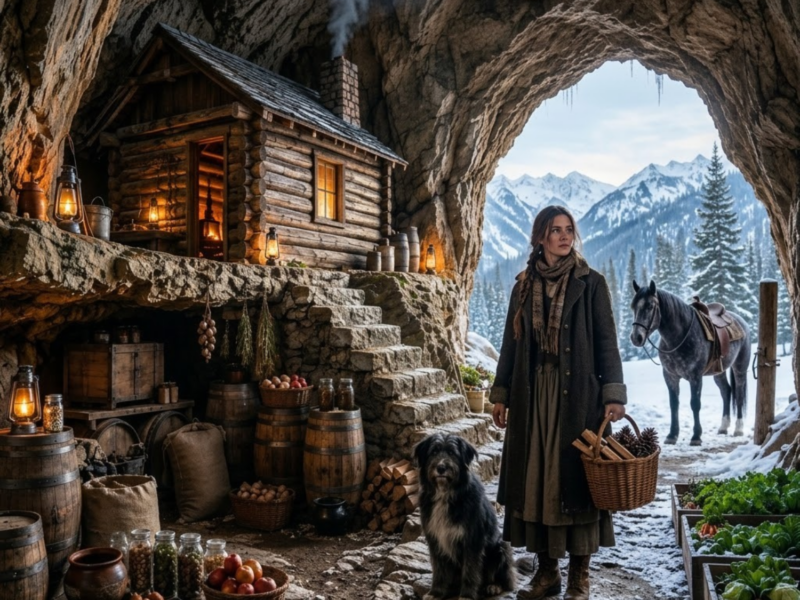
She Found a Secret to Surviving Winter That Changed an Entire Town
Measuring the Mountain
Outside, heavy storm clouds rolled over the western peaks, far beyond the ridge. The first major blizzard of the Colorado winter had already begun its slow, relentless march toward Copperline Hollow, but inside the hidden chamber, time seemed to slow to a crawl.
The cave did not become a home in a single day. It became one careful, agonizing trip at a time.
Before the sun climbed above the eastern ridge the next morning, Merritt loaded only the things she trusted most onto Deacon: her father’s draw-knife, a twenty-foot hemp measuring rope, a heavy felling axe, her lantern, and a small sack of iron nails she had nearly left behind in the collapsing cabin. Nothing else. No furniture, no unnecessary comforts.
The climb felt twice as heavy with every step. Loose stones rolled wickedly beneath the mule’s iron-shod hooves. Frigid air settled into the darkening timber. Above them, the hidden opening waited exactly as it had the evening before, a black slit in the gray stone.
The cave greeted her with the same profound stillness. Outside, pine branches bent and cracked in the growing wind, groaning under the atmospheric pressure of the storm. Inside, the dancing flame of her lantern hardly flickered, held steady by stone walls that had stood unmoved since the creation of the world.
She walked slowly through every nook and cranny of the cavern, studying the mountain’s architecture instead of rushing headlong into clumsy construction. Each step answered another vital question. The floor stayed bone-dry. The ceiling remained solid, anchored by massive overburden. Only one narrow, jagged crack high up near the rear allowed a faint thread of gray daylight to filter down from the surface above.
She stared at that crack for a long time. If light could escape upward through the mountain, perhaps smoke could as well.
She smiled—only once, a fleeting, tight expression that lasted no more than a second.
Instead of swinging an axe to cut green logs, she spent the entire day measuring. She counted every single step from the entrance to the deepest rear wall. She measured the interior height with her hemp rope, tying knots at five-foot intervals. She marked precisely where a narrow bed could fit, where a small stove might stand, and where Deacon could be stabled without blocking the vital airflow of the passage.
By sunset, she carried nothing back down to the failing cabin except absolute certainty. The unfinished cabin had asked her to fight the winter on unequal terms. The mountain offered something entirely different: it asked her to work beside it.
That night, the wind found every rotting crack in the cabin again, wailing through the empty rooms like a banshee. Frigid air slipped across her face while she lay awake beneath her heavy woolen blankets, shivering despite the feeble efforts of the stone fireplace. Smoke whispered around the chimney stones, smelling of creosote and failure. She stared into the suffocating darkness until morning.
Before daylight, she made her irrevocable decision. She would stop fighting a losing war to save the cabin. She would build her home inside the mountain instead.









