She Found a Secret to Surviving Winter That Changed an Entire Town
The First Night in the Dark
The first snow came quietly. That was what fooled everyone into a false sense of security.
By sunrise, only a few inches of powder blanketed the valley. Children laughed and shrieked, kicking up fresh tracks between the shuttered houses. Shopkeepers swept their wooden porches with bored efficiency. Miners joked over breakfast at the saloon that the nervous weather forecasters had worried themselves over nothing.
Not a single soul noticed the wind slowly, menacingly changing its voice, shifting from a playful sigh to a low, guttural growl.
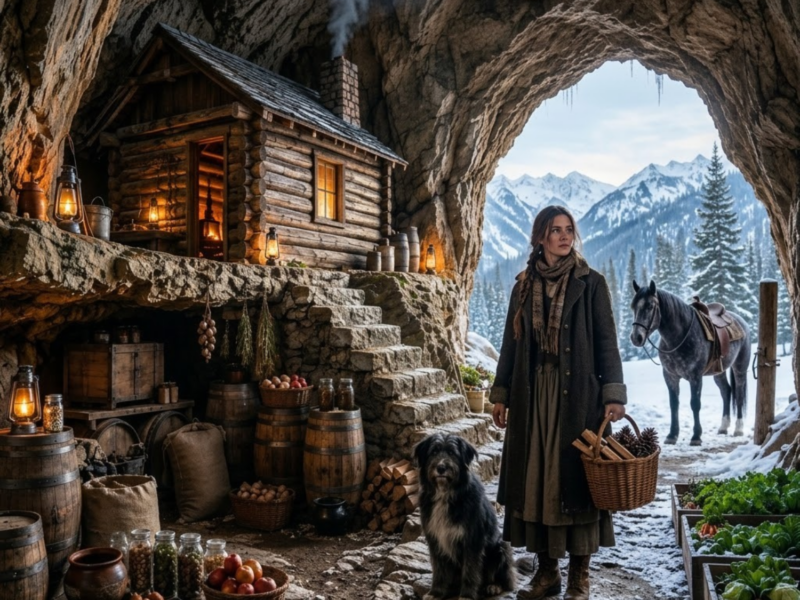
High above Copperline Hollow, Merritt stood behind the low stone barricade at the entrance to her cave, watching the gray clouds swallow the last stubborn patch of blue sky. Then she stepped back inside. The mountain closed around her like a heavy oak door, shutting out the dying world.
She fed one small, seasoned piece of pine into her iron stove—no more. The little fire burned with a clean, efficient blue flame, and radiant heat quickly gathered inside the tiny wooden room.
Outside, the first truly violent gust of the storm slammed into the sheer granite cliff with the force of a battering ram. The cave barely registered the shock, absorbing the kinetic energy into millions of tons of unyielding stone.
By evening, the snowfall had doubled, then tripled. The wind no longer sounded like ordinary weather; it screamed through the towering pines with a relentless, shrieking voice that never paused for breath.
Deacon shifted restlessly inside his stone stall for a moment, but quickly settled back into his straw, lulled by the profound stability of the cavern. The mule trusted the mountain now almost as much as Merritt did.
Morning arrived without direct sunlight. Only a dull, filtered gray glow reached the cave entrance. When Merritt finally pushed past the canvas flap to check the exterior, she stopped dead in her tracks without moving another inch.
The world had utterly disappeared.
Every pine tree looked identical, smothered in white. The trail had vanished beneath smooth, unbroken drifts ten feet deep. She searched frantically for the skeletal remains of the unfinished cabin below; nothing remained visible except a smooth, rounded mound of pure white snow marking the place where her old life had been buried.
She lowered her eyes. She had heard tales of such storms happening during her childhood in Ohio, but experiencing one isolated at 9,000 feet was a different category of trial.
She turned back inside. There was work waiting to be done.
She melted fresh snow in her iron kettle for water, fed Deacon his daily ration of wild hay, measured out another day’s strict allowance of firewood, and cooked a pot of beans flavored with a tiny sliver of salt pork. Everything followed the same unyielding, calm rhythm. The storm outside could waste all its furious strength trying to tear the world apart; inside the mountain, nothing rushed.
Late that afternoon, a faint, muffled sound drifted up through the howling wind—a distant, mournful tolling.
A church bell, striking one slow, heavy note, then another.
She counted each stroke silently without speaking aloud. When the last resonance faded into the white wasteland, she lowered the heavy skinning axe she had been holding. Someone down in the valley had died. She did not know who, and she would not know until the spring thaws pulled back the snow.
She picked up another log, split it cleanly down the grain with a single, practiced blow of the axe, and stacked it by the stove.









