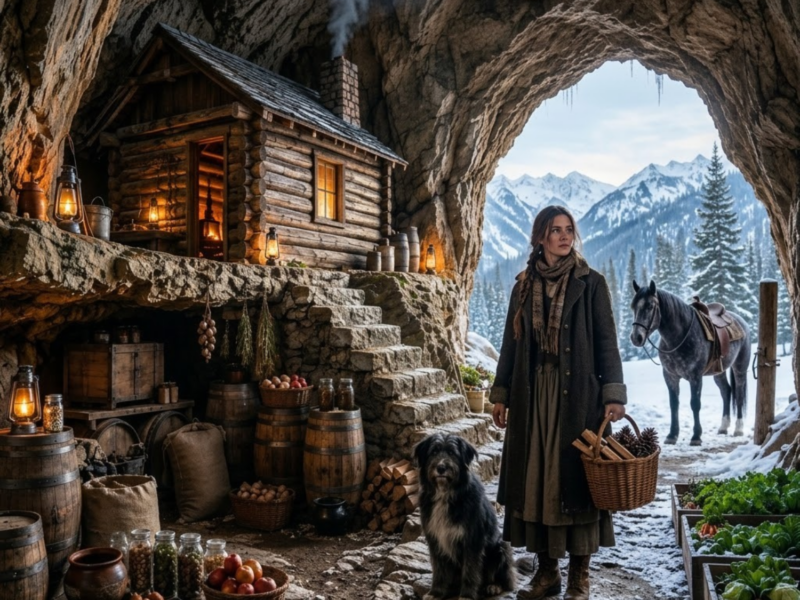
She Found a Secret to Surviving Winter That Changed an Entire Town
The Spring Thaw
Weeks later, the stubborn mountain snow finally began to soften.
A heavy, wet warmth settled over the valleys. Small, rushing streams pushed aggressively beneath shrinking crusts of ice. Green patches of alpine meadow began to poke tentatively through melting drifts like islands in a white sea.
One by one, bundled up against the lingering chill, people from Copperline Hollow climbed the steep ridge to visit Merritt Ainsworth.
Some came carrying rough, hand-drawn blueprints of their own cabins, hoping for advice. Others simply wanted to witness for themselves the miracle of the mountain sanctuary that had stared down a blizzard and won.
Merritt welcomed every single visitor with open arms. She served hot coffee whenever her water supply allowed, and then she explained her methods with infinite, unhurried patience.
She showed them the narrow airspace acting as an invisible thermal break. She showed them the stone wall breaking the vicious bite of the wind. She showed them the tiny stove and the clever way the mountain worked with her instead of fighting against her.
She never acted like an arrogant expert or a superior architect. She simply shared what the land had taught her when she had nowhere else left to turn.
An old, veteran carpenter named Obadiah Henson arrived one bright, clear March morning. He walked slowly around the tiny room, running his work-roughened palm across the smooth, reassuring granite. His eyes remained fixed on the wall for several long moments.
Finally, he turned to Merritt, his expression deeply humbled. “I’ve built houses for nearly forty years across three territories. I thought I understood winter.” He shook his head slowly. “I was wrong.”
He pulled a small leather-bound notebook from his coat pocket and began filling page after page with meticulous notes—every measurement, every structural angle, every theoretical explanation she offered.
Before leaving, he asked quietly, “May I share this with others, Mrs. Ainsworth? So that families who never meet you can still build this way when the next hard winter comes?”
Merritt looked toward Jonas’s old Bible resting quietly on the pine table. Her father’s parting wisdom echoed softly in her memory: Knowledge is meant to be shared, not hoarded.
She nodded, a genuine smile touching her eyes. “Write it all down. But leave my name out of it. Let the drawing and the stone speak for themselves.”
Obadiah smiled warmly, tucked the notebook safely inside his heavy coat, and walked back down toward the valley carrying something vastly more valuable than timber or gold: an idea that would outlive them all.
Epilogue: Listening to the Land
By late spring, small, profound changes began appearing across the architectural landscape of Copperline Hollow.
Families began rebuilding their collapsed or drafty chimneys along interior walls rather than exposed exterior gables. Others added sheltered subterranean rooms modeled directly after Merritt’s design. Some piled thick sod and earth embankments where winter gales once rushed unhindered against their floorboards.
Each individual improvement looked modest on its own. Taken together, they fundamentally transformed the valley’s resilience against the elements.
When Barnaby Thorne finally returned from Denver—furious, empty-handed, and realizing his legal maneuverings had been utterly defeated by a clerk’s quiet loyalty—he found a community that was no longer vulnerable to his corporate manipulations. The valley had learned a new kind of self-reliance, forged in the deep snows of the Great Die-Up.
One warm afternoon after the last stubborn snowdrift had melted away from the pines, Merritt stepped outside the cave entrance and looked across the expansive, green-tinted valley.
The unfinished timber skeleton of the cabin below remained half-buried under creeping weeds and wild raspberry bushes. She never bothered to tear it down or rebuild it; she no longer needed to. The mountain had already become her true, enduring home.
Old Deacon grazed peacefully nearby on the rich, waist-high grass of the meadow. The mountain breeze carried the clean, healing scent of pine resin and wet earth instead of the biting terror of ice.
She rested one bare hand against the solid, familiar granite of the cliff face. It felt exactly the same as it had on that desperate afternoon four years ago when she first discovered its shelter: steady, eternal, and unconditionally forgiving.
“We made it, Jonas,” she whispered softly to the wind.
There was no magical celebration, no grand parade through Copperline Hollow. True survival rarely required applause. It required listening when the world spoke in riddles, paying attention when the animals altered their ancient habits, and trusting that beneath the cruelest frost, the earth was always keeping a warm room ready for those wise enough to find it.









