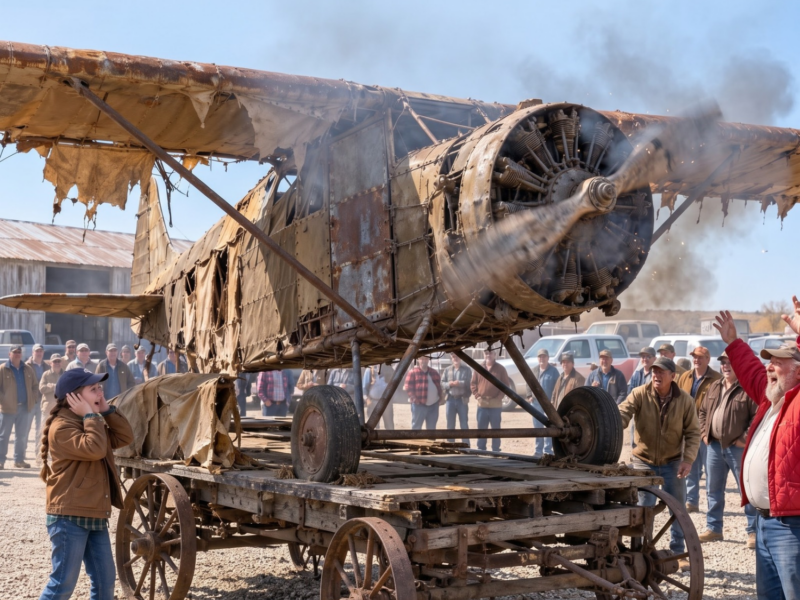
The Auction Sneered at the $40 a Girl Paid for a Wired-Shut Airplane — Then She Opened the Cockpit
The Meadowlark's Secret
Everybody turned around. Tess Pruitt was standing beside her grandmother with her hand in the air. She wore her father’s old brown chore jacket with the sleeves turned back, a green plaid flannel shirt underneath, jeans with grass on the knees, and a faded navy-blue cap with her long brown braid pulled through the back of it. She had forty dollars in her jacket pocket, folded into a square. It was every dollar from a summer of selling eggs along the county road.
“Young lady,” the Colonel said, and he was smiling, but gently. “I already came down to twenty-five.”
“I know,” Tess said. “I’ll pay forty. It’s worth more than that.”
That was the line that broke the yard open. Dwayne Rusk laughed until he had to put a hand on the wagon to hold himself up.
“Worth more,” he said. “Missy, it’s worth less than the wagon it’s sitting on. That’s a hundred pounds of rotten cloth and a motor that hasn’t turned over since Hoover was president. You want an airplane? I’ll buy you a model kit at the hardware store.”
The Colonel looked at Tess’s grandmother. Ida Pruitt was sixty-eight years old, small and straight-backed, with gray hair cut short, and a canvas apron she had forgotten to take off when she closed her shop that morning. She ran Pruitt Canvas and Awning on Main Street in Arbon, and she had sewn half the porch awnings and tractor seat covers in the county.
She met the Colonel’s eyes and gave him a small nod.
“Sold,” the Colonel said, and brought the gavel down on the wagon rail. “Forty dollars to the Pruitt girl.”
Tess walked up to the clerk’s table and unfolded her square of bills one at a time, and the clerk counted them twice because people were still laughing and she kept losing her place. Then, Tess walked back to the wagon and laid both palms on the fuselage again, as if she were checking that it was still there.
That was when the man in the back shouted for her to pry the tin off. That was when she said no.
Dwayne Rusk wandered over with his thumbs in the pockets of that red jacket. He did not crouch down or lower his voice. He talked to the airplane and to the crowd the way he talked at fair board meetings.
“Now, Ida,” he said to her grandmother, “you’re not really going to let her drag this thing home. The county will fine you for keeping junk in the yard. I’ll do you a kindness. I’ll give the girl sixty dollars for the engine, and I’ll haul the rest off free. She makes twenty dollars on the day and learns a lesson.”
Ida Pruitt looked at him the way she looked at a customer who wanted a free awning. “It’s not my airplane, Dwayne,” she said. “Ask her.”
So, he asked her. Tess shook her head. “It isn’t for sale.”
“Everything’s for sale, missy.”
“Not this.”
Dwayne laughed again, but shorter this time, and he looked around to see who was laughing with him. Plenty were. He tipped his cap to Ida and went back to his scrap piles.
Getting the airplane home took the rest of the day. Ida called her neighbor Walt Severson, who had a flatbed trailer and a pickup big enough to pull it. Walt and two of his hired men winched the hay wagon, airplane and all, up onto the flatbed with a hand winch and a great deal of language Ida asked them to keep down.
Tess was not allowed near the winch. She stood back by the pickup with her grandmother and watched every inch of it. And every time a strap tightened, she asked Walt to check that it was not pulling on the fabric.
“Girl, it’s ninety years old,” Walt said. “It’s not going to get any older on the way home.”
“It might get torn,” Tess said.
Walt looked at her for a second, then took off his gloves and moved the strap. They drove the gravel at fifteen miles an hour with the wing hanging out over both ditches. People waved. Some of them were laughing.
The Pruitt place was a white two-story house at the edge of town with a big Quonset shed out back where Ida kept her bolts of canvas and her industrial sewing machines. By the time they backed the flatbed up to the shed doors, it was nearly dark, and Tess’s mother was standing in the driveway with her arms crossed. Carla Pruitt drove a school bus route for Arbon Public Schools and she had heard about the airplane from three different parents before she even got back to the bus barn.
“Mom,” she said to Ida, “tell me you did not let her spend her egg money on that.”
“I did not let her,” Ida said. “She did it all by herself. I only nodded.”
Carla looked at the airplane for a long time. Then she looked at her daughter. “Tess, why?”
And Tess told her. She told her standing in the gravel by the flatbed, with the wing over her head and the first stars coming out. And when she was done, her mother had uncrossed her arms.
Here is what Tess knew, and what almost nobody else in Arbon knew: Ida’s mother had been named Ruth. In March of 1931, Ruth was six years old and lived on a rented farm two miles from the Kettle place. One morning, a late blizzard came down out of the northwest so fast that the cattle could not find the windbreak. And in the middle of it, an airplane came down out of the snow and landed rough and crooked in the Kettle pasture.
The pilot was a woman. Her name was Opal Wren. She was twenty-six years old and she flew the airmail on a contract route between Omaha and Cheyenne. And at that time, she was the only woman in the country flying the mail west of the Missouri River.
Her airplane was a Kessler Model 9, built in Wichita, painted cream with a dark green stripe, and she called it the Meadowlark. She had flown it into the storm because the mail had to go. She walked to the farmhouse through the snow, half-frozen, with a mail sack over each shoulder. Ruth’s father and Amos Kettle went back out with a team and dragged the Meadowlark into Amos’s machine shed before it could blow over.
Little Ruth carried coffee out to the shed in a lard pail, and Opal Wren let her sit in the pilot seat. The mail went on by train three days later. Opal went with it. The Meadowlark‘s landing gear was broken and its propeller was split, and the company would not pay to fix an airplane in a pasture in the Sandhills.
So, Opal made Amos Kettle a promise: she would come back for her airplane in the summer with a new wheel and a new propeller and fly it home. Amos Kettle made her a promise back: nobody would touch it until she did.
Opal Wren never came back. Ruth heard, years later, that she had been lost flying a mail route over the Gulf of Mexico the following winter. The Meadowlark was listed in the company’s books as destroyed in a forced landing, and that was the end of it on paper.
But Amos Kettle kept his word. He riveted a plate of tin over the cabin door so no farm boy could climb inside. He wired the mail hatch shut. He strapped down the tail, and he closed the shed doors and put a chain on them. And the chain stayed on through Amos and through his son, Merle, for ninety-four years.
Ruth told the story to her daughter, Ida, every winter. Ida told it to her granddaughter. And when the sale bill for the Kettle estate came out in the Arbon paper with a line at the very bottom that said, “Contents of machine shed, one antique aircraft as is,” Tess had read it at the breakfast table and put down her spoon.
That night, they rolled the Meadowlark into the Quonset shed beside the sewing machines. Still riveted, still wired, still strapped, and Ida pulled the big doors closed. Tess stood a long while in the doorway with a flashlight, just looking. Then she went in to supper.









