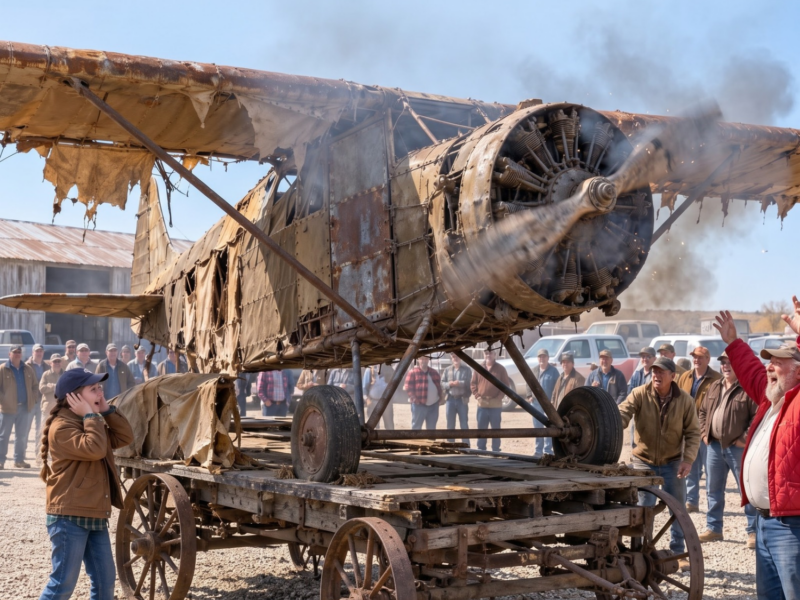
The Auction Sneered at the $40 a Girl Paid for a Wired-Shut Airplane — Then She Opened the Cockpit
The Microfilm Reel
By Monday, the whole town had the story, and the town had decided it was funny.
At the Prairie Rose Cafe on Main Street, the men at the round table by the window called it Tess’s flying chicken coop. At Arbon School, a sixth grader named Colby Doll asked Tess in front of the lunch line whether her airplane came with a parachute, and three tables laughed.
And Dwayne Rusk told the story everywhere he went. He told it at the co-op. He told it on the Thursday morning farm show on the Arbon radio station.
“Folks,” he told the whole county on the radio, “I’ve been in the scrap business thirty-three years, and I have seen people pay too much for junk, but I have never seen a little girl pay forty dollars for a pile of rotten bed sheets with a motor on the front. If Ida Pruitt wants to get rid of it before the county writes her up, my offer’s still good: sixty dollars and I haul.”
June Lindall, who ran the Prairie Rose, turned the radio off in the middle of it, but plenty of people heard. Tess heard it at the breakfast table. She listened all the way through without saying anything, then she rinsed her bowl and put on her jacket.
“Where are you going?” her mother asked.
“To the library,” Tess said. “Grandma’s taking me after school.”
The Arbon Public Library was one long room in the old Masonic Hall, kept by a librarian named Mrs. Okonkwo, who had never once told a child that a question was too big. Tess put the question on the reading table. She wanted everything the library could find about an airmail pilot named Opal Wren, a Kessler Model 9 airplane, and a forced landing near Arbon in March of 1931.
It took three weeks of afternoons. The Arbon paper from 1931 was on microfilm in a gray steel cabinet in the back. Tess sat at it with her grandmother on one side and Mrs. Okonkwo on the other, turning the crank a quarter turn at a time.
They found it on the twelfth reel, after two whole reels of cattle prices. A short piece on page three, under the weather report: “Airmail flyer down in storm near cattle farm. Lady pilot safe, machine damaged.”
Tess read it out loud, slowly, and when she got to the words lady pilot, Ida reached over and squeezed her shoulder.
After that, it got easier. Mrs. Okonkwo found Opal Wren in a book of early airmail history from the state library: half a page with a photograph of a slim young woman in a leather helmet standing on the wheel of a high-wing airplane with a dark stripe down its side. The caption said the Meadowlark had been the third of only nine Kessler Model 9s ever built, and that none of them survived.
“‘None of them survived,’” Tess read. She looked up. “That’s wrong.”
“Then we’d better tell somebody,” said Mrs. Okonkwo.
The somebody turned out to be a curator. Mrs. Okonkwo knew that the Platte Valley Air Museum in Kearney kept a whole hangar of early mail planes, and that it had a curator of aviation history named Dr. Helen Marsh.
So, that Thursday night at the kitchen table, Tess wrote Dr. Marsh a letter. She wrote it by hand on lined paper, four pages, and her mother read it over and only fixed two words. She told Dr. Marsh what she had bought, and where it had been, and what her great-grandmother had seen, and what the paper said. She put in a copy of the newspaper piece from the microfilm printer. And at the bottom, she wrote one more line:
“I have not opened it. Mr. Kettle promised Miss Wren nobody would touch it. I would like somebody who knows about airplanes to be there when it gets opened, so it gets done right.”
She mailed it on Friday. Then she waited.
Dr. Helen Marsh did not write back. She telephoned eight days later on a Saturday morning while Ida was hemming a grain truck tarp, and she asked to speak to Miss Tess Pruitt. She asked how many cylinders the engine had, whether the stripe was green, whether there was a small round window in the cabin door.
Tess answered from memory. “Seven cylinders,” she said. “The stripe is green where you can still see it. I can’t tell about the window. The tin covers the whole door.”
There was a long pause on the line. “Tess,” Dr. Marsh said, “I would like to drive out and look at it. Just look. I won’t touch it, and I won’t ask you to open it. And if it is what you think it is, I’m going to ask you not to let anybody else open it, either, including me, until we can do it properly.”
“That’s what I want,” Tess said.









