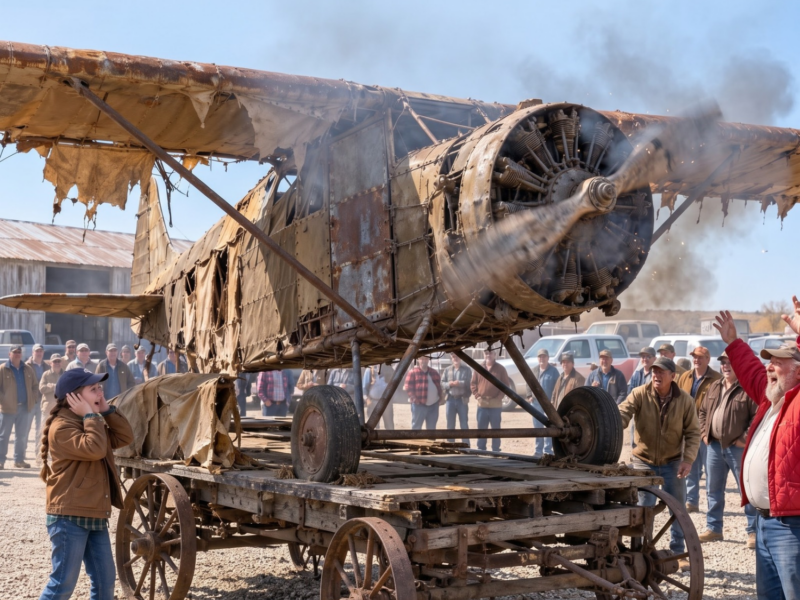
The Auction Sneered at the $40 a Girl Paid for a Wired-Shut Airplane — Then She Opened the Cockpit
The Appraisal
Dr. Marsh came the next Saturday in a museum van with a woman named Rosa Delgado, the museum’s conservator, who carried a camera and a notebook and a small bag of soft brushes. They spent four hours in the Quonset shed. They measured the wing, photographed every rivet, and wrote down the numbers cast into the engine’s crankcase.
When they came out into the yard, Dr. Marsh was quiet for a while. “I can’t tell you anything for certain until that door comes off,” she said finally. “But I’ll tell you this much. The engine is the right engine. The wing is the right wing. And there is not supposed to be one of these left anywhere in the world.”
The museum van had sat in the Pruitt driveway with its name painted on the side for four hours, and by Monday, Dwayne Rusk had heard about it, and Dwayne’s offer changed.
He came to the canvas shop himself, which he had never done in his life, and stood at the counter in his red jacket. “Ida,” he said, “I’ll be straight with you. I may have spoken too quick on the radio. I’d like to make that up to the girl. Five hundred dollars cash, and I’ll haul it out of your shed, so you’ve got your room back.”
“You’d better ask her,” Ida said. “She’s in the back.”
Tess came out of the back with a spool of thread in her hand and listened to the offer. “No, thank you, Mr. Rusk,” she said.
“A thousand, then,” said Dwayne. “Missy, that’s twenty-five times what you paid. You’ll never see a deal like that again.”
“It isn’t for sale,” Tess said, and she went back to winding thread.
Dwayne stood at the counter a moment longer. Then he put his cap back on and left, and the bell over the door rang behind him.
It was Tess who decided how the opening would go. Dr. Marsh had offered to truck the Meadowlark to the museum and open it there in a clean room with lights. Tess thanked her and asked if it could be done in Arbon instead.
“People laughed at it here,” she said. “I’d like them to see it here.”
So it was settled. The tin would come off on the last Saturday in October in the Quonset shed behind Pruitt Canvas & Awning at 10:00 in the morning. Rosa Delgado would remove the rivets because Rosa had done it on a dozen old airplanes and knew how not to tear what was underneath. Dr. Marsh would identify what was inside. And because a museum cannot be the one to say what a thing is worth when it might want to buy it, Dr. Marsh called an independent appraiser from Kansas City, a vintage aviation specialist named Graham Hollis who did appraisals for insurance purposes and for the big auction houses.
Then Tess made a list of who to invite. Her mother, her grandmother, Walt Severson who had hauled it home, Mrs. Okonkwo from the library, June Lindahl from the Prairie Rose, Colonel Hap Bellamy who had sold it to her, and at the bottom of the list in her neatest handwriting, she wrote one more name.
“Dwayne Rusk,” her mother said, reading over her shoulder. “Tess, why on earth?”
“Because he laughed the loudest,” Tess said. “He should be there when it gets opened.”
Her mother looked at her daughter for a long moment and did not argue. Tess wrote every invitation by hand. Word came back from the salvage yard two days later: Dwayne would be there. He told the men at the co-op he was coming to watch a twelve-year-old girl find out she’d bought a pile of mouse nests.









