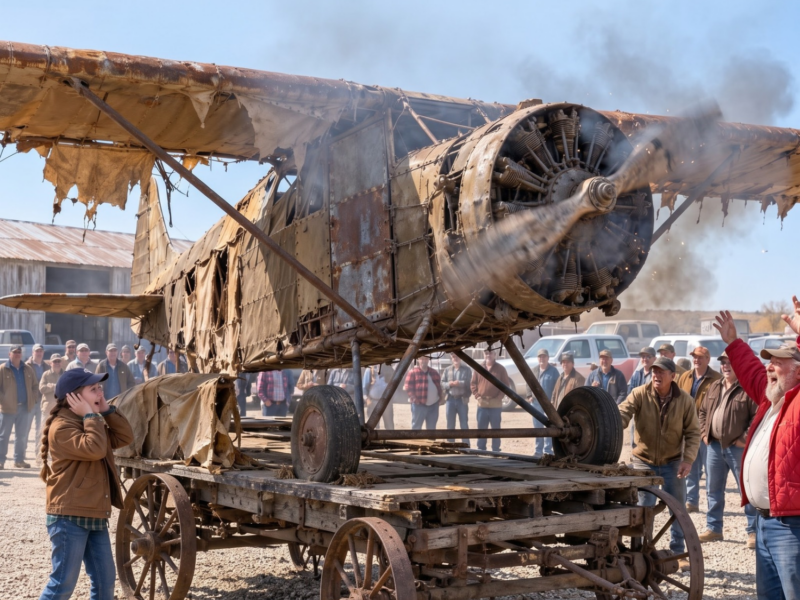
The Auction Sneered at the $40 a Girl Paid for a Wired-Shut Airplane — Then She Opened the Cockpit
The Meadowlark Unveiled
The night before the opening, Ida and Tess set up the shed. They swept the concrete floor. They borrowed folding chairs from the Lutheran Church, two rows of them, and set them in a half-circle in front of the cabin door. Ida hung two work lights from the rafters.
And Tess stood in front of the Meadowlark for a long while in the quiet, with her hands in her jacket pockets, looking at the tin. Then she went in to supper.
They came early. By half-past nine, every folding chair in the shed was full, and people were standing along the walls between the bolts of canvas. Tess had invited seven people, and the word had gone around, and nobody had the heart to send anybody home. June Lindahl closed the Prairie Rose for the morning. Dwayne Rusk came at five minutes to ten in his red jacket and stood at the back with his arms folded.
“Well,” he said to nobody in particular, “let’s see the chickens.”
A few people laughed, not as many as before.
Tess stood beside the cabin door with her grandmother. She wore her chore jacket and her navy cap and a pair of her grandmother’s leather work gloves, too big for her, rolled at the cuffs. Dr. Marsh stood on the other side with her notebook. Rosa Delgado knelt by the door with a small drill and a tray for the rivets.
“Miss Wren asked Mr. Kettle to keep it shut until she came back,” Tess said to the room. Her voice shook a little at the start, and then it didn’t. “She never came back. Mr. Kettle kept his word, and so did his son. So I kept it, too. Today, we’re opening it because I want her airplane to be where people can see it.”
“That’s all?”
Then she nodded to Rosa.
It took Rosa forty minutes to drill out the rivets, one at a time, slow and careful, dropping each one into the tray with a small ring of steel on steel. Nobody talked. When the last rivet was out, Rosa sat back on her heels. “It’s yours,” she said to Tess.
Tess took hold of the edge of the tin plate in her gloved hands, and her grandmother took the other edge, and together they lifted it away from the door and leaned it against the wall.
Under the tin, the cabin door was cream-colored, with a dark green stripe running across it, as bright as the day it was painted. There was a small round window in it, and just under the window, in faded gold letters, was one word: Meadowlark.
Somebody in the second row said, “Oh, my lord.”
Dr. Marsh opened the door. The hinges were stiff, and they groaned, and then the whole cockpit was there in the light. The leather pilot seat, cracked but whole; the wooden control wheel; the instrument panel, every gauge still in it, the glass unbroken; a leather flying helmet hanging from the throttle where somebody had hung it up in the snow ninety-four years ago and never came back for it.
And on the panel, under a film of dust, a small brass plate riveted in place.
Dr. Marsh leaned in with a flashlight and read the plate out loud. “Kessler Aircraft Company, Wichita, Kansas. Model 9, serial number three.”
She straightened up and turned around, and her eyes were wet. “This is Opal Wren’s airplane,” she said. “This is the Meadowlark. Serial number three is the airplane that flew the airmail between Omaha and Cheyenne in 1930 and 1931, flown by the only woman on that route. Every history book in my museum says it was destroyed. It wasn’t. It’s sitting right here. Original fabric, original paint, original engine, original instruments. Because a farmer kept a promise and the girl who bought it kept it after him. In thirty years of this work, I have never stood in front of anything like it.”
Then she stepped aside for Graham Hollis. The appraiser had been quiet all morning. He spent twenty minutes in the cabin and around the engine with a notebook. When he came out, he did not make a speech. He read from his notes in a plain, careful voice.
“For the record, this is the only surviving Kessler Model 9 of nine built,” he said. “It carries a documented history as a contract airmail aircraft flown by a pioneering woman pilot. It is unrestored with its original covering, finish, and instruments intact, which is almost unheard of for an airplane of this age. For insurance purposes and for sale, my appraisal of its fair market value today is $246,000.”
The shed went completely silent. Walt Severson sat down hard on his folding chair. Ida Pruitt put her arm around her granddaughter’s shoulders and held on.
And at the back wall, Dwayne Rusk stood with his arms still folded and his mouth open. He did not laugh. He did not say a word. He stared at the cream and green door of the airplane he had called a chicken coop on the radio, and then at the twelve-year-old girl standing beside it in her too-big gloves, and he said nothing at all.
Dr. Marsh spoke next. “The Platte Valley Air Museum wanted the Meadowlark,” she said, “and the museum’s board had already agreed it would pay the full appraised value, $246,000, if Tess was willing to sell. The museum would conserve it exactly as it was and give it its own place in the main hangar.”
Tess looked at her mother. She looked at her grandmother. Then she looked at Dr. Marsh. “I have two conditions,” she said.
Dr. Marsh smiled. “I thought you might.”
“The sign by it has to say Opal Wren’s name first,” Tess said, “and then it has to say Amos Kettle kept it for her, and Ruth Pruitt carried her coffee.”
“Done,” said Dr. Marsh. “Done and done.”
Epilogue: The Ribbon on Main Street
The papers were signed in the Pruitt kitchen two weeks later. The money went into a trust for Tess’s schooling—the part that was left after Ida put a new roof on the canvas shop and Carla paid off the family pickup.
Tess kept one thing for herself. Dr. Marsh gave her one of the rivets from the tin plate, and she wears it on a string around her neck.
The Meadowlark left Arbon on a museum flatbed in November. Half the town lined Main Street to watch it go. And outside Rusk Salvage and Iron, as the flatbed went by, a big man in a red jacket stood by his gate and raised one hand and held it there until the airplane was out of sight.
The next spring, at the museum in Kearney, the girl from Arbon cut the ribbon in front of the Meadowlark with her mother and her grandmother beside her. The sign said exactly what she had asked it to say. And at the bottom, in smaller letters, it added one final line Dr. Marsh had appended on her own:
Saved from the scrapyard for $40 by Tess Pruitt, age 12.









