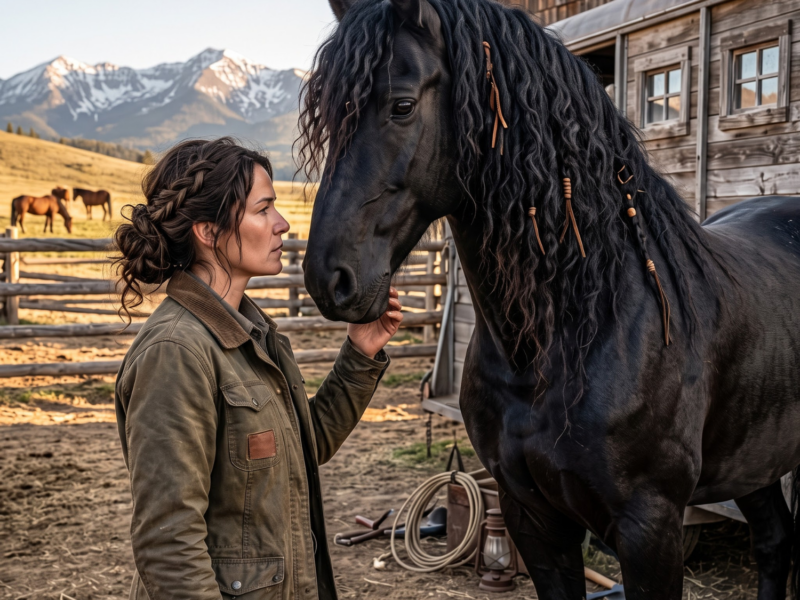
The Horse Breeder Sent the Wrong Stallion to a Widow’s Farm—She Turned It Into Her Greatest Stud
The Horse Breeder Sent the Wrong Stallion to a Wid…
The Horse Breeder Sent the Wrong Stallion to a Widow’s Farm—She Turned It Into Her Greatest Stud
PROLOGUE: THE WRONG HORSE
The aluminum walls of the transport trailer did not sound like they contained a living creature; they sounded like they were being beaten apart by a siege engine. Hooves hammered against the sheet metal with a rhythmic, furious violence that caused the transport driver to step back from the loading ramp, his face draining of all color until it matched the dull, zinc-coated steel of his truck. His hands trembled so violently he could barely hold the frayed end of the hemp lead rope. He thrust it at Ruth like it was a live grenade.
“He’s your problem now, lady,” the kid spat, his eyes wide with a residual terror that no amount of highway miles could wash away. He didn’t wait for a signature on the manifest. He simply scrambled back into the cab of his diesel rig, slammed the door, and threw the transmission into gear.
The truck lurched forward, spitting a cloud of black exhaust into the freezing November drizzle, leaving Ruth standing alone in the churned-up mud of her own driveway.
Ruth needed a sure thing. That was the only luxury she could afford, and she couldn’t even afford that. Her husband, John, had been dead for fourteen months, killed in a skid-steer loader accident that had crushed his chest and left the family ledger a smoking ruin. The farm’s primary tractor was throwing a rod, coughing gray smoke into the pasture like a dying animal, and the bank had begun sending letters printed on heavy, cream-colored paper. The expensive kind. The kind that meant they were done asking politely.
The farm was bleeding out, drop by drop, invoice by invoice.
Her plan to stop the hemorrhage was desperate, but the mathematical logic of it felt airtight on paper. She would use the last scraps of John’s life insurance policy—money intended for groceries and heating oil—to buy a proven, gentle quarter horse stud. She would breed him to her five remaining, high-grade mares, sell the foals in the spring, and use the revenue to survive another year while she figured out how to dismantle the mortgage.
Hayes, a slick, volume-driven breeder three counties over, had promised her a horse named Butterscotch. It was a ridiculous, childish name for a stallion, but Hayes swore by him. The animal was supposedly a tank—steady, calm, wrapped in a golden coat, and possessed of a temperament so dull and forgiving you could safely take an afternoon nap underneath his iron shoes.
That was what Ruth had wired her final four thousand dollars for. That was not what was currently trying to kick its way out of a two-horse gooseneck trailer in the deepening twilight.
The interior of the box was pitch black, illuminated only by the frantic beam of Ruth’s heavy-duty flashlight. When she clicked it on, the beam cut through the freezing mist and illuminated an animal that defied every promise Hayes had made.
He wasn’t golden. He was the color of a fresh sinkhole, black as a closed coffin, save for the thick, curdling lather of white foam that coated his chest and flanks like lye. He was bone thin. His ribs showed through his wet, matted coat like the timber ribs of a wrecked ship. His mane was a catastrophe of cockleburrs, matted dreadlocks, and rusted bits of wire.
But it was his eyes that made Ruth’s breath hitch in her throat.
They weren’t the soft, liquid brown eyes of a gentle family pet. They were wide, rolling, bloodshot, and entirely feral. This wasn’t a breeding stallion. This was a walking panic attack, an animal forged in the furnace of some nameless cruelty.
“Come on,” Ruth muttered. Her voice was flat, devoid of panic. She simply didn’t have the emotional bandwidth left for fear; she had run out of adrenaline months ago, replaced by a deep, crushing exhaustion that settled into her marrow.
The horse lunged. He didn’t aim for her; he aimed past her, launching himself off the edge of the ramp with a desperate, uncoordinated heave. His iron shoes slipped on the wet aluminum, and he hit the muddy gravel of the driveway with a heavy, sickening thud. He scrambled to his feet, tossing his massive head with such force that the slack of the lead rope whipped through the air like a cracking bullwhip.
The force ripped through Ruth’s shoulders, dragging her forward into the sludge. She didn’t let go. If she lost him now in the dark, he would bolt straight through the rotting perimeter fence and onto the two-lane county highway, where he would either kill a driver or get put down by the state troopers.
She dug the heels of her rubber boots deep into the mire, leaning back with her entire body weight. The coarse hemp rope burned through the palms of her leather gloves, smelling of friction and old sweat.
“Whoa! Hey! Whoa!”
He circled her in a wide, erratic arc, blowing hard through flared nostrils, his hooves sucking into the mud with wet, echoing smacks. The freezing rain plastered his sparse coat flat against his frame, revealing the terrifying topography of his body. In the harsh wash of her flashlight, Ruth saw them: jagged, white-tissue scars crisscrossing his neck and shoulders.
Someone had beaten this animal. Someone had taken a proud, high-strung thoroughbred cross, pushed him past the edge of sanity, and left behind only splintered wood and broken glass.
It took forty-five minutes to move him sixty yards from the driveway to the barn. Forty-five minutes of stopping, planting her boots, waiting for his rolling eyes to find some anchor in the dark, and taking a single, agonizing step forward. By the time she finally coaxed him into the largest folding stall at the end of the center aisle, her fingers were numb, and the cold had settled deep into the spaces where John used to occupy her life.
She pushed the thought away with practiced cruelty. There was no room for ghosts tonight. There was only the monster on the end of the rope.
As soon as she unclipped the lead, the black horse spun with terrifying speed, lashing out with a hind leg. The heavy iron hoof connected with the oak kickboards of the stall, splintering the two-inch hardwood with a sound that echoed like a pistol shot through the hollow barn.
Ruth slammed the heavy iron bolt into place. She stood in the aisle, her chest heaving beneath her canvas jacket, listening to him pace.
Tap-tap-tap. Three quick steps to the left, a sharp pivot on his hocks. Tap-tap-tap. Three quick steps to the right. The relentless, mechanical rhythm of a caged animal whose world had narrowed to the width of a box and the memory of a whip.
She walked to the tack room, picked up the heavy plastic landline receiver, and dialed Hayes’s number.
It rang eight times before an automated voicemail clicked on. You’ve reached Hayes Farm. Leave a message.
Ruth gripped the receiver so tightly the cheap plastic groaned in her hand. “You sent me a killer, Hayes,” she whispered into the dead wire, her voice shaking with a cold, murderous fury. “I want my money back. I’m calling the sheriff in the morning.”
She slammed the phone down. She knew the threat was empty even as the plastic cradle rattled. The money was gone—wired directly from an account that now sat at zero. Legal, untraceable, final. Hayes had offloaded a dangerous, broken liability onto a desperate widow, knowing full well she couldn’t afford a retainer for a civil attorney to fight him across county lines.
She walked back down the dark aisle. The black horse was standing motionless in the corner of his stall, staring at her through the vertical iron bars. The whites of his eyes glowed a sickly yellow in the flickering fluorescent light overhead.
He wasn’t glaring at her. He was terrified.
“All right, Ruin,” she whispered, naming him right then and there, sealing his fate and hers into a single, ugly syllable. “Looks like we’re both out of options.”
Related Articles

They Mocked the Widow’s Dirt Cellar—Then the Freeze Left Every Cabin Cold but Hers Warm
They Mocked the Widow’s Dirt Cellar—Then the Freeze Left Every Cabin Cold but Hers Warm…

A Homeless Veteran and His German Shepherd Inherited a Ridge No One Wanted — 35 Feet In, They Found
Chapter 1 / 7 A Homeless Veteran and His German Shepherd Inherit… A Homeless Veteran…

Neighbors Laughed When He Built A Cabin Inside An Old Barn—Until It Kept His Home 35 Degrees Warmer
Chapter 1 / 8 Neighbors Laughed When He Built A Cabin Inside An… Neighbors Laughed…

His Sod House Had No Woodpile in January – Until the Trains Stopped and the Town Came Begging
Chapter 1 / 10 His Sod House Had No Woodpile in January – Until t……

She Built Her Cabin Over the Woodshed and Never Burned Wet Wood Again
Chapter 1 / 8 She Built Her Cabin Over the Woodshed and Never Bu… She…

The Duke Abandoned Her on Their Wedding Day—Years Later, He Discovered What He Had Lost
Chapter 1 / 7 The Duke Abandoned Her on Their Wedding Day—Years… The Duke Abandoned…

He Wedged a Tiny A Frame Into a Crevice Before Winter and His Family Slept at 75°F While Town Hit
Chapter 1 / 7 He Wedged a Tiny A Frame Into a Crevice Before Win……

He Was Too Old to Ride—So He Bought the Ruined Ranch and Found the Room Behind the Fireplac
Chapter 1 / 5 He Was Too Old to Ride—So He Bought the Ruined Ran……

Settlers Laughed at His Underground Heat Recovery Duct — Until It Kept His Cabin 71°F Warmer
Chapter 1 / 9 Settlers Laughed at His Underground Heat Recovery… Settlers Laughed at His…

A Navy SEAL Built a Home Inside a Mountain—Then His Dog Warned Him Before the Storm
Chapter 1 / 5 A Navy SEAL Built a Home Inside a Mountain—Then Hi… A…