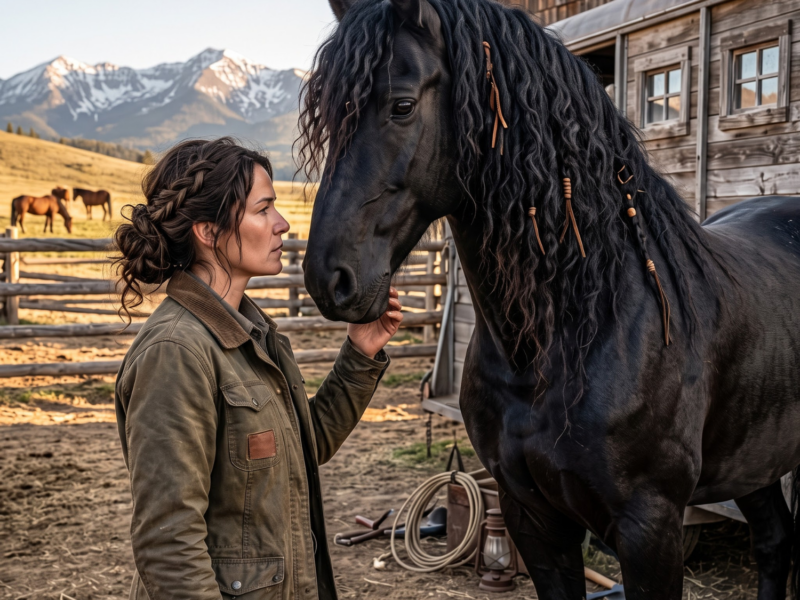
The Horse Breeder Sent the Wrong Stallion to a Widow’s Farm—She Turned It Into Her Greatest Stud
THE TACTICS OF SURVIVAL
Winter came down on western Ohio like an iron gate dropping from a height. The ground froze solid overnight, turning the mud in the paddocks into treacherous, ankle-breaking ruts that could snap a horse’s cannon bone in a heartbeat. The barn smelled of dry dust, old alfalfa, and the sharp, metallic tang of sub-zero air.
For two solid weeks, Ruin did not let Ruth touch him.
Every morning at dawn, she hauled a heavy five-gallon bucket of water and a flake of dry hay to his stall. The routine was rigidly, obsessively the same, designed to give a traumatized mind something predictable to lean against. She would slide the heavy oak door open precisely one inch. Ruin would pin his flat ears against his skull, bare a set of yellowed, dangerous teeth, and lunge at the gap with the speed of a striking cobra.
Ruth would slide the door shut, wait ten minutes in the freezing aisle, and try again.
Eventually, sheer, unadulterated thirst forced a fragile truce. Recognizing that she was not going away, he would retreat to the far corner of the stall, his massive head lowered, watching her every move with the predatory focus of a cornered wolf. She would quickly swap the buckets, shove the hay through the gap, and retreat to safety.
By the third week of December, the situation had deteriorated enough that Ruth called the local veterinarian.
Miller was an old pragmatist who had treated John’s horses for two decades. He smelled permanently of Red Man chewing tobacco, iodine, and cheap wintergreen. He ambled down the aisle, leaned his heavy forearms over the top of Ruin’s stall door, and watched the black horse pace his endless, frantic figure-eight.
Miller spat a dark stream of tobacco juice into a tin cup and shook his head. “Put him down, Ruth.”
“I can’t. He’s my entire breeding budget. He’s the only chance I have to pay the bank.”
“He’s a liability,” Miller said, turning his back on the horse as if the animal were already a carcass. “Look at him. He’s an off-track thoroughbred, likely bounced around the cheap, underground meat auctions in Kentucky. See those pin-firing scars on his front cannons? Some backyard quack tried to blister his tendons to fix his legs. And look at his back—there’s a saddle sore right down to the bone over his spine. Someone pushed him until he broke. And then they beat him because he was broken.”
Miller turned back to Ruth, his eyes hard and pitying—a combination she despised above all others. “You try to breed him, you pass on those fried nerves. You try to handle him, and one morning I’m going to be out here scraping what’s left of you off these oak boards and putting you in the ground right next to John.”
Ruth hated it when people invoked John. They used his death as a conversational trump card, treating her like a grief-addled child who needed to be protected from her own financial desperation.
“Thanks for coming out, Miller,” Ruth said, her voice dropping an octave. “Send me the bill.”
When the vet’s battered Dodge truck crunched down the gravel drive, scattering gravel and blue exhaust, Ruth went back into the barn. It was dead silent. The five mares were turned out in the lower pasture, dots of brown against the frozen snow. It was just her and Ruin in the cold, dusty aisle.
She looked at him through the bars. He was a wreck, yes. But beneath the layers of neglect and scar tissue, he was magnificent. He possessed a deep, powerful chest, strong and wide bone structure, and eyes that burned with an intelligence so hypervigilant it bordered on prophetic. He wasn’t lashing out because he was inherently mean. He was fighting a war that had never ended for him.
Ruth knew exactly what that felt like. She knew what it was like to wake up every single morning waiting for the next terrible thing to drop from the sky, her muscles permanently locked in a brace for impact.
She didn’t reach for a pitchfork. She didn’t grab a lead rope or a sorting pole. Instead, she walked into the tack room, reached past the saddles, and grabbed a faded, green plastic lawn chair.
She carried it back to Ruin’s stall and slid the door open three inches.
Ruin snorted instantly, spinning his massive hindquarters toward her—a textbook, calculated threat to double-barrel kick her skull in.
Ruth stepped inside anyway. She placed the cheap plastic chair flat against the wall, right inside the door. And she sat down.
Ruin stopped dead in his tracks. He whipped his head around over his shoulder, his eyes wide. This was entirely outside his framework of experience. People came into his stall to demand things. To tie him, to beat him, to drag him, to force him into trailers, to make him run faster than his lungs could process oxygen.
They didn’t just sit.
Ruth reached into the deep pocket of her canvas coat and pulled out a battered paperback—an old, thrift-store mystery novel with a cracked spine. She opened it, found her dog-eared page, and started reading aloud.
Her voice was calm, monotone, steady as a metronome. She didn’t look at the horse; she looked at the printed page, letting the cadence of human speech wash over the ammonia-scented air.
For the first hour, Ruin paced. He worked himself into a lather of white sweat despite the sub-zero temperature, blowing snot and dust into the frozen air. He kicked the oak wall with a hollow thump.
Ruth didn’t flinch. She just kept reading about a Chicago detective and a rainy night in 1954.
When her voice finally went hoarse, she stood up, picked up the plastic chair, and walked out without a word.
She did it the next day. And the day after that.
On the fourth day, he stopped pacing after twenty minutes, choosing instead to stand in the opposite corner and watch her with burning curiosity. On the seventh day, he took a single, hesitant step toward her while she read, his neck stretched out like a surveyor’s rod.
It was excruciatingly slow work. There were no cinematic breakthroughs, no swelling orchestral music where the wild, broken horse suddenly laid his head against the grieving widow’s shoulder. There was only the freezing dirt, the harsh smell of ammonia, and the tedious, grinding repetition of proving, hour after hour, that she was not an instrument of pain.
By week three, she could reach out and touch his shoulder.
His skin twitched violently under her gloved hand, the muscles spasming in involuntary anticipation of a blow. When the blow didn’t materialize, he let out a long, ragged exhale that rattled his massive ribs and filled the stall with a cloud of warm, vegetable breath.
By week five, she managed to buckle a stiff leather halter over his poll. She clipped a lightweight cotton lead rope to the brass ring and simply let it hang loose, dragging in the bedding.
Then came the day she had to lead him out.
The stall needed mucking out with a desperate urgency. The ammonia was beginning to sting her eyes, and his overgrown hooves were starting to curl at the toes, trapping manure against his frogs.
She clipped the heavy lead line to the ring. Click.
Ruin went rigid as a marble statue. The ancestral memory of the trailer, the tight ropes, the dragging, and the terror flashed instantly in his dark eyes. He planted his massive front hooves deep into the straw and bedding, turning himself into an anchor of pure muscle and refusal.
Ruth didn’t pull. Pulling meant a contest of raw strength, and a seventeen-hand thoroughbred cross would drag her across the county line without breaking a sweat.
Instead, she stepped right up beside his left shoulder, facing the open barn door.
“We’re going to walk out,” she said quietly, her voice dropping into her chest. “Just out to the center aisle.”
She put a single ounce of steady, unyielding pressure on the lead rope. Just a suggestion of direction.
Ruin balked, throwing his head violently toward the rafters, threatening to rear over backward and crush them both. Ruth didn’t yank back. She didn’t yell or curse. She simply lowered her center of gravity, dug her boots into the packed dirt, and became an immovable object.
“I’m right here,” she murmured.
For ten long minutes, it was a total, agonizing stalemate. The cold air bit at the tip of Ruth’s nose, and her fingers went completely numb inside her wool-lined gloves.
Then, slowly, infinitesimally, the iron tension leaked out of the horse’s thick, scarred neck. He lowered his head, blowing a soft, warm breath against her elbow.
Ruth took a step.
Ruin took a step.
Together, they walked out into the concrete aisle.
He stood there under the fluorescent lights, trembling lightly from head to toe, looking around the barn as if he had just been dropped onto the surface of a foreign planet. Ruth reached into her pocket, pulled out a peppermint wrapped in cellophane, unwrapped it, and held it completely flat on the palm of her bare hand.
Ruin lowered his nose, sniffing the candy with suspicious, whistling breaths. Then, with lips as soft as velvet, he delicately lifted the peppermint from her skin.
Ruth leaned her forehead against his dusty, scarred neck. He didn’t pull away. He was radiating an intense, living heat, smelling of dry hay, old dust, and something wild that refused to be extinguished. But for the first time in his life, he was grounded in the present moment.
“Okay,” she whispered into his coarse black mane. “Okay. Now we have to figure out how to save this farm.”









