The Horse Breeder Sent the Wrong Stallion to a Widow’s Farm—She Turned It Into Her Greatest Stud
THE SPRING RECKONING
Spring arrived in Ohio not with a gentle, poetic thaw, but with a sudden, muddy vengeance. The accumulated snow melted into the lower pastures over the course of forty-eight hours, turning the Blackthorn acreage into a brown, treacherous swamp that sucked the boots right off a person’s feet.
The bank letters stopped coming on cream paper. They arrived on bright, urgent pink paper. Final Notice.
Ruth pinned the latest one to the tack room bulletin board right next to John’s old leather work gloves. It hung there like a daily neon sign pointing toward the edge of a cliff. She had exactly four months to show the loan officer a concrete revenue projection, which meant she needed confirmed pregnancies. She needed Ruin to do the job Hayes swore on a stack of Bibles the horse was incapable of doing.
Breeding horses in a commercial setting is rarely a romantic endeavor. It is mechanical, often violent, and strictly controlled. Hand-breeding a difficult stallion requires breeding hobbles, heavy leather twitches clamped onto sensitive upper lips, and at least three farmhands holding heavy chain leads to ensure the stud doesn’t kill the mare or get his own skull caved in by a flying hoof.
Ruth had done the math, and the math was grim. She couldn’t afford a breeding crew. There was no crew. There was only her.
If she tried to slap a heavy metal chain over Ruin’s nose and drag him into a sterile breeding shed to face a restrained, defensive mare, the delicate architecture of trust they had built over the winter would shatter into dust in three seconds. He would fight the chains, and because of his sheer, raw mass, he would win.
She called Wayne.
Wayne owned the local feed store three miles down the road and ran a few head of commercial Angus cattle on the adjacent property. He was a man who communicated almost exclusively in monosyllabic grunts, pessimistic weather predictions, and unfiltered cigarette smoke.
“You’re out of your mind,” Wayne said, leaning his bony hips against the rusted fender of his pickup truck and spitting a stream of sunflower seed shells into the muck. “You’re gonna turn a rank, off-track thoroughbred stud out loose in a pasture with five seasoned broodmares? They’re gonna tear him to shreds, or he’s gonna run them straight through the perimeter wire and break their legs. It’s gonna be a bloodbath, Ruth. Call the meat truck.”
“I can’t hand-breed him, Wayne. He won’t take the physical restraint.”
“Then sell him for slaughter and get a job behind the counter at the diner in town. John wouldn’t want you getting killed over a ruined animal.”
Ruth didn’t flinch. She had heard variations of that sentence from half the county since the funeral. John wouldn’t want this. As if John had left behind a signed operational manual for how his widow was supposed to starve to death with dignity.
“I need you to stand by the gate with a long lunge whip just in case,” Ruth said flatly, ignoring the advice. “Give me ten minutes. If it goes sideways, you help me separate them.”
Wayne muttered something intensely profane about stubborn widows, but he reached into the truck bed, grabbed a long fiberglass lunge whip with a cracking nylon popper, and followed her toward the barn.
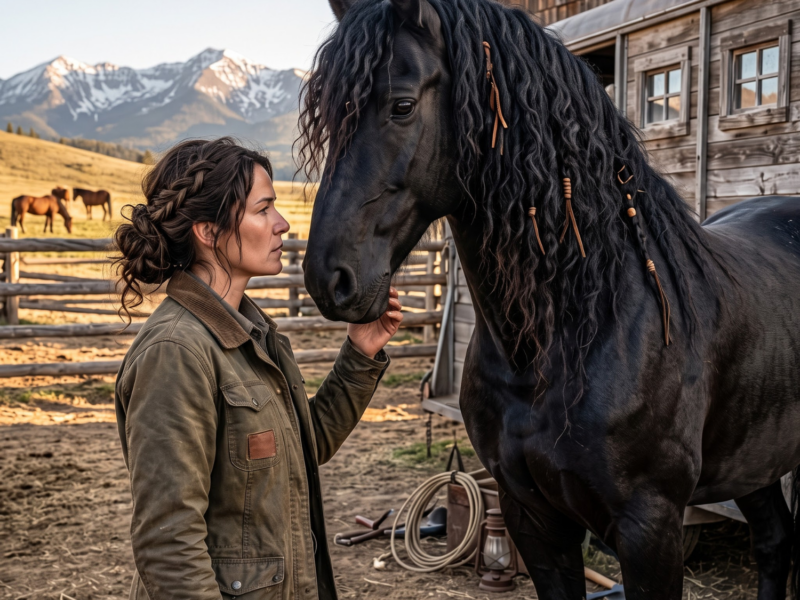
Ruin was shedding his winter coat in massive, rough, patchy clumps, revealing a sleek, jet-black hide underneath that caught the spring sunlight like polished obsidian. He was finally putting on weight; the sharp, starved ridges of his ribs had softened into thick, rolling muscle. When he saw Ruth walking down the aisle, he pressed his nose against the iron bars, blowing a soft, welcoming puff of air against her cheek.
“All right, big guy,” she said quietly.
She clipped a cotton lead to his halter. He walked out of the barn door obediently, his head level with her shoulder, his iron shoes clicking steadily on the concrete apron before sinking into the soft lane.
The five mares were loose in the five-acre lower pasture, knee-deep in emerging clover. At the head of the herd stood Bess. Bess was a red roan quarter horse mare with a chest like a bulldozer and the temperament of a marine drill sergeant. She didn’t tolerate fools, and she certainly didn’t tolerate strange horses invading her domain. If Ruin approached her with the panicked, wild-eyed violence he had arrived with in November, Bess would likely break his jaw with a single, calculated kick.
Ruth led Ruin to the heavy steel gate at the pasture line. Wayne stood ten feet back, gripping the fiberglass whip with white knuckles, his jaw clamped tight on an unlit cigarette.
Ruin saw the mares. His head snapped up, his neck arched into a magnificent, high-crested bow, and the muscles bunched thickly beneath his new coat. He let out a piercing, high-pitched stallion scream that rattled the metal roof of the barn fifty yards away.
The mares stopped grazing instantly. Five heads turned in unison toward the gate.
Bess pinned her ears flat against her skull, her teeth bared.
“Don’t do it, Ruth,” Wayne warned, tightening his grip on the whip.
Ruth unclipped the lead rope, swung the heavy latch, and shoved the gate open.
Ruin didn’t hesitate. He bolted forward into the mud, tearing into the lower pasture with an explosive power that made the wet ground vibrate beneath Ruth’s boots. But he didn’t charge the mares. Instead, he took off along the perimeter fence, galloping with a raw, kinetic energy that made his thoroughbred ancestry sing. His stride was impossibly long, fluid, and powerful—a living engine of speed and muscle.
Bess watched him sprint with absolute, unimpressed disdain. She lowered her heavy head and ripped up another mouthful of tender green grass.
After ten minutes of dead sprinting, Ruin slowed to a heavy, collected trot. He was blowing hard now, his black coat gleaming with dark sweat despite the crisp spring air. He turned his massive frame toward the center of the herd.
Ruth held her breath, her fingernails digging into the wood of the fence rail.
He didn’t charge. He approached Bess at a slow, deliberate, almost apologetic walk. He stopped exactly twenty feet away—just outside her personal defensive perimeter. He lowered his head, chewing the air rapidly with his lips in a submissive, pacifying gesture.
Bess took two deliberate steps forward, stretching her neck out to test him. Ruin extended his muzzle to meet her.
They bumped noses—a brief, quiet, electric touch.
Then Bess squealed, spun on her hindquarters, and lashed out with both hind legs in a vicious warning arc. The iron hooves whistled through the spring air, missing Ruin’s chest by less than three inches.
Wayne raised the lunge whip, stepping forward. “Here we go—”
“Hold,” Ruth snapped, her voice like a whipcrack.
Ruin hadn’t retaliated. He didn’t strike back or squeal in anger. He simply took three smooth steps backward, dropped his head back to the dirt, and started grazing, respectfully keeping his distance.
He wasn’t a monster. He understood herd dynamics far better than he understood the humans who had beaten him. He knew how to read a room, how to back down without losing face, and how to wait for an invitation.
Over the next three weeks, Ruth watched from the farmhouse porch with her morning coffee as Ruin courted the mares with a patient, immovable persistence. He stood watch over them while they slept in the warm afternoon sun. When Wayne’s curious Angus cattle crowded too close to the fence line, Ruin would trot over, putting his massive black body squarely between the mares and the perceived threat, lowering his neck in a silent challenge until the cattle drifted away.
When the biological imperative finally took over, there was no violence, no forced restraint, and no terror. There was only the ancient, quiet rhythm of nature playing out in the green Ohio grass.
By late May, Miller pulled his truck down the drive again. He walked out to the pasture carrying his portable ultrasound machine and a bucket of warm water. Ruin stood nearby, watching the vet closely with pricked ears, but he didn’t charge or threaten. He simply kept himself positioned squarely between Miller and Bess, calm as a sentry on a palace wall.
Miller wiped ultrasound gel off the mare’s flank, stared at the flickering black-and-white monitor, and let out a low whistle. He slowly straightened up, a wry, disbelieving smile cracking his weathered face.
“Well, I’ll be damned,” Miller muttered, wiping his hands on a rag. “She’s caught. In fact… they’re all caught, Ruth. All five of them.”
Ruth leaned her forehead against the rough wooden fence post. The relief washed over her with such physical force that her knees went weak, and she had to grab the top rail to keep from sliding into the clover.
“They’re pregnant?”
“They are,” Miller said, packing his gear. He looked over at the black stallion grazing peacefully in the spring sun. “I’ll eat my hat, Ruth. You got lucky with this one. But foals don’t pay the bank until they’re on the ground, standing on four legs, and sold to the highest bidder. A whole hell of a lot can go wrong in eleven months.”
“I know,” Ruth said quietly. But for the first time since John died, the crushing, leaden weight in her chest lifted just a fraction of an inch.









