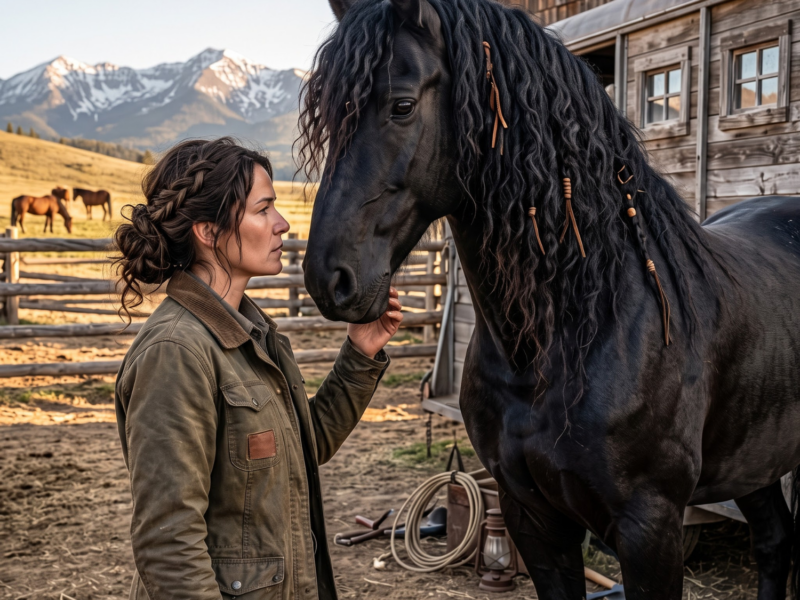
The Horse Breeder Sent the Wrong Stallion to a Widow’s Farm—She Turned It Into Her Greatest Stud
THE CROP OF BROKEN DREAMS
The following winter tested the structural and emotional integrity of everyone on the property. It was a relentless assault of freezing rain, ice storms, and sub-zero nights that coated the barns in glittering, dangerous armor. Ruth practically moved into the foal barn, sleeping on a stiff canvas cot in the corner of the tack room with a small space heater glowing orange against the damp chill, waking every two hours to check the heavy, swollen bellies of the mares.
Ruin spent the winter in the adjacent paddock. He had grown a thick, plush winter coat that made him look like a mythical beast, and the haunted, hollow look in his eyes was permanently gone. He recognized the specific rumble of Ruth’s truck engine down the lane. He knew the heavy, rhythmic thud of her boots on the gravel.
The first foal arrived in late March during a howling sleet storm that plastered the windows with gray ice.
Bess went down in the deep, clean straw of the foaling stall around midnight, her massive sides heaving with rhythmic groans. Ruth knelt beside her in the straw, her bare arms slick with warm amniotic fluid, guiding the heavy front legs and muzzle into the freezing world.
When the colt slid free, it was immediately clear he wasn’t a standard, blocky quarter horse. He had his mother’s deep, muscular hindquarters and strong bone, but his neck was long and impossibly elegant, and his legs were clean and fine as blown glass.
Within thirty minutes, the newborn wobbled to his feet, shaking the wet afterbirth from his tiny frame. He was completely, startlingly black, just like his sire, save for a single, sharp white star burning in the center of his forehead.
Over the next two weeks, the remaining four mares dropped their foals with clockwork precision. Every single birth was unassisted. Every single foal survived.
And every single one was a striking, high-performance athletic hybrid. They possessed the calm, unflappable cow-sense minds of the quarter horse mothers, fused seamlessly with the explosive agility, deep lung capacity, and sheer skeletal size of the traumatized thoroughbred stallion.
By the time autumn painted the hardwood ridges in shades of copper and rust, the foals were robust, independent weanlings, kicking up their heels in the lower pasture.
And the bank’s final deadline had officially arrived.
Ruth arranged an open farm sale—a massive, high-risk gamble that could either save her or finish her off. She had spent the last remnants of her available credit on a quarter-page advertisement in The Midwest Horseman, a regional livestock magazine that circulated among professional trainers and sport-horse breeders.
The text of the ad was stark and unadorned: Unique sport-horse crosses. Dam lines: Working quarter horse. Sire: Unregistered black thoroughbred cross. Unbroken, but handled daily from birth. By private treaty.
On the morning of the sale, the driveway was entirely empty at 8:00 AM.
At 9:00 AM, the bank called. Ruth let the phone ring out until the machine picked up. She stood by the paddock fence, watching the five black and bay weanlings gallop through the crisp autumn air, their breath pluming white in the morning sun. Ruin stood quietly in his separate pen across the aisle, chewing alfalfa with an unbothered dignity, occasionally glancing up to watch his offspring tear across the turf.
At 9:30 AM, a shiny dual-axle Ford pickup truck pulling a matching aluminum four-horse gooseneck trailer crunched down the gravel drive.
Ten minutes later, a weathered horse trailer arrived. Then three more trucks from Kentucky and Pennsylvania. Word had leaked out through the quiet grapevine of the horse world. Maybe Wayne had talked down at the feed store; maybe Miller had dropped a hint to his deep-pocketed clients in Columbus.
By 10:00 AM, twenty prospective buyers were standing against the oak fence rails, nursing bad coffee from thermoses, pointing fingers and murmuring assessments as the weanlings circled the paddock.
A man named Cole leaned against the top rail beside Ruth. He was a professional eventing trainer and bloodstock agent from a high-end equestrian facility two hours north. He wore expensive, custom-oiled leather paddock boots and a tailored wool jacket that looked absurdly out of place against the peeling white paint of Ruth’s barn.
“I heard a rumor about some accidental crosses down this way,” Cole said, his eyes tracking Bess’s black colt as the youngster executed a flawless, sliding stop in the mud, spun on his hocks, and launched into a dead sprint. “They aren’t accidents, are they?”
“No,” Ruth said flatly, keeping her hands jammed deep in her pockets. “They’re exactly what I bred for.”
Cole studied the colt, his professional gaze measuring bone angles, shoulder slants, and hock placement. “He’s got a massive engine on him. Looks like he could clear a five-bar gate without drawing a breath. But what’s the mind like? I don’t buy crazy horses. My clients will break their necks on a hot-headed project. I heard the sire was a rogue. Some broken-down killer a commercial breeder dumped on a widow.”
Ruth didn’t flinch. She didn’t offer an emotional defense of Ruin. She didn’t tell the rich trainer about the scars, the starvation, or the winter evenings spent reading Agatha Christie paperbacks in a freezing stall just to prove to an animal that humanity wasn’t entirely made of leather whips.
She simply turned her head and pointed a finger toward the adjacent paddock.
“Go look for yourself.”
Cole walked over to Ruin’s pen, stepping cautiously as the massive black stallion paused his chewing.
Ruin walked slowly to the fence line, lowered his head with an unhurried grace, and let the stranger scratch him behind his velvety ears. Ruin closed his eyes, leaning his heavy, broad forehead directly into the trainer’s palm, completely relaxed, grounded, and present in the world.
Cole stared at the horse for a long moment, then walked slowly back to where Ruth stood by the rail, pulling a leather checkbook out of his inner jacket pocket with a thoughtful expression.
“What do you want for the black colt?” Cole asked.
“Ten thousand dollars,” Ruth said without blinking.
It was double what a standard quarter horse weanling commanded in this part of Ohio, and Cole knew it. But he also knew quality when he saw it standing in the mud.
Cole didn’t even blink. “I’ll write the check right now. But I want the bay filly out of the mare with the white sock, too. Make it eighteen thousand dollars for the pair.”
By noon, all five foals were sold.
The checks sitting folded inside Ruth’s coat pocket totaled forty-two thousand dollars. It was more than enough to clear the immediate arrears on the mortgage, overhaul the tractor’s engine, replace the rotting roof boards on the hay shed, and secure the Blackthorn farm for another three years.
The horse trucks loaded up one by one. The buyers drove away down the gravel lane, leaving the farm quiet once more.
The mares stood by the fence line, calling out to the empty driveway for an hour before finally accepting the silence and lowering their heads back into the grass.
Ruth walked slowly over to Ruin’s paddock. The late-afternoon sun was casting long, golden shadows across the packed dirt, turning the autumn air to amber.
She rested her forearms on the top rail. Ruin ambled over immediately, bumping his soft nose gently against her shoulder, rummaging through the folds of her jacket in search of his daily peppermint.
Ruth laughed—a genuine, musical sound that startled a flock of sparrows off the barn roof—and pulled a peppermint from her pocket. She unwrapped it and laid it flat on her palm. Ruin took it softly, his thick whiskers tickling her skin.
She looked out across the acreage. The fences still needed a coat of white paint. The barn roof was still slightly sagging in the middle. John was still gone, and the dull, phantom ache in her chest would probably never completely disappear. But the ground beneath her boots felt solid, unyielding, and real.
“Hayes called yesterday,” Ruth said softly, scratching the thick, muscular expanse of the horse’s neck. “He saw the magazine ad. Wanted to know if he could buy you back. Offered me five thousand dollars.”
Ruin snorted, chewing the mint with a loud, contented crunch.
“I told him you weren’t for sale,” she smiled, leaning her forehead against the warm, hard plane of his jaw. “I told him he sent me the wrong horse… but that he sent me exactly the one I needed.”
Ruin pressed his heavy forehead against her chest, holding her there in the quiet Ohio dusk. He was finally home.
And if you have ever had to build something beautiful out of the broken, jagged pieces someone else left behind, you know down to your bones exactly what Ruth and Ruin faced. They proved that survival isn’t about being polished, unbroken, or perfect. It is about refusing to let the world break you twice.









