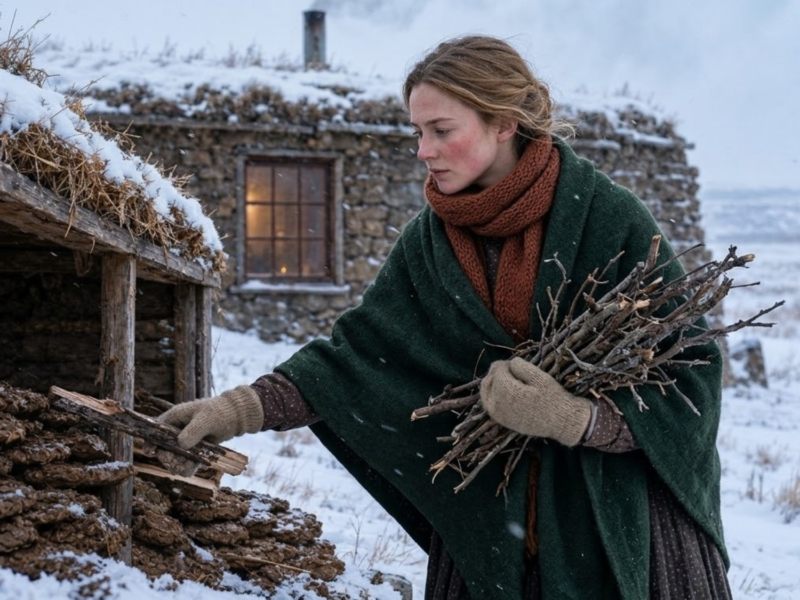
They Built a House Out of the Prairie — Then the Fuel Pile Had to Last Until Spring
The Ribbon of the Earth
The first critical decision was where to cut.
Xaver wanted to harvest the sod on the slope of the hill, right beside their building site, to save the exhausting labor of hauling heavy earth. Ursula walked the claim with a sharp spade, driving it deep into the soil and pulling it back to inspect the layers.
“No,” she said, shaking her head. “Not here.”
“Why not? It’s closer,” Xaver argued, wiping sweat from his forehead.
“Because sod from the slope is thin and sandy,” Ursula explained, running a crumbling handful of earth through her fingers. “It will crumble into dust in the first wet spring. If we build, Xaver, I mean to live inside these walls for years. We need the deep mat.”
She found what she was looking for in a low, flat valley where the native buffalo grass and little bluestem grew dense and short, their intricate, ancient root systems weaving the soil together like threads in a fine Persian rug.
Then came the cutting.
Xaver hitched the team to the breaking plow, and together they sliced the prairie into long, even ribbons, measuring about twelve inches wide and four inches thick. Behind the plow, Ursula followed with a sharp spade, chopping each heavy ribbon into manageable blocks roughly three feet long. By the time their arms burned and the horses foamed with sweat, they had turned over an entire acre of vibrant prairie just to make a single, small room.
Next came water. In the sandhill valleys, the water table sat tantalizingly close beneath the grass, but reaching it meant backbreaking labor. For the first few weeks, their supply came from the Middle Loup River itself, hauled in two wooden barrels roped upright in the wagon bed.
Then Ursula chose their permanent site on the flat, and Xaver dug a well by hand, lining the narrow shaft with stones so the sides would not cave in on him. Every drop came up one bucket at a time on a rope wound around a wooden windlass. Hand-drawn water was never quite enough for thirsty animals, and Clover the cow was always thirsty. Morning and evening, through scorching summer heat and freezing winter gales, the bucket went down and came up.
With the earth turned and water secured, Ursula laid out the floor plan: fourteen by sixteen feet.
She laid the first course of sod entirely by herself. Every single brick went in grass-side down. It was an iron rule rooted in simple biology: turned over, the grass died, and the rotting roots knitted each brick firmly to the one below it. In time, the wall would cease to be a stack of loose blocks and become one continuous, monolithic piece of earth.
She set the bricks two across, creating a wall roughly two feet thick. Every few courses, she turned the direction, laying a row crosswise so the blocks locked together like a woven basket, staggering the vertical joints to prevent cracks. Into every gap she pressed loose dirt, smoothing it with her bare hands.
“Two feet?” Xaver asked one afternoon, resting a heavy sod brick on his knee. “We could go thinner and be done sooner. My back is breaking, Ursula.”
She thought of February. Two feet of packed earth was slow to warm in the morning, but it was infinitely slower to give its warmth away at night. “We go two feet,” she said quietly.
It cost them more sod and days of agonizing lifting. But as the months wore on, she knew it was the best trade she would ever make.









