They Built a House Out of the Prairie — Then the Fuel Pile Had to Last Until Spring
The Winter’s Harvest
As the summer waned, the prairie grass cured to a brilliant gold, and the Yosts’ winter fuel began to accumulate outside.
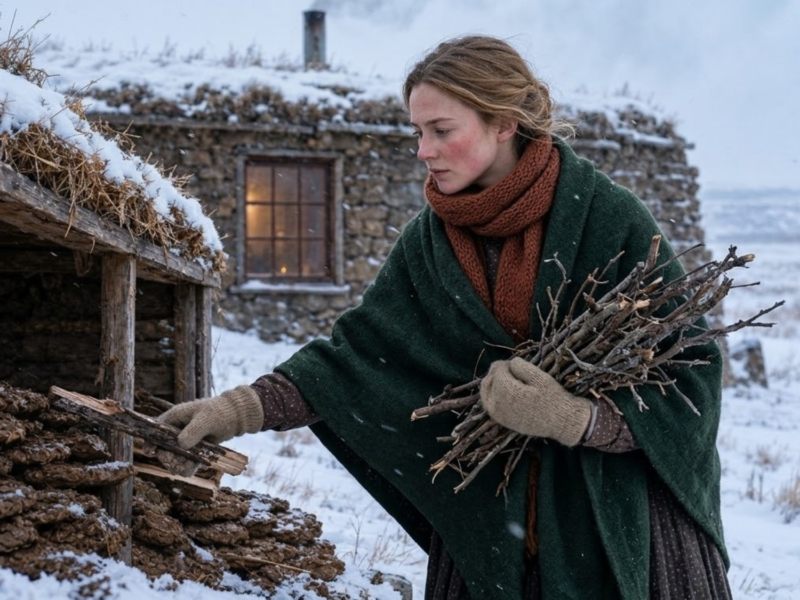
Because there was no firewood, they burned what the untamed land provided. First were the cow chips—droppings left by cattle grazing the open range, baked bone-dry by the summer sun. Dry chips burned with surprising efficiency, though damp ones only hissed, smoked, and choked the fire. Every morning, Ursula walked the range with a wicker basket; every evening, she walked behind Clover with a keen eye.
Second were corn cobs. Their small harvested field yielded baskets of cobs that caught flame instantly, perfect for kindling. Third were wild sunflowers whose thick, sun-dried stalks made a quick, bright blaze.
Fourth, and most labor-intensive, was hay. Heavy slough grass from the low, wet ground was cut and stacked in the fall. Loose hay flared up and vanished in seconds, but when twisted tightly by hand into hard knots—sometimes called “cats”—it held together long enough to provide steady heat.
Ursula’s hands quickly grew calloused, cracked, and rough from twisting hay hour after hour by the lamplight.
Cooking on these primitive fuels required constant vigilance. Chips and twisted hay burned hot but fast, meaning a cook could never walk away from the stove. Ursula learned to mix her dough and ready her ingredients completely before touching a match. Once the fire was lit, she stood beside the iron stove, feeding it a few chips at a time until the baking pans came out.
The byproduct of this fuel was mountains of ash. There was an old sandhills joke about a husband and wife who rarely saw each other except when one was carrying ashes out while the other carried fuel in. In the Yost house, the ash pail went out every single morning without fail.
By October, the chip pile reached Ursula’s shoulder, the cob barrel was brimming, and a solid haystack stood behind the house.
Yet danger lingered in the golden grass. Prairie fire was a terrifying threat whenever the plains dried out. While an earth-built soddy was immune to leaping flames, everything stacked outside to keep them alive would burn in an instant.
To protect their lifeline, Xaver plowed a wide fireguard—a strip of bare, exposed earth encircling the house, the shed, and the haystack. Ursula walked the perimeter with him, insisting he widen the circle far beyond standard practice.
“The house is earth,” she told him, wiping soot from her brow. “It can take the heat. It’s our fuel and our animals that need saving.”









