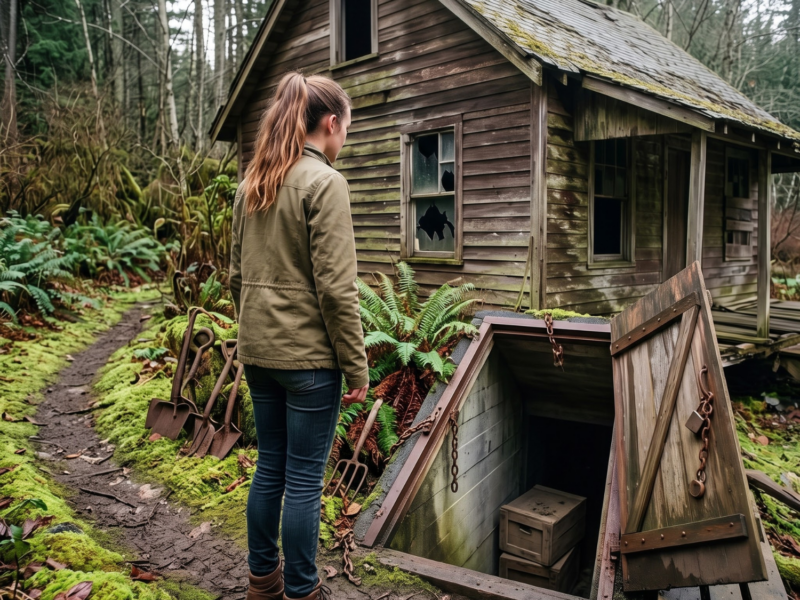
They Mocked the $1 Cottage She Bought—Until a Hidden Tunnel Led to Her Inheritance
Blood, Bleach, and Spite
The first week was a masterclass in physical suffering. Norah’s days were measured not in hours, but in blisters.
She had traded the last of her cash for heavy-duty construction trash bags, gallons of industrial bleach, a crowbar, and a cheap sleeping bag. By day three, her hands were cracked and bleeding, the knuckles wrapped in graying medical tape. The cold was a living, breathing entity that lived in the corners of the cottage, seeping into her bones the moment the sun dipped below the tree line.
Elias Harrelson had been a hoarder of the worst kind. The front rooms were packed waist-high with waterlogged cardboard boxes, rusted car parts, and stacks of encyclopedias fused together by decades of dampness. Norah worked in grim, methodical silence. She hauled bag after bag out to the dirt driveway, slowly building a small mountain of debris. She learned the hard way to avoid the soft spots in the floorboards, where the wood had turned to a spongy mush that threatened to drop her straight into the crawl space below.
The town of Oak Haven didn’t leave her alone. They couldn’t resist the spectacle. Cars would slow down as they passed the edge of Black Creek Road, headlights sweeping over her ruined domain. Teenagers threw empty beer cans into the tall grass near her rusted mailbox.
On Thursday morning, Greg, the local contractor who had laughed the loudest at the auction, pulled his heavy-duty pickup truck into her driveway. Norah was in the middle of dragging a moldy, heavy mattress across the front porch when he rolled down his window. He leaned out, a toothpick clamped between his teeth, surveying the ruined cottage with undisguised contempt.
“Morning, Norah,” Greg called out, the massive diesel engine of his truck rumbling aggressively. “See you’re doing some landscaping.”
Norah dropped the mattress. She wiped a streak of grime from her forehead with the back of her taped hand, leaving a dark smudge across her pale skin. “What do you want, Greg?”
“Arthur asked me to drive by. Check on you. Make sure the roof hasn’t caved in on your head yet.” He spat the toothpick onto the mud. “Look, I’ll give it to you straight. You’re wasting your time. The joists are rotting. The foundation is cracked. It’s a tear-down. Tell you what—I’ll bring an excavator out here next week. Haul it all to the dump. Clear the lot. I’ll do it at cost, just to help you out. Once it’s flat dirt, you might be able to flip the land for a couple grand.”
“It’s not a tear-down,” Norah said. Her voice was scratchy from breathing a week’s worth of dust. “And I don’t have the money to pay you anyway.”
Greg let out a short, harsh laugh. “Suit yourself. Don’t come crying to the town council when you freeze to death in December.”
He rolled up the window and backed out, spinning his heavy tires deliberately to kick up a spray of muddy gravel across her legs. Norah watched him leave, her jaw clenched so tight her teeth ached. She turned back to the house. The sight of it—sagging, pathetic, decaying—fueled a hot, burning anger in the pit of her stomach. She marched back inside, grabbed her crowbar, and went to work on the kitchen.
The kitchen floor was covered in three layers of hideous, cracked linoleum. The bottom layer, a mustard-yellow floral pattern from the 1970s, had been glued down with an adhesive that had hardened into something resembling concrete. Norah dropped to her knees. She wedged the sharp end of the crowbar under a peeling edge of the linoleum and threw her weight backward. A chunk of plastic ripped free with a sound like tearing fabric.
She worked for hours, fueled by nothing but stale bottled water and sheer spite. She wanted to strip the house down to its bones. She needed to see what was underneath the rot to prove to Arthur, to Greg, to the entire smug town of Oak Haven that she hadn’t made a mistake.
By late afternoon, the winter sun was casting long gray shadows through the cracked windows. Norah was exhausted. Her arms felt like lead. She had managed to clear the center of the kitchen floor, revealing the original hardwood beneath. The planks were wide-plank oak, dark and stained with water damage, but structurally sound.
She paused, sitting back on her heels, breathing heavily. The house was utterly silent, save for the wind rattling the loose shingles outside.
Norah frowned. She wiped the sweat from her eyes and looked down. A sharp, icy draft was blowing against her shins. She looked at the baseboards. They were flush against the wall. The draft wasn’t coming from the perimeter of the room. It was coming from the floor beneath her.
She shifted her weight, tracing the cold air with her bare hand. It was rising from a seam in the hardwood. But as she looked closer, wiping away decades of dirt and dried adhesive, she realized it wasn’t just a seam between two planks.
It was a perfect square.
Someone had cut a three-foot by three-foot square into the center of the oak floor.









