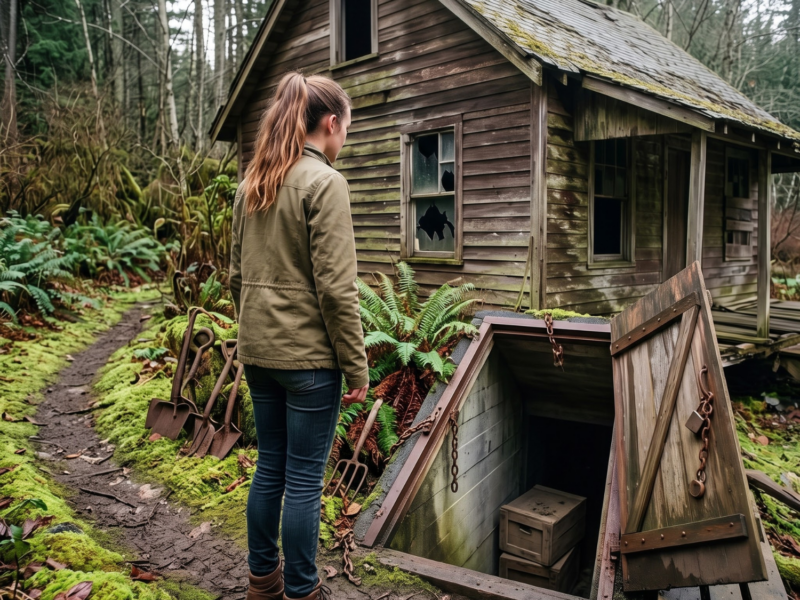
They Mocked the $1 Cottage She Bought—Until a Hidden Tunnel Led to Her Inheritance
The Ghost’s Hoard
The air grew colder with every step, but the dampness of the swamp above vanished entirely. It was replaced by a clinical, desert-like dryness. She counted fifteen steps before her boots hit a solid concrete floor.
She swept her phone light in a slow, sweeping arc. She was standing in a narrow corridor, roughly four feet wide and thirty feet long. Thick, rubber-coated electrical wires ran along the ceiling, leading to caged industrial light fixtures that had long since lost power. The walls were lined with heavy-duty metal shelving.
And the shelves were not empty.
Norah walked forward slowly, her breath pluming faintly in the cold air. The first set of shelves held rows of plastic, airtight drums. She popped the lid off one. It was filled to the brim with vacuum-sealed bags of rice, dried beans, and what looked like military surplus rations. Decades old. Worthless. Elias had been preparing for the end of the world.
She moved further down the corridor. The next set of shelves held ammunition boxes—heavy, green steel crates stacked five high. She didn’t touch them.
At the very end of the tunnel, the corridor widened into a square room. The beam of her phone light caught a dull, metallic reflection. Sitting in the center of the room was a large, heavy safe. It wasn’t a modern electronic lockbox; it was a massive antique floor safe, standing four feet tall, made of solid iron with a large brass combination dial.
But it wasn’t the safe that made Norah stop breathing.
Stacked against the far wall, hastily piled as if Elias had run out of time or energy to properly store them, were dozens of heavy canvas bank bags. Several of them had rotted away at the seams, their contents spilling out onto the concrete floor in a chaotic, glittering avalanche.
Norah dropped to her knees. The concrete bit into her bruised legs, but she didn’t feel it. She reached out with a trembling hand and picked up a rectangular block from the spill. It was heavy. Unbelievably heavy for its size. It was the size of a thick paperback novel, coated in a layer of dust and tarnished to a dull charcoal gray.
She rubbed her thumb hard across the surface, scraping away the grime. The metal beneath gleamed with a soft, whitish luster. Stamped into the center of the bar were clear block letters:
ENGELHARD. 100 TROY OUNCES. 999 FINE SILVER.
Norah stared at it. Her brain refused to process the information. She set the bar down and grabbed another from the ripped canvas bag. It was identical. She aimed her phone light at the pile. There were dozens of them. Hundreds of them. The canvas bags were stacked three deep, completely filling the corner of the room.
She crawled toward a different stack of smaller wooden crates next to the safe. The top crate was unsealed, the lid resting loosely on top. She pushed it aside.
Gold. Not bars, but coins. Thousands of them, packed in neat plastic protective tubes. She pulled one of the tubes out, popped the plastic cap, and slid a coin into her palm. It was an American Gold Eagle, one ounce, dated 1998. It caught the harsh LED light of her phone and threw it back in a warm, blinding glare.
“Oh my god,” Norah whispered.
The sound of her own voice terrified her. It echoed in the dry, dead air of the bunker. She dropped the coin back into the tube and scrambled backward, her heart hammering a frantic, violent rhythm against her ribs. Elias Harrelson wasn’t just a crazy old man who collected trash. He was a man who trusted absolutely no one. He didn’t trust banks. He didn’t trust the government. He had liquidated his entire estate—maybe inherited wealth, maybe something else—and buried it in untraceable precious metals beneath a house he deliberately let rot to deter anyone from looking.
And the county had just sold it to her for one dollar.
Norah sat on the cold concrete floor, surrounded by a fortune, and did the only thing her exhausted, overloaded nervous system could handle. She put her face in her dirty, blistered hands and began to laugh.
It started as a breathless gasp and grew into a loud, echoing, hysterical laugh. Tears streamed down her face, cutting tracks through the dust and grime. She laughed until her ribs ached. She laughed at Arthur’s smug face in the municipal building. She laughed at Greg the contractor offering to tear the house down for a favor. She laughed at the creditors who had drained her bank accounts and told her she was ruined.
The flashlight on her phone flickered as the battery dipped to five percent.
The sudden dimming snapped her back to reality. The survival instinct honed by five years of brutal business warfare kicked in. The hysteria evaporated, instantly replaced by a cold, sharp clarity. She was alone in a condemned house in the woods. Nobody knew what was down here. But if anyone in Oak Haven found out, the town council would immediately file an injunction. They would claim a clerical error. Arthur would suddenly decide she was mentally unfit and try to assume control of her assets. They would tie her up in court for decades until the legal fees bled her dry.
She couldn’t tell a soul. Not yet.
Norah grabbed her phone, picked up a single 100-ounce silver bar, and stuffed it into the deep pocket of her coat. She practically ran up the concrete stairs. She hauled the heavy wooden trapdoor shut, the iron ring clanking softly into place. She dragged the heavy, moldy mattress she had abandoned earlier directly over the seam, covering it entirely.
She sat on the mattress in the freezing ruined kitchen, the heavy weight of the silver bar pulling at her pocket. She didn’t sleep a single wink that night. She just sat in the dark, watching the door, her hand tightly gripping the steel crowbar.









