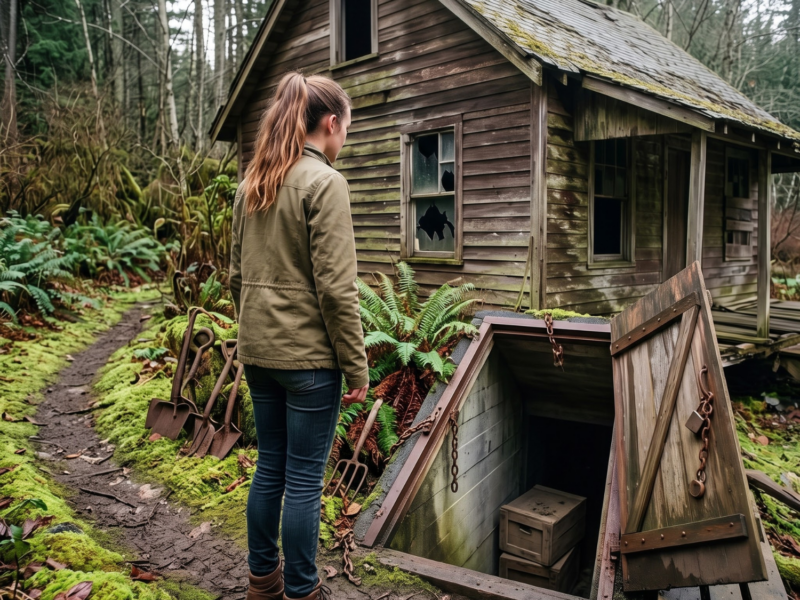
They Mocked the $1 Cottage She Bought—Until a Hidden Tunnel Led to Her Inheritance
Armor of Silver
The morning sun did nothing to warm the Oak Haven woods. It simply illuminated the frost clinging to the shattered windows of the cottage. Norah was already moving.
She had stripped off her ruined clothes, washed her face with freezing bottled water, and changed into a clean black turtleneck and dark jeans from her suitcase. She wrapped the silver bar in a thick wool sweater and placed it at the bottom of a nondescript canvas tote bag. She needed cash. Real, liquid cash to secure the property legally, pay the back-owed utility fees to get the power turned on, and hire a lawyer who didn’t play golf with Mayor Higgins.
She drove out of Oak Haven, ignoring the speed limit. She bypassed the neighboring county entirely, driving two and a half hours south until the dense pine forests gave way to the sprawling concrete arteries of the city. She didn’t stop until she found a high-end commercial district lined with secure storefronts.
She parked three blocks away from a place called Apex Numismatics and Bullion. The storefront had barred windows, thick security glass, and a buzzer system. Norah pressed the intercom button. A heavy magnetic lock clicked, and she pushed the door open.
The shop smelled of floor wax and old paper. Behind a reinforced glass counter stood a man in his late sixties. He wore a crisp vest and had a jeweler’s loupe resting on his forehead. He looked up from a velvet tray of silver dollars, his eyes scanning Norah’s disheveled hair and the dark circles under her eyes. He looked exactly like a man who was used to desperate people trying to sell stolen jewelry.
“Can I help you?” he asked. His tone was polite, but guarded.
“I need an appraisal,” Norah said. She unzipped the canvas tote, reached past the wool sweater, and hoisted the heavy silver bar onto the glass counter. It landed with a dull, substantial thud.
The man’s demeanor changed instantly. He reached under the counter, pulled out a pair of white cotton gloves, and slid them on before touching the bar. He turned it over, examining the stamped lettering.
“Engelhard. 100-ounce extruded,” he muttered. He pulled the jeweler’s loupe down over his right eye and inspected the surface. “Tarnished, but that doesn’t affect the weight. Where did you get this?”
“An inheritance,” Norah lied smoothly. “My grandfather was paranoid about the banks.”
The man chuckled dryly. “He wasn’t the only one. Engelhards carry a premium. People like the vintage stamp. I can test it, but assuming it passes the specific gravity and acid tests, you’re looking at spot price plus about two dollars an ounce.”
“How much is that, exactly?” Norah asked, keeping her voice entirely flat.
The man tapped a few keys on a computer terminal behind the counter. “Silver spot is hovering around thirty-two dollars today. Plus the premium… I can offer you thirty-four hundred dollars for this bar, right now. Cash or wire.”
Norah stared at him. Thirty-four hundred dollars for one bar. She thought about the subterranean room. The canvas bags piled three deep against the wall. There had to be at least two hundred bars down there. Maybe three hundred. Plus the gold coins. Her lungs felt tight. She fought to keep her expression neutral.
“Cash, please.”
“I’ll need to drill a tiny test hole in the back. Standard procedure for bars this thick. To ensure it’s not lead-filled.”
“Do it,” Norah said.
She watched in silence as the man took the bar into a back room. Ten minutes later, he returned. He opened a heavy floor safe beneath the register and began counting out hundred-dollar bills. He slid a stack of thirty-four crisp notes across the counter, along with a carbon copy receipt.
“If your grandfather left you any more of these,” the man said, looking at her with a renewed sense of respect, “I’m always buying.”
“I’ll keep that in mind,” Norah said. She shoved the cash into her coat pocket, turned, and walked out the door.
When she got back to her car, she locked the doors, gripped the steering wheel, and let out a long, ragged exhale. The money in her pocket was a shield. It was the first real piece of armor she had worn in five years.
Her phone buzzed in the cup holder. The caller ID flashed Arthur.
Norah stared at the screen. Yesterday, that name would have triggered a spike of anxiety and shame. Today, she just felt a profound, icy calm. She tapped the green button and put the phone on speaker.
“Norah,” Arthur said. His voice was clipped, carrying that familiar tone of exasperated authority. “Where are you?”
“I’m out,” Norah said. “What do you want, Arthur?”
“I just got off the phone with Greg. He said you turned down his offer to clear the lot. Look, I’m trying to help you. I spoke to Mayor Higgins this morning. The county building inspector is going to formally condemn the Harrelson structure on Monday. It’s a liability. If someone walks onto the property and the roof collapses on them, you’re going to be sued into oblivion.”
Norah’s eyes narrowed. They were moving fast. They wanted her off the land before she could establish residency.
“You called Higgins?” Norah asked softly.
“I’m trying to protect you from your own stubbornness!” Arthur snapped. “Greg is willing to give you a thousand dollars for the deed today. He’ll take on the demolition costs. You make a nine-hundred-and-ninety-nine-dollar profit. You can use it to rent a decent apartment in town. Stop playing contractor, Norah. It’s pathetic.”
A slow, sharp smile spread across Norah’s face. She looked out the windshield at the bustling city street.
“Arthur,” Norah said, her voice dripping with absolute serenity. “Tell Greg to go to hell. And tell Mayor Higgins if he sends a building inspector to my property without a warrant, I’ll have them arrested for trespassing.”
“Norah, you don’t have the money to fight this—”
“I have to go, Arthur. I have a lot of renovations to do.”
She hung up the phone.









