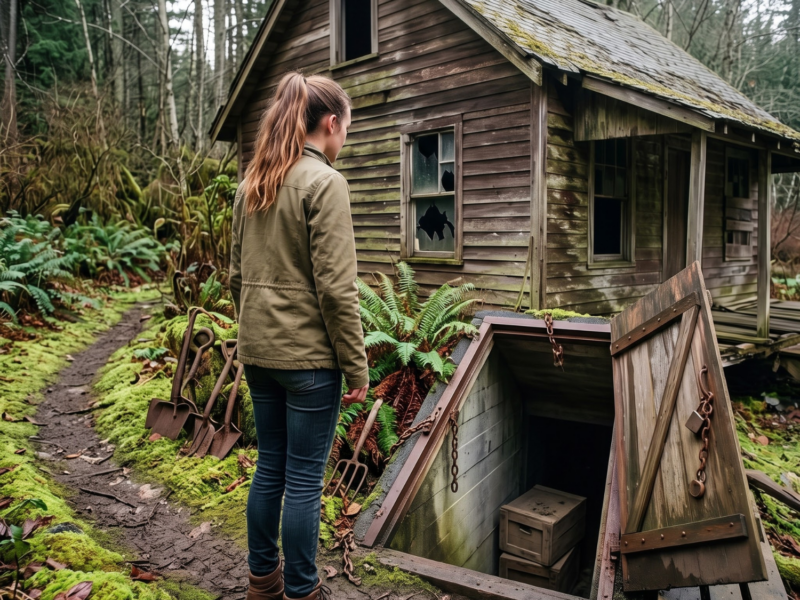
They Mocked the $1 Cottage She Bought—Until a Hidden Tunnel Led to Her Inheritance
Fortifying the Ruin
She didn’t drive back to Oak Haven immediately. Instead, she searched for the nearest high-end hardware store. She had money now. It was time to secure her fortress.
Norah did not buy groceries. She did not buy a hot meal or a warm coat. She drove straight to a heavy industrial hardware supplier on the edge of the city limits. She bought four commercial-grade steel deadbolts, heavy-duty hinges, a battery-powered drill, three motion-activated trail cameras, and one hundred feet of thick, galvanized steel chain. The total came to eight hundred dollars. She paid in crisp hundred-dollar bills and loaded the heavy boxes into her rusted sedan.
By the time she returned to Oak Haven, the sun was sinking below the tree line, casting long, skeletal shadows across Black Creek Road. The cottage looked exactly as she had left it: a miserable, sagging pile of wet wood. But Norah didn’t see a ruin anymore. She saw camouflage.
She worked straight through the fading light. She drilled into the swollen, waterlogged wood of the front and back doors, anchoring the heavy steel deadbolts into the only solid studs she could find. She strapped the trail cameras to the weeping willow trees, angling the motion sensors to cover the dirt driveway and the perimeter of the house. Finally, she dragged the heavy galvanized chain across the entrance of the driveway, securing it between two massive oak trunks with a weatherproof padlock.
Her hands were bleeding again by the time she finished, but she didn’t care. She locked herself inside, drew the rotting curtains, and went straight to the kitchen.
She hauled the damp mattress aside. The iron ring felt less like an anchor now and more like a handshake. She pulled the trapdoor open, grabbed her newly purchased high-lumen tactical flashlight, and descended into the freezing, dry air of the bunker. She needed to know exactly what she was dealing with. The hysteria from the previous night had burned away, leaving a cold, calculating machine in its wake.
Norah approached the stack of canvas bank bags first. She began counting. Not every individual bar, but the bags themselves. Three bags per row, five rows deep, stacked four high. Sixty bags in total. She sliced one of the intact bags open with a utility knife. It contained five of the 100-ounce Engelhard silver bars.
Three hundred bars in total. At $3,400 a piece, the silver alone was worth over a million dollars.
Norah sat back on her heels. A million dollars. It was a life-changing amount of money. It was enough to walk away, buy a house in the suburbs, and never look back. But the silver was just the appetizer.
She turned her flashlight toward the wooden crates. There were ten crates. She opened the first one. It held fifty plastic tubes, each containing twenty 1-ounce gold coins. One thousand ounces of gold per crate. Ten crates.
Ten thousand ounces of pure, untraceable American Gold Eagles.
She didn’t need to know the exact spot price of gold to know what that meant. Even at a conservative estimate of two thousand dollars an ounce, the crates held twenty million dollars.
Twenty million dollars.
Norah lay flat on her back on the freezing concrete floor, staring up at the caged industrial lights. The sheer magnitude of the wealth was suffocating. Elias Harrelson hadn’t just been paranoid. He had been a ghost hoarding a fortune that defied logic. And now, by the grace of a municipal tax error and the cruel laughter of a small town, it all belonged to a woman who had bought it with the lint in her pocket.
She spent the next three hours transferring the gold. She couldn’t leave it all down here. If the town managed to condemn the property and force an emergency demolition, the bulldozers would crack the concrete ceiling of the bunker. She took three empty canvas bags and packed them with the plastic tubes of gold coins. They were astonishingly heavy. She lugged them up the stairs one by one, her muscles burning, and hid them in the trunk of her car beneath her spare tire.
The next morning, the motion alert on her phone chimed loudly at 7:00 a.m.
Norah sat up in her sleeping bag. She pulled up the trail camera feed. Greg’s heavy-duty pickup truck was idling at the edge of the driveway, its bumper pressed right up against the galvanized steel chain she had installed. Greg was out of the truck, wearing a heavy Carhartt jacket, violently shaking the padlock.
Norah slipped on her boots, grabbed a thermos of cold water, and walked out onto the sagging front porch. The morning air was biting. She watched in silence as Greg finally noticed her standing there.
“What is this?” Greg shouted, pointing at the chain, his breath pluming in the freezing air.
“That is a chain, Greg!” Norah called back, her voice projecting clearly across the overgrown lawn. “It indicates private property. It keeps the garbage out.”
Greg’s face flushed a deep, ugly red. He climbed over the chain and started marching up the driveway, his heavy boots crunching loudly on the frozen mud. “Listen to me, you crazy bitch. The county building inspector is coming on Monday. Higgins signed the order. They are going to condemn this death trap. I’m out here doing you a favor, trying to figure out the logistics for the excavator.”
Norah didn’t flinch. She didn’t retreat. She stepped off the porch and walked halfway down the driveway to meet him. She stopped ten feet away.
“You are trespassing,” Norah said. Her voice wasn’t raised. It was unnervingly quiet.
“I’m not trespassing. I’m a designated contractor for the town council.”
“You are standing on my property,” Norah interrupted. She pulled her phone from her pocket and held it up. “There are three cameras currently recording you. If you take one more step toward my house, I will call the state police. Not the local sheriff. The state police. And I will press charges for criminal trespassing.”
Greg stopped. He looked at the phone, then scanned the trees. He spotted the lens of the trail camera strapped to the nearest oak. He scoffed, but the bravado in his shoulders vanished.
“You’re making a massive mistake, Norah. Arthur is trying to save you from bankruptcy.”
“Arthur doesn’t care about my bank account,” Norah said smoothly. “Now get off my land before I make good on my threat.”
Greg stared at her for a long, venomous moment. Then he spat on the muddy ground, turned, and marched back to his truck. He climbed over the chain, got in, and slammed the truck into reverse, peeling away down Black Creek Road.
Norah watched him go, a tight, vicious smile tugging at the corner of her mouth. The town thought they were dealing with the desperate, broken woman from the auction. They were wrong. They were dealing with a ghost holding twenty million dollars in the dark.









