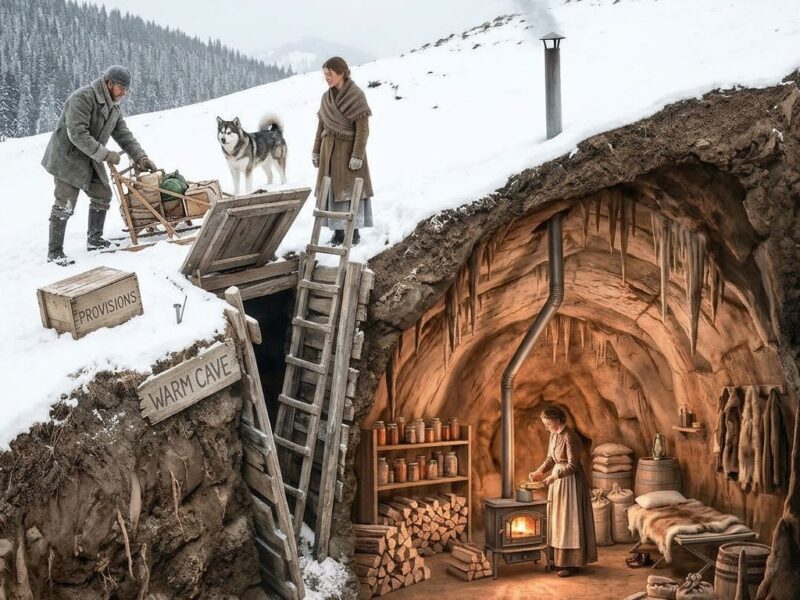
They Said Her $15 Cave Would Collapse—Until the Worst Dakota Winter Proved Her Right
The Digging
The road to survival began with a shovel bought from the general store for two dollars and fifty cents.
Silas Thorne watched her carry it over her shoulder as she left town, his expression that of a man watching a stray cat cross a dangerous road. Bridget ignored him. She walked the two miles back to Mercer Hill, the wooden handle rubbing her collarbone raw, and she began to dig.
She did not dig downward, like a grave. She dug sideways into the steep south face of the hill, channeling the generational wisdom of her grandmother Mave. Mave had grown up in a bank house near the Cumberland Gap—a dwelling half-buried in a mountainside, its front wall stacked stone and its back wall the mountain itself. Mave’s grandmother had built it in 1802, and it had survived sixty winters and two wars.
Bridget cut a doorway-sized notch into the sod and began to hollow out the earth.
On the third day of digging, Silas Thorne rode past and pulled his horse up short. Bridget was covered in gray-blue clay to the elbows, her hair tied back in a sweat-stained rag.
“What in the name of God are you doing, girl?” he demanded, resting a gloved hand on his pommel.
“Building my home, sir,” she replied, not stopping her shovel.
Silas took off his hat and rubbed his thinning hair. “That is a cave! That is a hole in the dirt! Civilized people build houses out of lumber.”
“Lumber costs eighty dollars for a small house, sir. I have twenty cents.”
“Because things cost what they cost for a reason, foolish girl. You will live like an animal.”
Bridget drove her shovel blade into the clay so hard the handle rang. “Animals survive winters, Mr. Thorne. I heard last winter three families in this county lost fingers to frostbite in lumber houses. Perhaps the animals know something.”
Silas wheeled his horse and rode away in silent fury. But her words took root in the town’s conscience, and within a week, everyone knew the Irish widow on Mercer Hill was living like a beast.
When Jedadiah Weatherbe, the town’s master carpenter, came up with his sons offering scrap lumber for a proper wooden shed, Bridget politely refused it. When Prudence Pedigrew—the self-appointed keeper of the town’s moral ledger—came with a basket of charity and heavy doses of condescension, Bridget accepted the stale bread and chokecherry preserves with quiet grace, thanking them for the food while standing firm on her ground.
For three weeks of dawn-to-dark labor, she carved out a rectangular chamber eighteen feet deep and twelve feet wide, with an eight-foot ceiling at the crown. She reinforced the walls by mixing the gray-blue clay with chopped prairie grass, pressing the paste into the raw earth with her own palms until it dried into a smooth, ash-gray shell.
For the ceiling, she scavenged willow trunks from the creek two miles away, dragging them one by one with a rope tied around her waist. She laid eight heavy beams across the chamber, covered them with a mat of branches, stretched her single canvas tarp over them, and piled two feet of living prairie sod on top.
She laid a floor of flat river stones hauled in canvas slings from the creek, built a stone-lined pit beneath a dented iron barrel stove bought from the blacksmith, and rigged a sideways stovepipe so the hot flue gases would bathe the stones in heat before escaping. It was ancient engineering born of Appalachian ridges—designed to absorb the earth’s constant subterranean warmth and radiate it gently through the coldest nights.
By early September, her dugout was finished. From the outside, it was indistinguishable from the natural swell of the hill. Inside, it was a sanctuary.









