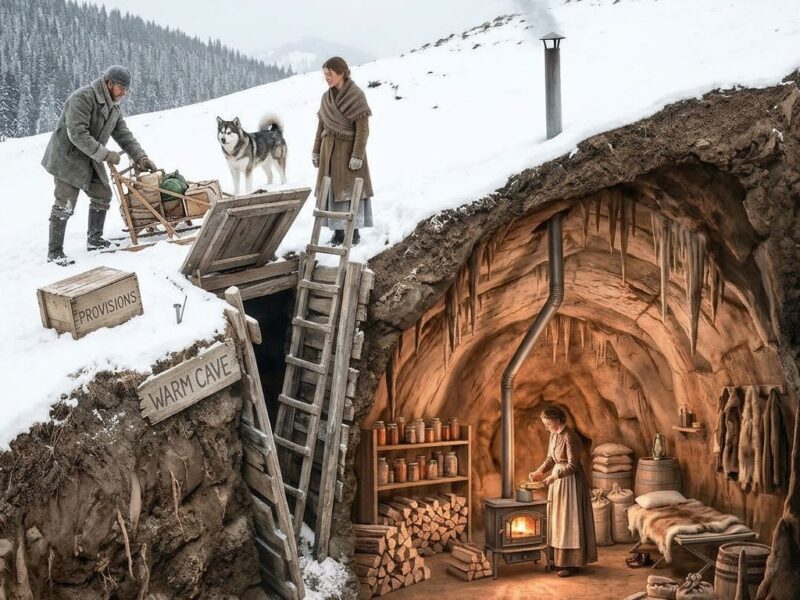
They Said Her $15 Cave Would Collapse—Until the Worst Dakota Winter Proved Her Right
The Legacy of Mercer Hill
On the fourth day, as the weather broke, the men retrieved sleds and hauled hidden stores from their own homesteads—smoked hams, flour, molasses, butter, cheese, unbleached muslin, and blankets—stacking Bridget’s vestibule high with provisions.
When they departed down the hill, they did not walk as isolated families, but together. The winter of 1881 became a turning point for Ashfall Bend.
In the spring, Jedadiah Weatherbe came back to Mercer Hill with a notebook and a piece of charred willow twig. “Teach me,” he said.
Bridget drew the diagrams of the flues, the stone heat batteries, the sunk floors, and the curtain vestibules. Over the next fifteen years, Jedadiah and other local carpenters built dozens of “Howerin Houses” across Bloomfield County. Not a single person perished in those subterranean sanctuaries during subsequent blizzards.
Elias Weatherbe grew from a quiet boy into a steady man who built his own dugout connected to Bridget’s, sharing a common wall of hill. After waiting a faithful year with his hat in his hand, he married Bridget in October of 1887, standing beside her as a true partner. They raised Samuel, and later welcomed two more children, Mave and Josiah, into the warm embrace of the earth.
Prudence Pedigrew eventually spent her final years living in a small side chamber on Mercer Hill at her own request, passing away in peace after carving a simple, honest truth onto her heart: I was wrong.
Bridget lived on her hill for decades, outliving Elias, seeing her children grow, and watching her community transform from a cluster of proud, freezing skeptics into a resilient brotherhood rooted in the wisdom of the earth.
When Bridget Howerin passed away in October of 1938 at the age of seventy-four, sitting in her wooden chair in the warm Dakota sunlight, she did not close her eyes on the cold sky. She closed them on the solid, enduring sod ceiling of the home she had carved out with her own hands.
The earth had held her, just as her grandmother promised it would. It never asked her if she deserved to enter; it only asked if she was willing to step in. And once she stepped in on that June evening in 1880, she never once stepped back out.
Her tombstone on the East Ridge bore no grand titles, only a single line chosen by her own hand:
She built low, lived long, and kept a warm door.









