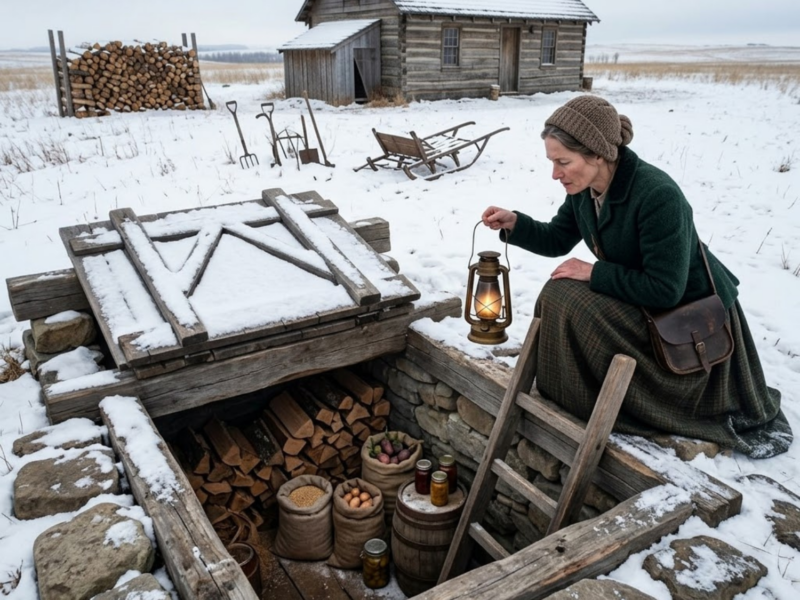
Winter Came With No Firewood—Then the Widow Opened Her Father’s “Dry” Well
THE MAN WHO BUILT IN THE DARK
Descending the iron-bolted ladder into her father’s dry well felt like falling backward into a tomb.
At twenty feet down, the howling fury of the Nebraska wind died instantly, replaced by a deep, dead stillness. The air smelled of cold limestone, dry earth, and faint, sweet-scented cedar shavings. Dela held the lantern high, its amber glow stretching across the masonry her father had laid stone by stone, year after year, while the county mocked him over their fences.
She pressed her palm against the rough limestone wall. One stone didn’t match the others. It was set a fraction of an inch deeper, framed by a razor-thin shadow line.
Dela slid her fingers into the crevice and heaved.
With a smooth, silent slide that defied its weight, a massive oak-and-timber slab slid aside on a hidden counterweight system. Beyond it lay a black, rectangular corridor framed in hand-hewn oak beams.
Dela stepped through.
The lantern light caught the edges of something that made her breath hitch in her throat. Wall-to-wall, floor-to-ceiling, stacked with mathematical precision, was cordwood.
Oak. Split, seasoned, bone-dry oak.
She walked down the narrow corridor, running her gloved hand over the pristine logs. There was no mold, no damp rot, no insect borers. The stable, subterranean cold of the earth had preserved the timber in a state of cryogenic perfection. She counted the stacks in the flickering light—room A, stretching twenty feet back, packed tight.
Her father hadn’t failed. He had succeeded beyond anyone’s wildest imagination. He had spent seven years turning his own property into an underground fortress of heat, anticipating the exact winter that was now bearing down on his granddaughters.
But as Dela reached the far end of the chamber, her heart dropped. A charcoal diagram scrawled on the timber frame caught her eye, labeled in her father’s shaky hand: Chamber A: 2.5 cords. Chamber B: 2.5 cords.
Five cords total.
She did the math in her head, her stomach twisting into a hard knot. Five cords. Combined with what little she had above ground, she had roughly six cords.
Six. Not eight.
Silas Kerr had told her eight was the absolute floor for a drafty tar-paper cabin. Six cords meant she would run out of fuel by late February. She would freeze to death just two weeks before the spring thaw.
Frantic, Dela searched the walls of Chamber A. She pressed against the timber panels until her fingers found another hidden latch. It yielded with a muffled groan, revealing a second corridor branching off to the southeast.
She hurried down the tunnel, holding the lantern high. This was Chamber B. But as she entered, the toe of her boot splashed into dark, stagnant water.
A wave of dread washed over her. A subterranean spring had breached the foundation corner. The water was ankle-deep, iced over at the edges. Nearly half of the wood stacked in Chamber B was submerged, the lower logs swollen, gray, and ruined by stagnant rot.
She waded into the freezing water, desperately pulling at the stacked logs, but they were waterlogged and impossibly heavy. She had lost at least a full cord to the flood.
Four cords.
She was looking at a slow, agonizing execution. Even with her father’s secret vault, she was still short. The math was immutable. The mountain—and the earth—would not save her.
Unless there was a Chamber C.









