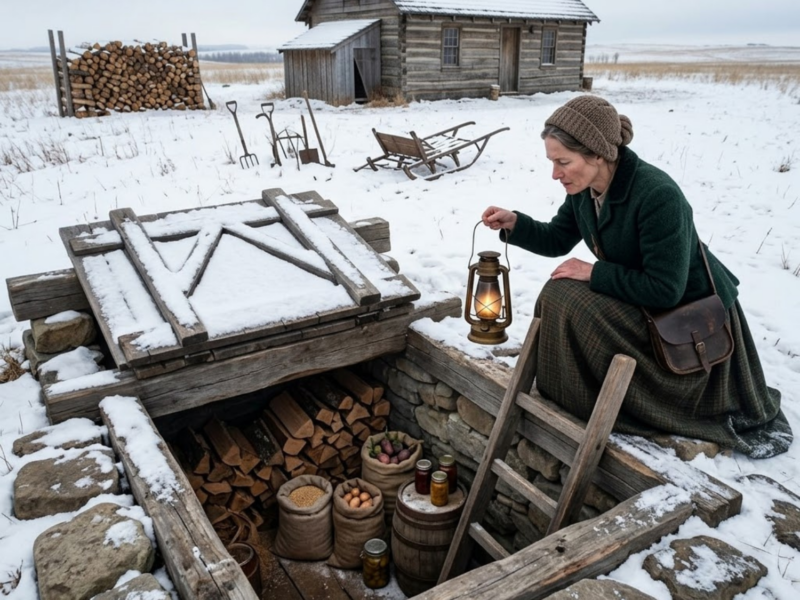
Winter Came With No Firewood—Then the Widow Opened Her Father’s “Dry” Well
THE ARCHITECT'S GRAVE
The clay gave way with a wet, sucking sound.
Dela unhooked her crowbar and wedged the flat end into the seam of a hidden trapdoor. She threw her entire body weight against the iron bar.
CRACK.
The rotted pine boards splintered, lifting upward. A blast of cold, bone-dry air rushed up from the opening—air that smelled intensely of cedar, pitch, and absolute preservation.
Dela lowered her lantern into the hole.
Stairs. A steep, narrow flight of wooden steps plunged straight down into the earth, thirty feet below Chamber B.
She didn’t hesitate. She scrambled down the steps, her heart hammering against her ribs like a trapped bird. At the bottom, her boots hit a solid, dry floorboards. She raised the lantern.
Her breath caught.
Chamber C was twice the size of A and B combined. The ceiling was timber-cribbed with masterclass precision, utterly impervious to the groundwater above. And filling every square inch of the vast subterranean vault were towering, immaculate stacks of seasoned oak.
Cord after cord. Stack after stack. Row after row.
It was easily six cords of pristine timber, untouched by moisture, locked away in a microclimate engineered to outlast a nuclear winter.
Dela walked slowly down the narrow aisles between the towering woodpiles, running her hand over the rough-cut bark. She was saved. Her children were saved. The winter could howl until its lungs bled, but it couldn’t touch them.
Then, her light hit something sitting on a small wooden crate at the far end of the chamber.
It wasn’t wood. It was a man’s leather ledger, propped open beside a heavy iron box and a framed charcoal drawing.
Dela approached cautiously, as if the space might vanish. She picked up the open ledger. The pages were filled with her father’s meticulous handwriting. She read the entry dated July 14, 1886—just six weeks before his heart gave out.
“To whoever finds this—likely my Dela, if she had the grit to follow the maps I left in the coat and the key. They said I was mad. They said a well in this soil was a fool’s errand. But I wasn’t digging for water. I was digging for time. A man can fight the prairie if his children are warm. Do not let Pike have this land. He knows what lies beneath this ridge, and it isn’t just wood.”
Dela frowned, her eyes darting down the page.
“The regional survey I filed in ’78 wasn’t for farming soil. This entire ridge sits atop the largest high-grade anthracite coal deposit in the Nebraska territory. The wood is just the shield, Dela. The coal is the key. Pike wants this claim because he discovered the mineral rights revert to the crown-patent holder if the homestead lapses. He engineered the drought rumors. He engineered the credit freeze. He wants you starved out.”
The room seemed to spin.
The wood wasn’t just for heat. The wood was a decoy hiding a massive, multi-million dollar mineral deposit that Rowan Pike was willing to commit murder—or legal sabotage—to acquire.
Dela looked down at the iron box sitting beside the ledger. It was unlocked. She lifted the heavy lid. Inside sat a stack of legal documents bearing the territorial seal: the original, unassailable mineral patent papers for the entire North Ridge, signed and countersigned in 1875, granting absolute ownership to Elias Whitmore.
Her father hadn’t just left her a winter supply. He had left her a war chest.
And upstairs, sitting in the frozen air of the Nebraska plain, Rowan Pike was preparing to snap his jaws shut on a trap that was about to blow up in his face.









