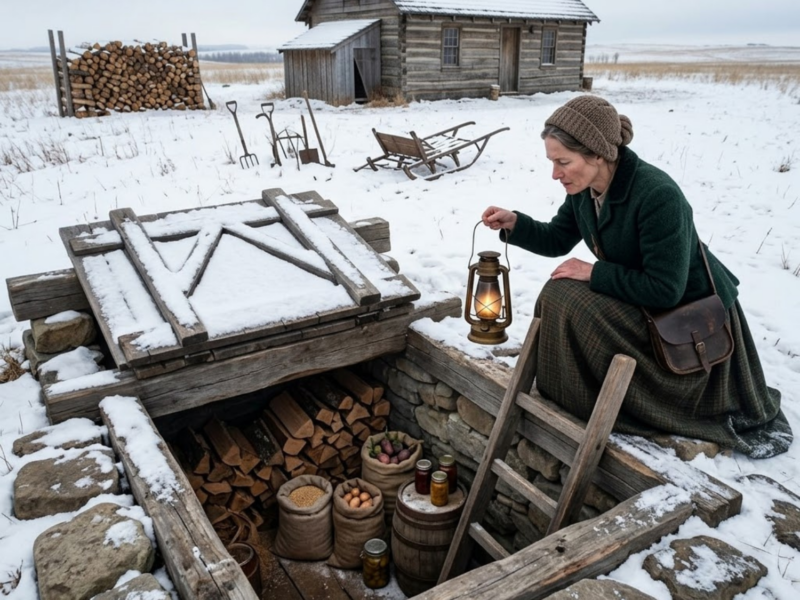
Winter Came With No Firewood—Then the Widow Opened Her Father’s “Dry” Well
THE WRONG KIND OF WIDOW
The morning of November 14th dawned with a vicious, slate-gray frost that painted the prairie in deadly silver.
Inside the cabin, the air was warm, rich with the scent of roasted corn and black coffee. Josie and Pearl sat at the table, color returning to their cheeks, laughing as they shared a bowl of warm porridge.
Dela stood by the window, wearing a crisp, tailored wool dress she had sewn herself the previous week. She wore her hair pinned back in a severe, elegant twist. The split, bleeding blisters on her hands had healed into thick, durable calluses. She wasn’t the terrified, freezing seamstress who had walked onto this property two months ago.
She was a landholder.
A heavy knock rattled the front door. Not a polite rap—an aggressive, commanding pounding.
Dela opened it.
Silas Kerr stood on the porch, his breath pluming in the freezing air, looking grim and uncomfortable. Behind him, sitting on a high-wheeled buckboard, was a sharp-eyed local magistrate named Arthur Vance, accompanied by two armed county deputies.
And trailing behind them on his massive black gelding was Rowan Pike.
Pike wore a smug, victorious grin that didn’t reach his dead eyes. He stepped up onto the porch, brushing past Kerr without a word.
“Good morning, Mrs. Whitmore,” Pike purred, stepping into the doorway as if he already owned the threshold. “I trust you survived the first frost? Though I imagine it got rather chilly without a proper woodpile.”
Dela didn’t move. She stood in the center of the doorway, blocking their entry into the cabin. Her eyes were like shards of broken glass. “Mr. Pike. Magistrate Vance. To what do I owe the chilling draft?”
Magistrate Vance stepped forward, holding a thick sheaf of legal papers. He looked down his nose at Dela with bureaucratic boredom. “Mrs. Whitmore, we have received a formal petition from Mr. Pike regarding Homestead Claim 442-B. Under Section 12 of the Land Act, properties showing demonstrable signs of abandonment, unreconciled tax liabilities, or undeclared structural anomalies are subject to immediate receivership review.”
“Abandonment?” Dela’s voice cut through the cold morning air like a razor. “My daughters and I have slept under this roof every night for three months.”
“You have no visible fuel reserves, Mrs. Whitmore,” Pike interjected smoothly, stepping to the front. “Anyone with eyes can see you’re freezing. You haven’t broken ground for spring, and you’ve failed to report any legitimate agricultural improvements. The land is failing. You are failing. Sign the forfeiture papers, take your girls, and catch the afternoon stage back to St. Louis. I’ll give you fifty dollars for your trouble.”
Silas Kerr, standing near the edge of the porch, shifted uncomfortably. He looked at Dela, his expression a mix of pity and warning. “Dela… maybe you should listen. It’s getting late in the season. You can’t fight the land office.”
Dela didn’t look at Kerr. She kept her eyes locked on Rowan Pike.
“Fifty dollars,” Dela repeated, her voice dangerously quiet. “For a hundred and sixty acres of prime homestead.”
“It’s a mercy,” Pike smiled, his arrogance peaking. “You don’t belong here, Mrs. Whitmore. You’re a seamstress. You belong in a parlor with a needle and thread, not starving on a dead prairie.”
Dela turned her head slightly. “Josie, Pearl. Go into the back room and close the door, please.”
The girls, sensing the electric tension in the air, scurried obediently into the bedroom, clicking the latch shut behind them.
Dela reached behind her back, untied a heavy leather satchel from the coat rack, and dropped it onto the wooden floorboards with a dull, leaden thud that made the magistrate jump.
“What is the meaning of this?” Magistrate Vance demanded, peering down at the bag.
Dela reached inside. She pulled out a massive, leather-bound ledger and slammed it onto the porch table, right in front of Pike’s face. Then she pulled out the iron box, flipped the latch, and withdrew the original 1875 mineral patent papers, unfolding them with a sharp, crisp snap.
Finally, she pulled out her father’s journal and opened it to the very last page, pointing her finger at a specific paragraph.
“Mr. Pike claims I have no improvements,” Dela said, her voice rising, ringing across the quiet prairie with cinematic power. “He claims my land is a barren waste. But under the provisions of the 1875 Crown-Patent and Territorial Mining Code Section 4, a subterranean infrastructure—duly engineered, reinforced, and containing over ten cords of cured hardwood and verified anthracite mineral deposits—constitutes a multi-thousand-dollar capital improvement directly tied to this deed.”
Pike’s smile vanished instantly. The color drained from his face, leaving him the exact shade of the winter sky.
“What… what are you talking about?” Pike stammered, stepping back.
“I’m talking about the fact that my father didn’t dig a dry well, Mr. Pike,” Dela stepped forward, backing the wealthy rancher off the porch steps. “He dug a multi-chambered vault. And I’m talking about the fact that under federal law, attempting to fraudulently induce a forfeiture by manufacturing drought rumors and withholding local credit is a felony punishable by ten years in federal prison.”
Magistrate Vance snatched the mineral patent papers from the table, his eyes scanning the embossed seals and signatures. His hands began to shake violently. ရှင်Good god… this is a legitimate anthracite patent. The North Ridge… it’s a coal seam.”
“It’s my coal seam,” Dela corrected, her eyes burning into Pike.
Silas Kerr stared at Dela, his jaw hanging open in pure, unadulterated shock. He looked at the dry well, then back at Dela, the pieces finally clicking together in his mind. She wasn’t desperate. She was armed.
“You’re lying,” Pike hissed, his voice cracking with panic. He lunged forward, grabbing at the papers. “You’re a penniless seamstress! You don’t know anything about mining!”
Dela didn’t flinch. She reached into her pocket, pulled out the heavy brass key, and dangled it inches from Pike’s nose.
“Would you like to go down and count the cords yourself, Mr. Pike?” she whispered, pure venom in her tone. “Or would you prefer I have the federal marshal come out from Omaha to inspect your financial ties to the regional land office?”
Pike stared at the key. He looked at Silas Kerr, who was now standing with his arms crossed, a slow, grim smile spreading across the old farmer’s weathered face—a smile of profound, burning respect.
Pike realized he had walked into a buzzsaw. He had underestimated the seamstress, and it had cost him everything.
“This isn’t over,” Pike snarled, his voice trembling with impotent rage as he backed down the porch steps, stumbling over his own boots. He vaulted onto his black gelding, yanking the reins so hard the animal reared. “You won’t get away with this! The courts will tie you up for years!”
“The courts move fast when there’s a federal mineral patent attached to the docket, Mr. Pike,” Dela called out smoothly as Pike spurred his horse into a frantic, panicked gallop across the frosted grass. “I suggest you sell your cattle while you still have a ranch to keep them on!”
Magistrate Vance nervously stuffed his papers into his briefcase, avoided looking at Dela entirely, and hurried back to his buckboard, urging the driver to whip the horses away.
Silas Kerr stood alone on the porch with Dela. The prairie wind blew around them, but neither of them felt the cold.
The old farmer took off his battered hat, holding it in both hands, looking at the young woman with an expression that crossed the chasm of class, gender, and age.
“Mrs. Whitmore,” Silas said, his voice thick with emotion. “I’ve lived in this county for forty years. I thought I knew every trick the prairie could play. But you… you didn’t just play the hand you were dealt. You built a whole new deck down in the dark.”
Dela looked out over her land—the sprawling, beautiful, unbreakable claim that was finally, unequivocally hers.
“My father always said,” Dela murmured, a fierce, triumphant smile breaking across her face, “that a man builds a roof he will sit under. But a true father builds one he never will.”
Silas nodded slowly, putting his hat back on. He turned to walk to his horse, then paused, looking back over his shoulder. “Need any help hauling that coal to town when the roads clear, Mrs. Whitmore? My wagon’s got bigger wheels than yours.”
Dela looked down at her hands—hands that bore the calluses of a survivor, hands that had conquered the dark.
“I’d appreciate that, Mr. Kerr,” she said. “I’d appreciate that very much.”









