Winter Came With No Firewood—Then the Widow Opened Her Father’s “Dry” Well
THE SHADOW OVER THE CLAIM
Morning broke over the plains not with a sunrise, but with a dirty, yellow smear across a leaden sky.
Dela stood by her woodstove inside the cabin, her hands trembling as she fed two precious sticks of the underground oak into the iron firebox. The heat bloomed instantly, rich and dense, filling the drafty room with a comfort she hadn’t felt since she arrived.
Josie and Pearl sat near the stove, their color slightly better, watching her with wide, quiet eyes.
“Mama, is that the wood from the magic well?” Pearl asked softly, wrapping her arms around her knees.
“Yes, sweetheart,” Dela said, forcing a bright, reassuring smile that felt like glass on her face. “And it’s going to keep us warm all winter.”
If I can find the rest of it, she added silently to herself.
She knew she couldn’t stay in the cabin. The local land office was holding her fate in a balance, and Rowan Pike was a viper. He didn’t just want her land; he wanted to prove she was an interloper who didn’t understand the iron-clad rules of frontier survival. If he petitioned the territorial judge to inspect the homestead’s improvements before her claim was officially patented in the spring, he would discover the underground vault.
And under the strict interpretations of the Homestead Act, an unrecorded, massive subterranean cache of timber could be legally argued as an undeclared commercial asset or a structural modification requiring back taxes she couldn’t pay—giving Pike the legal crowbar he needed to evict her.
There was a heavy, rhythmic thud of a horse’s hooves outside.
Dela walked to the frost-feathered window. A massive black gelding stood at her fence line. Sitting upright in the saddle was Rowan Pike. He didn’t dismount. He simply sat there, his cold gray eyes scanning the modest woodpile by her door—the few pathetic logs she had dragged up from Chamber A to maintain appearances.
Pike tipped his hat—a gesture devoid of respect, dripping with condescension—then turned his horse and trotted away toward the north.
He was watching her bleed out. He knew she didn’t have enough wood. He was waiting for the desperation to set in, waiting for her to come begging to his porch to sell the land for pennies.
Dela’s jaw set. The soft, refined seamstress from St. Louis was gone. In her place was a woman forged in the dark of a stone tomb.
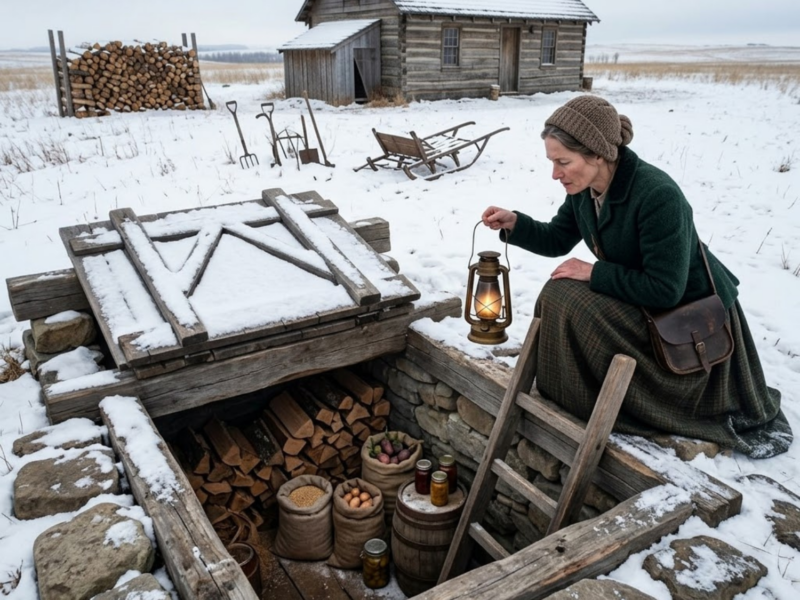
She grabbed her father’s heavy iron crowbar from the tool chest, bundled herself in her coat, and marched back out to the dry well. There had to be a Chamber C. Her father was a meticulous, brilliant engineer. He wouldn’t leave a puzzle half-solved.
She climbed back down into Chamber B, wading through the freezing, ankle-deep water of the flooded corner. She swept the lantern beam across the rough-hewn beams, ignoring the biting chill soaking through her boots.
In the absolute darkest, dampest corner of the room, behind a rotted timber support, she spotted something odd. The dirt floor wasn’t dirt. It was packed clay, studded with small wooden pegs driven flush with the ground.
She dropped to her knees, ignoring the freezing water numbing her fingers, and began clawing at the clay with her bare hands.









